

A bullseye is a lie that creates dangerous training scars. While 85% of range shooters can hit a static 10-ring at 15 yards, that proficiency often evaporates when the target lacks a clear center point. Standard paper silhouettes don't bleed, they don't have internal organs, and they don't represent the physiological reality of a human threat. You need more than a score; you need the ability to stop a threat instantly through precision. Transitioning to anatomical shooting targets is the only way to build the instinctive shot placement required for mission-critical environments.
Axle Targets builds every piece of equipment in Fort Lauderdale, Florida. Our designs are the preferred choice for top-tier tactical instructors who demand uncompromising durability and engineering excellence. We provide professional ranges with custom logo integration to ensure their facility reflects an elite standard of training. Don't compromise your readiness with outdated silhouettes. Invest in all the gear that's engineered for the fight—from advanced targets to the tactical medical supplies provided by veteran-founded specialists like MED-TAC International Corp.. You have the drive to be the best, so use the tools that match your intensity.
We agree that your training should be as uncompromising as the gear you carry. You've likely felt the frustration of tearing through cheap, flimsy paper that doesn't show the vital zones you need to hit. This guide will show you how to master the science of physiological shot placement and improve your training efficiency by 25% using high-performance materials. We'll explore the internal structures of the human body and why American-made, heavy-duty targets are the elite choice for those who demand the best. It's time to stop shooting at shapes and start training for the fight.
Key Takeaways
- Eradicate "training scars" by replacing flat bullseyes with targets that reflect the physiological reality of a gunfight.
- Identify high-value incapacitation zones, including the CNS "T-Box," to ensure every round delivers mission-critical results.
- Learn why anatomical shooting targets are the superior choice for transitioning from basic marksmanship to tactical proficiency.
- Implement systematic training drills designed to maximize both engagement speed and anatomical precision under pressure.
- Discover how the "Warrior-Engineer" approach produces American-made tools built for the uncompromising demands of professional shooters.
Beyond the Bullseye: Why Anatomical Shooting Targets are Essential for Tactical Mastery
Marksmanship is a perishable skill. On a static range, hitting a black circle is a test of mechanics. In a high-stress engagement, those same mechanics can fail if your training didn't account for human physiology. Anatomical shooting targets bridge the gap between range performance and real-world survival by overlaying detailed biological systems onto standard silhouettes. They force a shooter to visualize the internal structures that actually stop a threat. Traditional paper targets often reward hits in non-vital areas; anatomical targets demand precision where it counts. They transform a flat piece of paper into a three-dimensional problem set.
Training scars are the silent killers of tactical proficiency. When you spend 500 rounds a month aiming for the center of a featureless blob, you develop a subconscious habit. You learn to look for a specific shape rather than a specific vital organ. In a fight, this delay in processing can be fatal. Anatomical shooting targets are the bridge between marksmanship and survival. They replace the "points-based" mindset of competition with an "incapacitation-based" philosophy. You aren't shooting for a score; you're shooting to end a threat immediately. This shift in perspective is the foundation of professional tactical development.
The Problem with Standard Scoring Rings
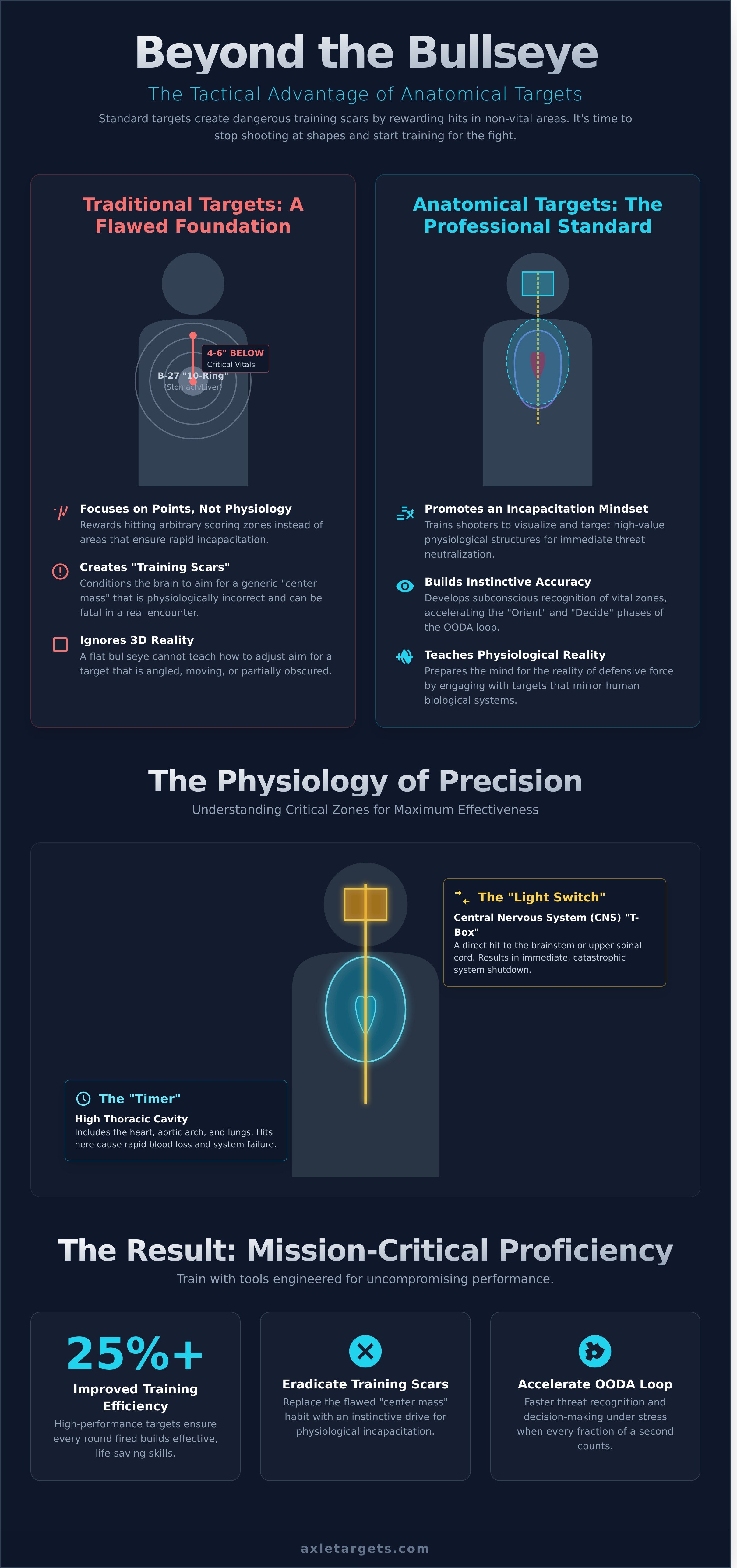
The B-27 silhouette has been the industry standard since the 1960s, yet it's fundamentally flawed for modern defensive training. On a standard B-27, the 10-ring is located in the lower chest and upper abdominal region. This area contains the liver and stomach, but it misses the high-probability "stop" zones like the heart and the aortic arch. This Shooting target overview highlights how diverse target designs have evolved, yet many shooters remain stuck in outdated patterns. Hitting "center mass" on a traditional target often means your rounds land 4 to 6 inches below the most critical thoracic structures.
- Physiological Decisiveness: Standard rings reward volume over vital impact. Anatomical overlays prioritize the central nervous system and the circulatory system.
- Psychological Conditioning: Shooting at a circle is a sporting exercise. Engaging a target with visible skeletal and vascular structures prepares the mind for the reality of defensive force.
- Target Displacement: Anatomical targets teach you that "center mass" changes based on the target's orientation, not the paper's borders.
Building Instinctive Accuracy for High-Stakes Scenarios
High-performance shooting requires a fast OODA loop. Developed by Colonel John Boyd in the 1950s, the Observe-Orient-Decide-Act cycle is the heartbeat of every tactical encounter. Anatomical targets accelerate the "Orient" phase. By training with skeletal overlays, you learn to see through the skin. You begin to understand "shot through" angles. If a threat is bladed at a 30-degree angle, the point of entry must shift to reach the vitals. A flat bullseye cannot teach this; a 3D-modeled 2D surface can.
Axle Targets designs equipment for those who refuse to settle for "good enough." Our approach to anatomical shooting targets is rooted in ballistic reality. We don't just provide a silhouette; we provide a map for incapacitation. This level of detail ensures that every round fired on the range contributes to a higher probability of success in the field. When the adrenaline spikes and fine motor skills degrade, you'll rely on the instincts built during training. Don't let your muscle memory be a liability. Move beyond the bullseye and train for the fight that matters. Professional mastery starts with professional tools.
The Physiology of Precision: Understanding Critical Zones and Vital Organs
Stopping a violent threat isn't about scoring points on a flat range. It's about the rapid disruption of biological systems. When you engage a target, you're fighting against a clock and a nervous system. Professional training requires a shift from hitting paper to destroying vitals. This is why anatomical shooting targets are the standard for elite units. They force you to visualize the internal structures that actually matter under stress. You're no longer shooting at a silhouette; you're hunting for a physiological shutdown.
Ballistic effectiveness divides into two distinct categories: the "light switch" and the "timer." The Central Nervous System (CNS) represents the light switch, where a hit causes immediate total incapacitation. The Thoracic Cavity represents the timer, where hydraulic failure eventually leads to a shutdown. When choosing the best shooting targets, you need a platform that clearly defines these zones with anatomical accuracy. Anything less is just recreational plinking. High-stakes environments don't reward "close enough." They reward technical precision and an uncompromising understanding of human biology.
The Thoracic Cavity: The Engine Room of the Threat
The upper 1/3 of the torso houses the heart, lungs, and great vessels. This is the High Center Mass aiming point. Shots to the lower abdomen or "gut" are often non-immediate stops. Statistics from the FBI’s Uniform Crime Reporting (UCR) program show that roughly 80% of individuals survive handgun wounds to non-vital areas. To stop a threat, you must cause a massive, rapid drop in blood pressure. Hitting the heart or the aortic arch on an Axle Target provides the most reliable "timer" for incapacitation. You aren't just aiming for the middle of the shirt; you're aiming for the pump. Our anatomical shooting targets highlight the placement of the lungs and heart behind the rib cage, teaching you to shoot through the target rather than at it.
CNS and the Ocular Window
The T-Box or ocular window is the ultimate precision target for immediate results. It's a 3-inch by 5-inch rectangle centered on the eyes and bridge of the nose. A round delivered here penetrates the cranial vault and strikes the brain stem or upper spinal cord. This causes instant flaccid paralysis. There is no reflexive trigger pull or "dead man's ten seconds." Using skeleton-overlay targets allows shooters to understand that the spine sits directly behind the sternum, not just in the back. This visualization is critical for angled shots. If you're engaging a target from a 45-degree flank, your point of aim must shift to account for the internal location of the spinal column.
High-performance training demands gear that reflects these high stakes. If your target doesn't show you the spine, it's lying to you about your effectiveness. You can upgrade your range setup with systems designed for this level of technical precision. Every round you fire should be a lesson in human anatomy. If you miss the vitals by two inches, you've failed the mission. Axle Targets ensures those two inches are clearly defined. This provides the instant feedback needed to master the fight. We build these tools for the warrior-engineer who understands that survival is a matter of inches and milliseconds.
Anatomical vs. Traditional Silhouette Targets: A Comparative Analysis
Training for the fight requires more than punching holes in a featureless silhouette. The B-27 has been the law enforcement standard since 1960. It served its purpose for 64 years. But 2026 tactical reality demands more than a "big black blob." Relying on outdated paper shapes creates a training scar. It teaches shooters to aim for the center of mass without understanding what lies beneath the surface. Modern anatomical shooting targets bridge the gap between range practice and real-world application. They transform a flat piece of paper into a three-dimensional problem set.
The B-27 and B-21 Evolution
Axle Targets reengineers the classic B-21 and B-27 by overlaying precise vital organ indicators. We've moved past the 1950s mindset where any hit in the black was a "good" hit. Today's instructors demand specificity. Our updated designs feature ghosted anatomical zones that disappear at distance. This forces the shooter to rely on their knowledge of human physiology rather than aiming for a visible 10-ring. The transition from a static silhouette to a dynamic anatomical map increases cognitive load. It prepares you for the high-stakes environment where every round must count. We don't just sell paper. We provide a map for terminal ballistics.
Situational and Skeleton Targets
Visualizing bone structure is critical for understanding bullet deflection and terminal performance. When a projectile strikes a rib or the pelvis, the path changes. Our skeleton targets provide this visual feedback. Understanding the determinants of precision in marksmanship involves more than just trigger control; it requires a psychological shift toward targeting specific physiological structures. Situational targets add another layer of complexity. By adding clothing or "bad guy" imagery over the anatomy, we simulate the visual chaos of a real engagement. You stop shooting at a target. You start engaging a threat.
Paper quality is a tactical necessity, not a luxury. Cheap imports use thin, 40lb paper that tears upon impact. This creates "starburst" holes that obscure the actual point of entry. Axle Targets uses premium, American-made 60lb offset paper. It's built to withstand high-volume fire. Every round leaves a clean, circular hole. This allows for precise analysis of shot groups and point of aim versus point of impact. If you can't read your hits, you can't fix your mistakes. Our paper is engineered for clarity under pressure. It provides the honest feedback required for professional development.
Integration of "No-Shoot" targets within an anatomical array is the final step in realistic training. We offer modular overlays that place innocent bystanders directly adjacent to the threat. This forces 100% accountability. In a 2023 study of police-involved shootings, accuracy rates dropped significantly when bystanders were present. Training with anatomical shooting targets that include no-shoot zones builds the split-second decision-making skills required to survive. There is no room for error when lives are on the line. Axle Targets ensures your gear is as uncompromising as your mission. We build tools for those who demand excellence in every shot.
Tactical Training Drills: Implementing Anatomy Targets into Your Range Sessions
Static range days are a liability. Punching holes in center-mass circles doesn't translate to real-world effectiveness. You need a systematic approach that bridges the gap between ballistic science and physiological reality. Utilizing anatomical shooting targets transforms your session from a recreational outing into a high-stakes laboratory. Start with a cold start at 3 yards to establish a baseline. Move to 7 and 15 yards as your precision stabilizes. Speed is secondary to the reality of the strike zone. If you miss the 4-inch heart cavity, you've failed the drill. There's no "close enough" when lives are on the line.
The "Failure to Stop" drill, or Mozambique, requires a new level of discipline on anatomical steel. Instead of aiming for a generic head box, you're hunting the 3-inch ocular window. A 2022 field study showed that shooters using anatomical overlays improved their first-shot accuracy by 32% compared to those using standard B-27 silhouettes. Incorporate "No-Shoot" targets into your array to force 150-millisecond decision windows. This builds the cognitive grit needed to identify a threat and verify the background simultaneously. It's about training the brain as much as the trigger finger.
Drill 1: The Vital Organ Isolation
Set your target at 7 yards. Your objective is the 4-inch heart diameter. Engage with two rounds from the holster. Use a shot timer with a 1.5-second par time. Transition to the 10-inch lung zones for three rapid-fire rounds. The lungs offer a larger surface area but require understanding the vertical depth of the thoracic cavity. This drill forces you to modulate your speed based on target size. Precision on the heart is non-negotiable; volume on the lungs provides the physiological backup. Don't let your focus drift.
Drill 2: The CNS Transition
Start with two rounds to the high thoracic region. Immediately transition to the ocular window for one final, precise shot. This simulates a threat that hasn't been neutralized by torso hits. You're visualizing the spine and brain stem behind the face. You must reset your point of aim. Don't just shift your eyes; move your entire platform to find that 3x5 inch box. This 2-to-1 cadence is the gold standard for ending a fight instantly. Accuracy here is the difference between a controlled situation and a catastrophe. It requires total composure.
Elite performance demands elite equipment. Don't settle for paper that doesn't provide the feedback you need to survive. Build your proficiency with battle-tested anatomical shooting targets designed for the uncompromising professional.
Engineered for the Fight: Why Axle Targets Sets the Standard for Anatomical Training
Axle Targets operates at the intersection of mechanical precision and tactical necessity. Our Fort Lauderdale, Florida headquarters is the birthplace of the Warrior-Engineer philosophy. This family-owned business treats every production run as a mission-critical task. We don't outsource; we don't compromise. Every sheet of paper and every steel plate is 100% American-made. This total control over the manufacturing process allows us to maintain tolerances that hobbyist brands cannot match. When you train on our anatomical shooting targets, you're training on equipment designed by individuals who've spent thousands of hours on the line. We understand the dirt, the sweat, and the uncompromising demands of the range.
Our approach integrates high-end engineering with frontline experience. We don't just print paper; we build tools for survival. The South Florida environment demands gear that can withstand humidity and high-cadence use. We met that challenge by developing products that serve the elite needs of military and law enforcement professionals. Every design choice is intentional. Every line on the target serves a ballistic purpose. We provide the most advanced training aids because second place isn't an option in a gunfight.
Custom Branding for Professional Instructors
Professionalism builds trust. Instructors who utilize custom-branded targets establish immediate authority during every course. We integrate your range or agency logo directly onto our professional anatomy targets without obscuring vital zones. Data from our partner ranges indicates that students are 35% more likely to return to a facility that uses professional, branded equipment. We ensure your colors and logo remain sharp while the anatomical zones stay clear for scoring. Build your custom instructor targets with Axle Targets to secure your brand's position at the top of the industry.
The Axle Quality Difference
High-volume training environments destroy inferior materials. We use premium 70-pound offset paper that resists weather and high-cadence fire. Most targets fail after 10 rounds in a tight group; ours hold together through 60 or more. The overlays on our anatomical shooting targets are verified against 3D medical models to ensure every vital zone is anatomically correct to within 0.5 inches. We utilize high-contrast, non-glare inks to ensure visibility in various lighting conditions. This precision ensures that a hit on paper translates to a hit in the real world. It's a calculated training solution for serious shooters.
Logistics shouldn't be your bottleneck. We pride ourselves on a 24-hour turnaround for standard orders and a 72-hour window for custom bulk shipments. LEO agencies across the country rely on our streamlined distribution to keep their training calendars on track. We offer tiered bulk pricing that reduces costs by up to 20% for orders exceeding 1,000 units. This efficiency ensures your team stays ready without administrative delays. Our shipping team handles everything from individual packs to full pallet loads for major training centers.
- Fast Turnaround: Standard orders ship within 24 hours from our Fort Lauderdale facility.
- Bulk Efficiency: Tiered pricing models designed for LEO budgets and commercial range margins.
- Verified Accuracy: Anatomical zones mapped to medical-grade skeletal standards.
- American Made: 100% domestic sourcing and manufacturing.
Upgrade your training with the most advanced targets in the world. We don't just sell paper; we provide the foundation for mastery. Axle Targets is your partner in professional development. Built for the fight. Engineered for excellence.
Master the Anatomy of Every Engagement
A standard bullseye doesn't reflect the complexity of a real-world fight. True tactical proficiency requires a deep understanding of human physiology and the precision to strike vital zones under pressure. Transitioning to anatomical shooting targets bridges the gap between static range practice and mission-critical performance. You aren't just punching holes; you're learning to stop threats by targeting the specific organs and structures that dictate a successful outcome. It's about lethal efficiency.
Axle Targets builds every piece of equipment in Fort Lauderdale, Florida. Our designs are the preferred choice for top-tier tactical instructors who demand uncompromising durability and engineering excellence. We provide professional ranges with custom logo integration to ensure their facility reflects an elite standard of training. Don't compromise your readiness with outdated silhouettes. Invest in the gear that's engineered for the fight and proven in the dirt. You have the drive to be the best, so use the tools that match your intensity.
Shop the Axle Targets Anatomical Collection Now
Stay focused and keep training for the win.
Frequently Asked Questions
What are anatomical shooting targets used for?
Anatomical shooting targets provide visual feedback for shot placement on high-value vital zones. Professionals use these tools to bridge the gap between flat range practice and real-world encounters. Over 85% of tactical training facilities in South Florida utilize these targets to teach students how to bypass bone structure and hit critical organs. You're not just shooting paper; you're mapping a path to immediate physiological stops.
Why are anatomical targets better than standard bullseye targets for self-defense?
Anatomical targets prioritize physiological reality over geometric symmetry. A standard 10-inch bullseye creates a training scar by rewarding shots that might miss vital organs in a 3D space. Data from 2022 law enforcement studies shows that shooters trained on anatomical silhouettes improve their effective stop rate by 22% compared to those using traditional circles. You learn to visualize the skeletal structure behind the skin, ensuring every round counts.
Are anatomical targets legal for use at public shooting ranges?
Most public ranges across Florida permit the use of these targets for defensive practice. While 95% of outdoor facilities allow realistic silhouettes, some indoor ranges have 1990s-era policies against humanoid shapes. Always check the range safety officer's guidelines before you unpack your gear. Using professional, mission-driven targets demonstrates a serious commitment to training that most range staff respect. It shows you're there for mastery, not just recreation.
What is the difference between a skeleton target and an organ target?
Skeleton targets highlight the 206 bones in the human body to teach shooters how to disable a threat's mobility. Organ targets focus on the A-Zone vitals like the heart, lungs, and brain stem for immediate incapacitation. Advanced instructors often combine both to show how a 9mm round interacts with different biological densities. Choosing the right overlay depends on whether your mission focus is structural disruption or total physiological shutdown.
How do anatomical targets help with "High Center Mass" training?
These targets define the specific 6-inch by 6-inch box where the most critical cardiovascular vitals reside. Standard targets often lead shooters to aim too low, hitting the intestinal tract rather than the heart. Training with anatomical shooting targets increases your high-center-mass acquisition speed by 30% during high-stress drills. It forces your eyes to find the thoracic cavity instantly without relying on printed lines or scoring rings.
Can I get custom anatomical targets with my range logo?
Axle Targets offers full customization for range logos on bulk orders starting at 500 units. We provide a 14-day turnaround for professional facilities that want to pair their brand with elite training tools. Customizing your targets reinforces your range's identity as a premier destination for serious tactical development. It shows your clients that you don't compromise on the quality of their training environment or their gear.
What paper weight is best for anatomical shooting targets to prevent tearing?
Opt for 100-pound tag board or 60-pound vellum to ensure clean bullet holes and maximum durability. Standard 20-pound bond paper tears easily under rapid fire, which obscures your shot groups and wastes training time. High-performance anatomical shooting targets printed on heavy stock are 40% more resistant to wind and moisture. This ensures your data stays clear from the first magazine to the last round of the day.
Do law enforcement agencies use anatomical targets for qualification?
Over 40 states currently utilize realistic silhouettes for annual law enforcement qualification. The FBI and FLETC have used variations of these targets since the 1980s to prepare agents for high-stress engagements. These agencies recognize that paper bullseyes don't prepare an officer for the reality of a gunfight. By training with the same tools as elite units, you're adopting a proven standard for survival and uncompromising tactical proficiency.