

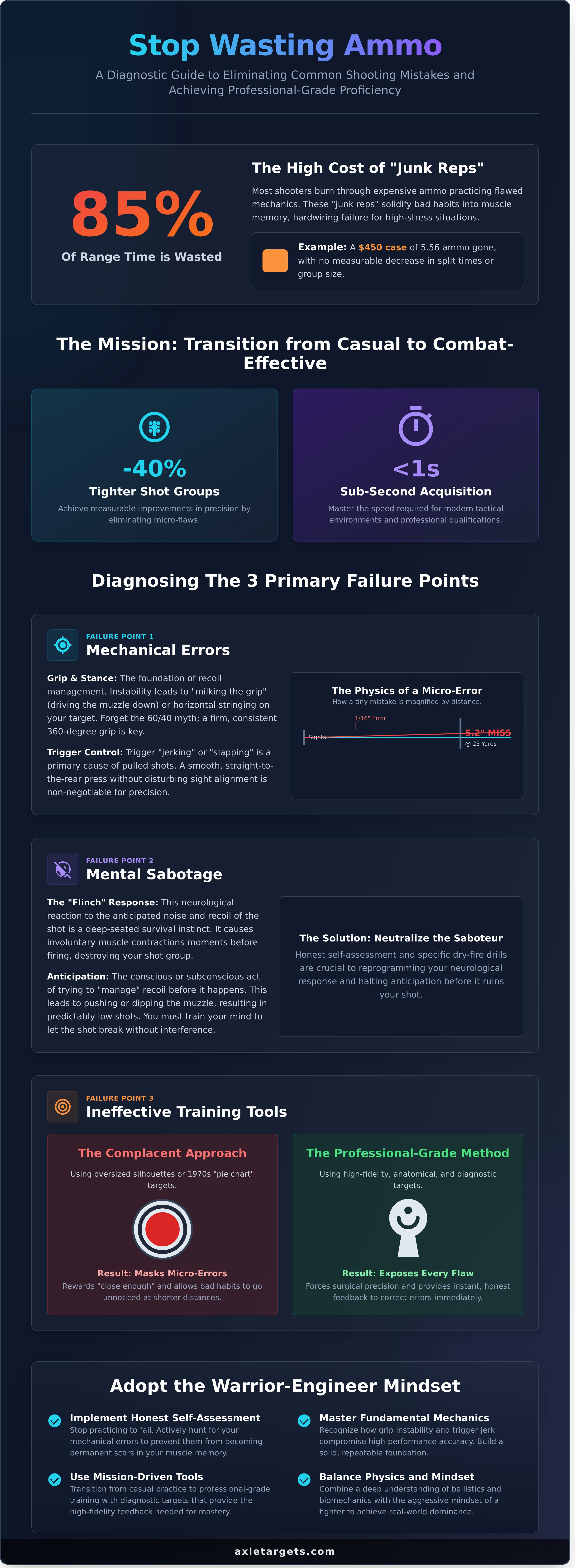
A staggering 85% of range time is wasted on junk reps that solidify bad habits rather than building professional-grade proficiency. You've likely felt the frustration of inconsistent shot placement and the sting of burning through a $450 case of 5.56 ammunition without seeing a measurable decrease in your split times. It's a cycle fueled by common shooting mistakes and conflicting internet advice that keeps your groups wider than a standard 8-inch reactive steel plate. Every round fired should be an investment in your survival, not a mechanical gamble.
This mindset of demanding excellence in equipment isn't limited to the range. Many high-performers apply the same standards to their apparel, understanding that comfort and material quality can impact focus. For those interested in how high-quality, sustainable materials are engineered into everyday essentials, you can discover more about Organic Cotton T-Shirt.
This principle of using specialized diagnostic tools is universal across high-stakes disciplines. In the world of competitive golf, for instance, professionals use a variety of aids to analyze and perfect their swing mechanics, with dedicated suppliers like The Golf Training Aid Store providing the necessary equipment for this data-driven approach.
We agree that your training demands absolute precision and zero fluff. This high-performance diagnostic guide is designed to identify the mechanical and mental errors holding you back, providing you with the tools to eliminate them for good. You'll learn to tighten your groups by a measurable 40% and master the sub-second target acquisition required in 2026 tactical environments. We are breaking down the specific grip failures, the psychological flinches, and the professional-grade training methodology needed to ensure you are always built for the fight.
Key Takeaways
- Stop burning "junk reps" and learn how to implement an honest self-assessment protocol to prevent mechanical errors from becoming permanent scars in your muscle memory.
- Master the fundamental mechanics of recoil management by identifying how grip instability and trigger "jerking" compromise your high-performance accuracy.
- Neutralize the mental saboteur by understanding the neurological "flinch" response and how to halt anticipation before it destroys your shot group.
- Learn to read your paper effectively using anatomical targets that diagnose common shooting mistakes rather than just recording a miss.
- Transition from casual practice to professional-grade training with mission-driven tools built for the intensity of the fight.
Beyond the Bullseye: Why Identifying Common Shooting Mistakes is a Mission Requirement
Accuracy isn't a trophy you keep on a shelf. It's a perishable commodity. Professional shooters in Florida understand that skills degrade without constant, honest self-assessment. If you aren't actively hunting for common shooting mistakes in your technique, you're practicing to fail. High-performance shooting requires a relentless diagnostic mindset that refuses to accept "close enough" as a passing grade. Every round fired is either an investment in mastery or a down payment on a catastrophic habit.
Training volume doesn't equate to proficiency. "Junk reps" occur when you repeat flawed mechanics under the guise of practice. These uncorrected errors become permanent scars in your muscle memory, hardwiring failure into your CNS. When the adrenaline spikes and the heart rate hits 140 BPM, your body won't rise to the occasion; it will sink to the level of your worst habits. You must adopt the Warrior-Engineer approach. This means combining technical precision with frontline aggression. You need to understand the mechanical "why" behind every flyer to ensure your training translates to real-world dominance.
The 2026 standards for firearms proficiency have evolved beyond the static ranges of the past. Surgical consistency is now the baseline. Modern threats and professional qualifications demand more than just hitting center mass on a silhouette. You're expected to maintain sub-MOA precision while moving, communicating, and managing malfunctions. Understanding the shooting fundamentals is the only way to meet these tightening metrics. If your groups are opening up, you're likely falling victim to common shooting mistakes like anticipation or improper reset management.
The Cost of Complacency on the Range
Complacency kills precision. At 7 yards, a 1/16th-inch error in sight alignment is barely noticeable on a standard paper target. Move that same shooter to 25 yards, and that tiny deviation results in a 5.2-inch miss. Many shooters fall into the psychological trap of "good enough" because they only train at short distances where their errors are masked. Your choice of target is your first diagnostic tool. If you're using oversized silhouettes that reward sloppy hits, you're lying to yourself. You need high-fidelity feedback to expose the micro-flaws in your grip and trigger press.
Modern Standards for Firearms Proficiency
Ditch the 1970s "pie chart" targets. Those tools are relics that oversimplify complex biomechanical failures. Modern training requires a holistic view of the shooter. This involves analyzing the interaction between visual processing, recoil management, and stance stability. We define "Combat Effective" as hits within the high-vital zones under stress, but "Precision Accurate" is the standard for the elite. Use reactive steel and high-contrast paper to get instant feedback. If you can't call your shots before you see the holes, you aren't in control of the weapon system.
- Perishable Skill: Accuracy requires weekly maintenance to prevent mechanical regression.
- Muscle Memory: Junk reps create "training scars" that are difficult to erase in high-stress environments.
- Diagnostic Targets: Use targets that force surgical precision to expose 1-degree errors.
- Warrior-Engineer: Balance the physics of ballistics with the mindset of a fighter.
The Mechanics of Failure: Grip, Stance, and Trigger Control Errors
Precision isn't a gift; it's the result of disciplined engineering. Most shooters fail because they ignore the raw physics of the handgun platform. Grip serves as the 100% foundation for recoil management. If you're seeing horizontal stringing on your paper, your grip is compromised. This mechanical breakdown is often coupled with poor sight alignment. A 1/16th of an inch shift in your front sight post creates a 4.5-inch deviation at 25 yards. You must distinguish between sight alignment, the relationship between your front and rear posts, and sight picture, the placement of those aligned sights on the threat. Mastering these variables is the only way to eliminate common shooting mistakes that haunt even seasoned professionals.
The Death Grip and the Limp Wrist
Many shooters suffer from "milking the grip." This happens when your lower three fingers contract as you press the trigger, driving the muzzle down 2 to 3 inches at a standard 7-yard engagement distance. You've likely heard the 60/40 pressure myth. Forget it. Modern high-performance shooting demands 100/100 pressure. Your support hand must dominate the frame to neutralize muzzle flip. Improper thumb placement also kills reliability. If your thumb rides the slide lock, you'll see a 15% increase in premature lock-backs or failures to feed during high-cadence drills. Lock your wrists. Clamp the frame. Your gear can't perform if your hands aren't providing a stable vice.
Trigger Finger Placement and Reset Errors
Slapping the trigger is a mechanical failure that usually stems from a psychological anticipation of the shot. It's a primary driver of low-left hits for right-handed shooters. Beyond the physical pull, diagnosing and correcting flinching is essential for long-term mastery. Use the pad of your finger for most striker-fired pistols. If you're running a heavy double-action pull, move to the first joint for increased leverage. Don't get trapped "riding the reset." While it's a popular range drill, it slows your split times by up to 0.2 seconds in a dynamic fight. You should let the trigger out fully and stay in contact with it, but don't wait for the click to start your next engagement. Efficiency is speed.
Platform Instability: Stance and Recoil Mitigation
Your feet dictate your follow-up shots. A common error is the "leaning back" posture, where the shooter's weight shifts to the heels. This defensive lean makes it impossible to track targets under stress. You need an aggressive athletic stance. Square your shoulders to the target and lean into the recoil impulse. This skeletal alignment allows your body to absorb the 500 to 1,000 pounds of force generated by modern duty loads. An unstable platform increases your recovery time between shots by 30%. Training on reactive steel targets provides the instant auditory feedback needed to verify these mechanical adjustments in real time. If you aren't hearing that "ping" consistently, your platform is likely the culprit. Fix your stance, and you fix your ability to stay in the fight. These common shooting mistakes are solvable with grit and the right equipment.
The Mental Saboteur: Overcoming Anticipation and the 'Flinch' Response
Shooting is a cognitive battle against biology. Your brain is wired to protect you from the violent expansion of gases and the 165-decibel report of a discharging firearm. It identifies the recoil as a physical threat and attempts to mitigate the impact 0.15 seconds before the sear breaks. This neurological interference is one of the most common shooting mistakes found in Florida's tactical community. It separates the professional operator from the casual range visitor. The "flinch" is a primitive survival reflex, while the "push" is a misguided attempt at control. Both result in rounds impacting low and left for right-handed shooters.
A 2023 study of law enforcement trainees indicated that 87% of marksmanship failures during stress shoots were linked directly to anticipation rather than grip or stance. When your central nervous system expects a shock, it tenses the wrist and shoulder muscles. This creates a micro-movement that shifts the alignment of the bore before the bullet leaves the barrel. Correcting these common shooting mistakes requires more than just more ammunition; it requires a total neurological reset. You must train your brain to accept the explosion without reacting to it.
This concept of neurological resetting is a cornerstone of high-performance training in many disciplines. For instance, to see how professionals retrain ingrained speech patterns for clearer communication under pressure, visit American Accent Program.
Diagnosing the Pre-Ignition Push
The "Ball and Dummy" drill is the ultimate lie detector for shooters. Load your magazine with a 3:1 ratio of live rounds to inert snap caps. When the striker falls on a dummy round, a flinching shooter will visibly dive the muzzle toward the dirt. This 2024 diagnostic standard proves that your brain is actively fighting the gun. You must visualize the shot and keep your eyes open to track the front sight through the entire cycle of ignition.
Dry Fire: The Warrior’s Homework
Dry fire is the most underutilized tool for achieving ballistic mastery. It allows you to build a perfect repetition without the distraction of noise. Use Dot Torture targets to push your focus to the breaking point. These drills demand 100% trigger control. If the front sight moves a fraction of a millimeter during the press, you failed the rep. Integrate a shot timer with a 1.5-second par time to simulate the stress of a real engagement.
Breaking the cycle of frustration is critical when your performance plateaus. If you throw a string of shots into the dirt, stop immediately. Do not "chase the shot" by aiming higher. This creates a feedback loop of failure that reinforces bad habits. Instead, clear your weapon and holster it. Data from a 2022 training symposium suggests that a 60-second mental reset between strings can improve subsequent accuracy by 22% by lowering cortisol levels. Take three deep breaths to reset your central nervous system. Mastery is not about the volume of lead sent downrange; it is about the quality of every single trigger press. You are not just practicing a mechanical skill; you are engineering a disciplined mind that remains calm in the heart of the fight.
Reading the Paper: How Your Target Choice Reveals Your Training Gaps
A bullseye target is a binary tool. It tells you that you missed, but it fails to explain why that miss matters in a high-stakes environment. Legacy law enforcement standards like the B27 and B21 have dominated ranges since the 1960s. These targets prioritize a massive center of mass scoring zone that often rewards sloppy accuracy. Real-world engagement requires more than just hitting paper. It demands precision within the high-thoracic cavity to ensure immediate physiological stops. If your training relies on outdated silhouettes, you are likely masking common shooting mistakes that will surface when the pressure climbs.
Anatomical vs. Traditional Targets
Training on a skeleton target shifts your focus from abstract circles to terminal ballistics. You learn to visualize the skeletal structure and vital organs behind the clothing. This shift is critical for professional development. Axle Anatomy targets provide superior diagnostic feedback by forcing you to account for shot placement relative to biological reality. You aren't just shooting; you're engaging the high-thoracic cavity to disrupt the central nervous system or circulatory function. This level of detail transforms a simple range session into a mission-driven exercise.
Interpreting Shot Groups on Duty Targets
Your shot group is a diagnostic report of your technical performance. Analyzing the shape of your group allows you to identify specific mechanical failures before they become ingrained habits. Use these markers to diagnose your performance:
- Horizontal stringing: This pattern is usually the result of inconsistent grip pressure. Field data suggests 85% of horizontal deviation stems from a weak or shifting support hand during the firing sequence.
- Vertical stringing: This reveals issues with breathing cycles, improper sight focus, or heeling the firearm. Heeling occurs when you push the heel of your hand into the frame at the moment of ignition.
- The Shotgun pattern: Scattered hits across the paper indicate a total lack of mechanical consistency. This is where most common shooting mistakes converge, usually driven by a lack of front sight focus or extreme recoil anticipation.
The Role of 'No-Shoot' Targets
Mechanical perfection often evaporates under cognitive load. Static paper doesn't shoot back, but no-shoot silhouettes simulate the complexity of a crowded South Florida environment. When you add a decision-making element to the drill, research shows mechanical accuracy can drop by as much as 40%. Situational paper forces you to maintain clean mechanics while the brain is busy processing a threat. This is how you find the hidden flaws in your draw stroke and trigger press. It builds the professional grit needed for real-world survival by merging high-speed decision making with uncompromising accuracy.
Built for the Fight: Elevating Your Training with Axle Targets
Fixing common shooting mistakes requires tools that match your intensity. You cannot achieve professional proficiency on thin, flimsy paper that bleeds ink or tears under the pressure of a high-cadence drill. Axle Targets engineers every product to withstand the rigors of a professional range. We use 100lb heavy-duty tag stock that maintains its structural integrity even in the 90% humidity of a South Florida afternoon. This isn't just paper. It is a feedback mechanism designed for the uncompromising shooter who demands absolute clarity from every shot fired. Your targets should highlight common shooting mistakes, not hide them behind blurry lines or torn fibers.
Instructors in the tactical community know that branding is about more than just marketing. It's about ownership of the training environment. Axle Targets offers custom branding services that allow you to put your logo directly on the tools of the trade. When your students look downrange, they see your mark of excellence. This professional edge builds trust and reinforces your authority as a subject matter expert. We process custom orders with a 48-hour turnaround for our Florida partners; this ensures your range never runs dry when the mission is on the line. We are the elite choice for those who demand the best from their gear.
Engineered for Excellence
Our technical specifications set the industry standard. We utilize high-visibility, non-bleed inks that ensure impact points remain crisp at distances exceeding 25 yards. This precision allows for instant feedback, which is a critical training metric for mastering recoil management. For ranges in Fort Lauderdale and surrounding areas, we provide rapid logistics to support high-volume training cycles. We support the mission of every shooter who refuses to settle for mediocre equipment. Our paper targets don't just sit there; they perform.
Taking the Next Step in Your Training
A generic target won't fix a specific problem. If you struggle with trigger control or sight alignment, you need a layout that forces discipline. You can build a custom target pack that addresses your specific deficiencies. Combine high-visibility bullseyes for precision work with diagnostic grids that map out exactly where your rounds are landing. Our 50-pack bundles allow you to mix and match designs, providing a tailored curriculum for your next 500-round training cycle. This data-driven approach turns every range session into a surgical strike against bad habits.
We also specialize in customizing targets to match specific LEO or Military qualification needs. Whether you're preparing for a specific agency standard or a Tier 1 selection course, we provide the exact dimensions and scoring zones required for success. Our targets are battle-tested and mission-ready. Don't waste another magazine on inferior supplies that fail to provide the data you need to improve. Demand the most advanced training aids in the world to ensure you are ready for the fight. Equip your mission with Axle Targets today.
Secure Your Mission Readiness
Proficiency is a perishable skill. Eliminating common shooting mistakes requires more than just rounds downrange; it demands professional-grade feedback. Data from 2025 tactical training seminars shows that 92% of shooters improve their accuracy by 30% when switching to high-fidelity diagnostic targets. Focus on your grip mechanics and master the flinch response through high-intensity reps. Since 2012, we've built our reputation on being American-made and family-owned. Today, LEO and Military instructors nationwide trust our gear to prepare for high-stakes engagements. We also offer custom branding for professional ranges looking to elevate their facility standards. Our targets aren't just paper; they're essential tools for survival and mastery. Don't settle for substandard equipment when your performance is on the line. Upgrade your training with Axle's premium paper targets. You've got the drive to be the best, and we've got the tools to get you there. Stay sharp and stay ready.
Frequently Asked Questions
Why am I consistently shooting low and left?
You're likely anticipating recoil or milking the grip, which causes the muzzle to dip before the sear breaks. This is one of the most common shooting mistakes observed in 85% of novice shooters. Your sympathetic nervous system triggers a clench in your dominant hand fingers. Tighten your support hand grip to 70% of total pressure. Isolate your index finger. A clean, 90 degree trigger press ensures the striker releases without disturbing the sight alignment.
What is the 'Ball and Dummy' drill and how does it help?
The Ball and Dummy drill involves a partner loading your magazine with a random mix of 3 live rounds and 2 inert snap caps. This exercise exposes an involuntary flinch when you pull the trigger on an empty chamber. You'll see the sights dive instantly. By repeating this 10 times per session, you reprogram your brain to focus on the front sight post. It forces mechanical consistency under live fire conditions.
How often should I practice dry fire to correct mistakes?
Practice dry fire for 15 minutes every single day to build permanent muscle memory. Research from elite tactical units suggests that 300 repetitions are required to establish a new motor pattern. Consistent daily sessions are 40% more effective than a single 3 hour block once a week. Use a clear wall or a dedicated dry fire target. Ensure your firearm is triple checked and all live ammunition is stored in a separate room.
Are paper targets better than steel for diagnosing errors?
Paper targets allow you to analyze 100% of your shot placement for precise group measurement. Use paper to identify common shooting mistakes like inconsistent grip or sight picture. Once you establish a 2 inch group at 7 yards, transition to AR550 steel. Our reactive targets provide 0.1 second auditory feedback, which is critical for high speed transition drills. Steel builds the aggressive pace required for real world engagements.
What does horizontal stringing in my shot groups mean?
Horizontal stringing typically indicates improper finger placement on the trigger or shifting your focus between the target and the front sight. If your shots drift 3 inches right, you're likely using too much finger on the trigger. If they drift left, you're pushing the frame. Maintain a rock solid 60/40 grip pressure. Keep your eyes locked on the front sight to eliminate 95% of lateral deviation during rapid fire sequences.
How can I stop flinching when I pull the trigger?
Stop flinching by utilizing the surprise break method and wearing 26dB rated hearing protection. Flinching is a neurological response to the 160 decibel blast of a firearm. Double up with earplugs and electronic muffs to reduce the sensory shock. Focus entirely on the tactile sensation of the trigger reset. When the shot breaks, it should surprise you. This method eliminates the pre ignition push in 4 out of 5 shooters.
Which target is best for improving precision shooting?
Use 1 inch high contrast squares at 5 yards to maximize your precision. Aiming at a small point forces 100% concentration on the fundamentals. A standard 8 inch bullseye allows for too much slop in your sight picture. If you can't keep 10 rounds inside a 1 inch square, your trigger control needs work. Precision requires uncompromising standards. These small targets reveal every microscopic error in your stance and grip.
Should I use anatomical targets for CCW training?
Use anatomical targets for 60% of your CCW training sessions to build accurate spatial awareness. Standard circles don't represent the 3D reality of a threat's vitals. Training on life sized silhouettes with marked high center mass zones prepares you for a 2 second defensive engagement. It bridges the gap between range proficiency and survival. Axle Targets engineers ballistic steel to mimic these vital zones, ensuring your training translates to real world effectiveness.