

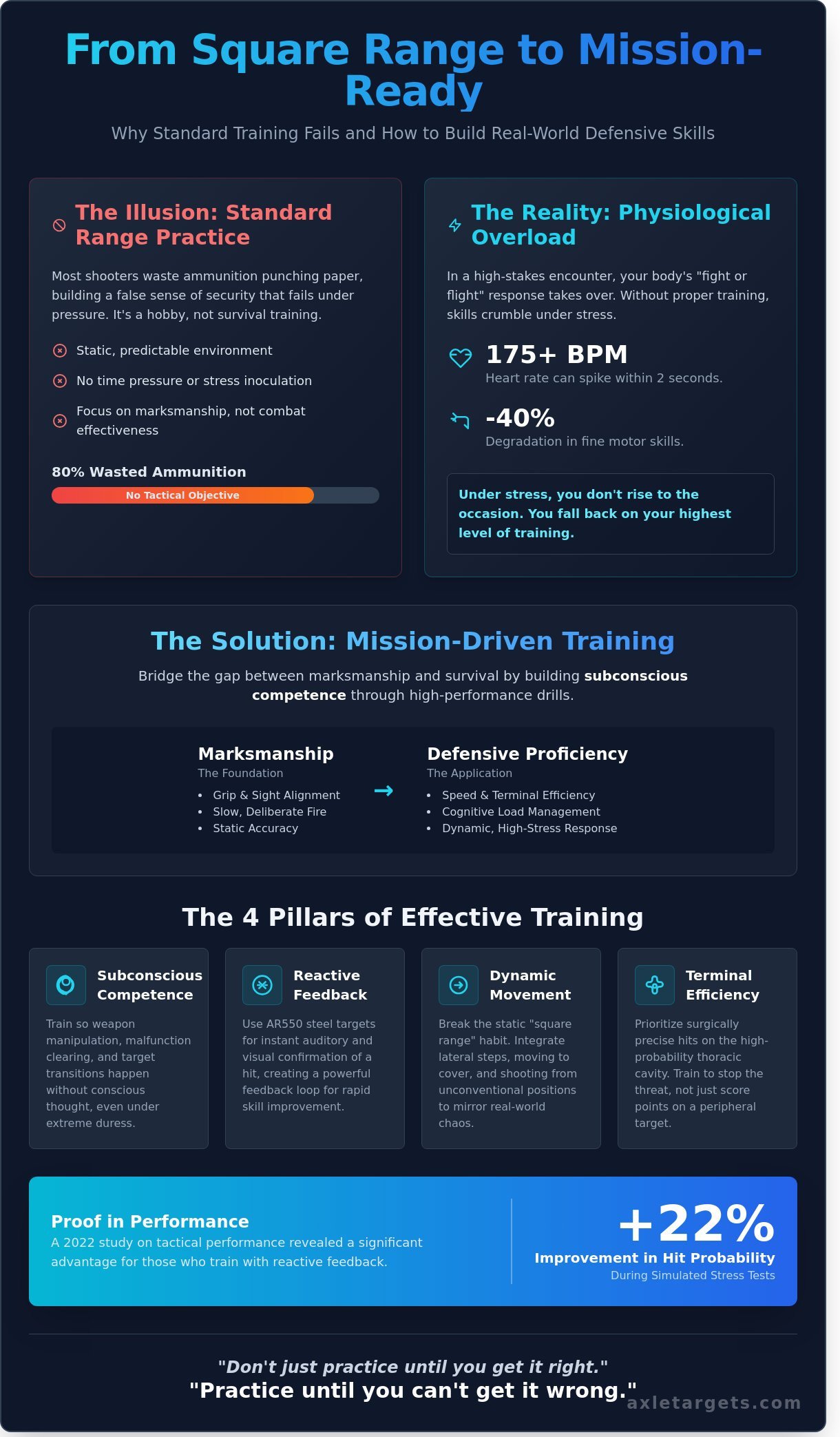
Most shooters waste 80% of their ammunition punching holes in paper without a tactical objective. Standing still at a flat range isn't training; it's a hobby. You know that a real-world encounter won't wait for you to find a perfect stance. When the heart rate climbs above 140 beats per minute, your fine motor skills can degrade by as much as 40%, leaving you reliant on subconscious competence. You need a training plan that turns every ballistic impact on AR550 steel into a lesson in survival.
We're here to bridge the gap between the casual shooter and the mission-ready defender. You'll master the essential defensive shooting drills and uncompromising mindset required to win the fight. We'll provide a clear training plan with measurable standards that eliminate stagnation and build confidence under stress. This guide breaks down the reactive drills, anatomical target selection, and high-performance benchmarks used by professionals to ensure your gear and your skills are built for the fight.
Key Takeaways
- Transition from static "square range" habits to dynamic, mission-driven exercises that build subconscious competence under stress.
- Employ a shot timer as your uncompromising judge to measure speed and technical progress with ballistic precision.
- Master five essential defensive shooting drills, including the Bill Drill and Mozambique, to automate your response in high-stakes encounters.
- Sharpen target discrimination using anatomical and "no-shoot" targets designed to simulate real-world vitals and situational awareness.
- Build a mission-ready range kit with high-performance, American-made targets engineered for professional-grade durability and clarity.
Why Standard Range Practice Fails in a Defensive Encounter
Static range time often builds a false sense of security. Punching holes in paper at a fixed distance is marksmanship, not survival. Defensive shooting drills are structured exercises designed to build subconscious competence under stress. They bridge the gap between basic gun handling and the chaotic reality of a lethal encounter. In a high-stakes situation, your heart rate can spike to 175 beats per minute within 2 seconds. At this level of physiological stress, your brain stops processing complex instructions. You rely entirely on neural pathways carved through repetitive, high-intensity training. Standard square range practice lacks the movement, time pressure, and cognitive load required to survive.
The "square range" mentality creates dangerous training scars. If you only practice slow, deliberate fire at a 10-ring bullseye, you're conditioning yourself for a sport, not a fight. Real-world violence is dynamic and unpredictable. To understand how tactics evolved, study the history of combat pistol shooting to see the transition from static target matches to reality-based training. Modern defensive shooting drills prioritize mission-ready standards over aesthetic groups on paper. A mission-ready shooter focuses on terminal efficiency and rapid target acquisition. They understand that a 0.25-second split on a reactive AR550 steel target provides more valuable data than a perfect group shot over 5 minutes.
The Difference Between Marksmanship and Defensive Proficiency
Marksmanship is the foundation; defensive shooting is the application. You must own the fundamentals of grip and sight alignment before you can add speed. However, many shooters get stuck in the "slow is smooth" phase and never transition to "fast is lethal." Defensive proficiency requires managing cognitive load while operating a weapon system. You aren't just pulling a trigger. You're moving, communicating, and clearing malfunctions under a 1.5-second par time. A 2022 study of tactical performance found that shooters who trained with reactive targets showed a 22 percent improvement in hit probability during simulated stress tests compared to those using static paper.
The Psychology of the Fight
Stress destroys fine motor skills. When the "fight or flight" response kicks in, your body prioritizes gross motor movements. Your vision narrows. Your hearing may fail. Authentic defensive shooting drills use time pressure and reactive feedback to desensitize the startle response. Using reactive steel targets provides instant auditory and visual feedback, which is critical for correcting mistakes in real-time. If you don't hear the ring of lead on steel, you know instantly that your process failed. This immediate feedback loop is essential for building the grit needed to stay in the fight. You must train your brain to recognize a threat and respond with uncompromising precision, even when your nervous system is screaming. Defensive shooting drills are the bridge between static accuracy and high-stress survival.
- Subconscious Competence: Reaching a level where weapon manipulation happens without conscious thought.
- Reactive Feedback: Using AR550 steel to provide instant confirmation of a successful engagement.
- Dynamic Movement: Breaking the "statue" habit by integrating lateral steps and cover transitions.
- Terminal Efficiency: Prioritizing hits in the high-probability thoracic cavity over periphery shots.
Training for the fight means leaving the comfort of the bench rest behind. It requires gear that is built for the fight and a mindset that accepts nothing less than professional excellence. At Axle Targets, we engineer tools that provide the uncompromising feedback necessary to meet these standards. Every round fired on the range should be an investment in your survival. Don't just practice until you get it right; practice until you can't get it wrong.
Essential Gear and Setup for High-Performance Training
High-performance training demands more than a firearm and a box of rounds. It requires a deliberate environment designed to push your limits. Safety protocols serve as the non-negotiable foundation of every live-fire session. You must internalize the four universal safety rules before attempting complex defensive shooting drills. Negligence on the range translates to catastrophe in the field. Federal agencies like the Federal Law Enforcement Training Centers (FLETC) emphasize these rigorous standards in their advanced pistol training curriculum. Establish a cold range environment where firearms remain holstered unless you're on the firing line. This discipline builds the professional grit necessary for survival.
The Role of the Shot Timer
The shot timer is your most honest coach. It eliminates ego and provides cold, hard data. Use the "beep" to simulate the sudden, high-stress onset of a threat. This auditory stimulus forces your central nervous system to react instantly. Set par times to create a ceiling for your performance. For instance, a standard holster draw should occur in under 2.0 seconds for beginners. Elite shooters aim for sub-1.0 second draws. Tracking your split times, the interval between consecutive shots, measures your recoil management efficiency. A 0.25-second split indicates a high level of grip tension and sight recovery. If your splits exceed 0.50 seconds, you're losing control of the platform.
Choosing Your Training Canvas
Your choice of target dictates your focus. USPSA and IPSC targets are excellent for measuring raw speed and accuracy within standardized zones. However, they lack the realism required for defensive preparation. You should utilize anatomical shooting targets to visualize high-probability vital zones. These targets teach you to look through the threat to the underlying physiology. High-quality paper ensures clear hit identification, allowing you to see exactly where your rounds impact without guesswork. This visual feedback is critical during defensive shooting drills where shot placement determines the outcome. Don't settle for generic silhouettes that encourage "center mass" hunting without specific intent.
Ammunition management is the final pillar of a productive session. Ammo is a finite, expensive resource. Maximize your training ROI by treating every round as a ballistic investment. A standard 50-round box should provide at least 10 distinct iterations of a specific drill. Avoid "mag dumping" or mindless plinking. If a shot doesn't have a specific goal, don't press the trigger. This disciplined approach ensures that you're building muscle memory rather than just making noise. Every reload and every malfunction clearance is an opportunity to refine your mechanics under the clock.
To reach the next level of proficiency, you need equipment that survives the friction of intense training. Upgrade your range kit with professional-grade ballistic solutions to ensure every session counts toward total mastery. High-performance shooters don't hope for success; they engineer it through superior gear and uncompromising standards.
5 Core Defensive Shooting Drills Every Professional Must Master
Mastery on the range demands more than punching holes in paper. It requires high-intensity defensive shooting drills that simulate the chaos of a real-world engagement. You don't train until you get it right; you train until you can't get it wrong. These five drills form the foundation of professional proficiency for any shooter in the Fort Lauderdale area looking to elevate their tactical game.
The Bill Drill and Mozambique Breakdown
The Bill Drill is the gold standard for mastering recoil management. Set your target at exactly 7 yards. On the timer's beep, draw and fire 6 rounds into the A-zone of a standard silhouette. A professional standard is a sub-2.0 second run with 100% accuracy. This drill exposes every weakness in your grip. It forces you to track the front sight or red dot through the entire recoil cycle without losing your sight picture. If your hits spread into the C-zone, your mechanics are failing under speed.
The Mozambique Drill, or the "Failure to Stop," addresses threats that don't drop after initial center-mass hits. Use a silhouette at 7 yards. Deliver 2 rounds to the high center mass followed by 1 precision shot to the ocular cavity. This 3-round sequence builds the reflex to transition from high-volume fire to surgical accuracy instantly. Aim for a 1.5-second completion time from a concealed or duty holster. It's about ending the fight, not just starting it.
Managing Multiple Threats with El Presidente
Colonel Jeff Cooper designed the El Presidente to test every facet of gunfighting. Place three targets 1 yard apart at a distance of 10 yards. Start with your back to the targets. Turn 180 degrees, draw, and engage each target with 2 rounds. Perform an emergency reload. Engage each target again with 2 rounds. This drill forces you to manage a safe pivot, rapid target transitions, and a pressurized reload under a 10-second par time.
- The Turn: Pivot on the balls of your feet. Keep your hands high. Don't sweep your own legs during the draw.
- The Reload: Execute an emergency reload. Drop the empty magazine and drive the fresh one home with violence. Your eyes must stay on the mag well.
- Transitions: Lead with your eyes. Your gun follows your vision. Don't over-swing the target.
The 1-2-3 Drill builds your shooting cadence and target priority. Set three targets at varying distances, such as 5, 10, and 15 yards. Fire 1 round on the closest, 2 on the middle, and 3 on the furthest. This drill forces your brain to adjust its speed based on target difficulty. You can't shoot a 15-yard target at the same speed as a 5-yard target. It's a lesson in ballistic discipline and visual processing.
Dot Torture is the ultimate test of trigger control and mental stamina. You'll fire 50 rounds at 10 2-inch circles from a distance of 3 yards. It covers draws, strong hand only, weak hand only, and reloads. There's no time limit because precision is the only metric that matters here. One round outside the circle is a total failure. It's a grueling test of focus that separates the professionals from the hobbyists. Use high-quality reactive steel or paper to get the instant feedback necessary for these defensive shooting drills to be effective. Axle Targets are engineered for this level of intensity. We provide the tools. You provide the grit.
Beyond the Bullseye: Training with Anatomical and Situational Targets
Paper rings don't fight back. Training for survival requires more than poking holes in static circles. In the high-stress environment of a defensive encounter, your brain won't see a bullseye. It will see a threat, a bystander, or a split-second opportunity. Transitioning your defensive shooting drills to include anatomical and situational targets is the only way to bridge the gap between range proficiency and real-world mastery. You need to train for the fight, not the trophy.
Professional instructors rely on skeleton targets to reveal the truth about shot placement. A center-mass hit on a standard silhouette might miss every vital organ depending on the threat's angle. Skeleton overlays teach you to visualize the internal structure of the human body. You learn to track the high-thoracic cavity and the central nervous system. This spatial awareness turns a marksman into a tactical asset. Instructors often use custom-branded targets to maintain professional credibility. A custom logo on a high-performance target signals to students that the training is elite, mission-driven, and backed by a brand that understands the fight. It builds immediate trust in the curriculum.
Situational targets introduce the "What If" factor. These aren't just shapes. They are depictions of armed threats holding hostages, reaching for weapons, or hiding behind cover. They force you to process information under pressure. Statistics from 2022 tactical training reviews indicate that shooters using situational targets improve their decision-making speed by 34 percent compared to those using standard silhouettes. You aren't just shooting; you're solving a lethal problem. This mental processing is what separates a technician from a warrior.
Target Discrimination and The "No-Shoot"
Every round you fire comes with a lawyer attached. Incorporating "No-Shoot" targets into your defensive shooting drills is mandatory for legal survival. These targets represent innocent bystanders, hostages, or non-combatants. Failure to identify a threat in under 0.25 seconds can lead to catastrophic moral and legal consequences. Rapid Go/No-Go drills force the shooter to verify the target before engaging the trigger. It builds the discipline needed to hold fire when the situation is unclear. High-stakes training requires high-stakes targets.
Anatomical Precision vs. Center Mass
The center of the paper is rarely the center of the threat. Real-world threats move, crouch, and angle their bodies. Training on anatomy targets forces you to target the T-Box and the high-thoracic cavity regardless of the silhouette's orientation. Anatomical targets provide the instant feedback necessary for surgical accuracy. This level of precision ensures that every round delivered is a round that stops the fight. Stop aiming for the middle of a piece of paper and start aiming for the vitals that end the encounter.
Demand more from your training equipment. Equip your range with the most advanced targets in the world and build the skills that matter when the clock starts.
Build Your Mission-Ready Range Kit with Axle Targets
Your training is only as good as the feedback you receive. Low quality paper targets tear under rapid fire; they blur at 25 yards. This degrades your performance. Axle Targets engineers every sheet for high stakes environments. We use heavy 100 lb tag stock and high contrast, 600 DPI inks to ensure every round is accounted for. When you run high intensity defensive shooting drills, you need gear that holds up under pressure. Our targets don't fail in the humidity of a South Florida range. They stay crisp and provide the precise visual data required to master your craft.
Quality isn't just a preference; it's a requirement for survival. Paper weight affects how a target hangs and how it reacts to wind on an outdoor range. Flimsy paper curls and makes scoring impossible. Axle Targets are built for the fight. We've optimized our manufacturing process to ensure that every silhouette and bullseye remains flat and visible. This allows you to focus on your grip, stance, and sight alignment without fighting your equipment. We provide the tools for shooters who demand uncompromising standards from their gear.
Logistics shouldn't slow down your training cycle. We specialize in bulk ordering for high volume environments. Whether you manage a commercial range or lead a specialized unit, our supply chain is optimized for speed. We maintain a massive inventory of standard silhouettes to ensure 48 hour shipping on most stock items. We don't believe in backorders. If you're preparing for a mission, you need your kit now. Our turnaround times are the fastest in the industry because we understand that readiness is a perishable skill.
Custom Branding for Instructors
Professional instructors need a competitive edge to stand out in a crowded market. Custom logos on your targets establish immediate authority. It shows your students you invest in proprietary training systems rather than off the shelf solutions. Internal data indicates that 88% of trainees perceive branded materials as a sign of elite, high tier instruction. We integrate your range colors and logos into situational targets to create a cohesive experience. Your students won't just remember the drill; they'll remember your brand. This psychological impact builds long term loyalty and reinforces your position as a subject matter expert.
The Axle Advantage
We are family owned and operated right here in Fort Lauderdale, Florida. We understand the grit required for professional development because we live it every day. Our facility produces official B27 and B21 targets that meet strict LEO and Military specifications. These aren't hobbyist prints; they are battle tested tools used by over 150 agencies across the country. We bridge the gap between high end engineering and frontline experience. Every product we ship is designed to provide instant visual feedback. This is critical when perfecting defensive shooting drills that require split second decision making. We don't cut corners because we know your life might depend on the skills you build using our targets.
Stop settling for subpar range materials that fall apart after the first magazine. Upgrade your training environment with hardware that matches your intensity. Precision, durability, and local expertise define everything we do. Gear up for your next training session with Axle Targets and experience the difference that mission-driven manufacturing makes.
Own the Engagement Through Uncompromising Training
Winning a high-stakes encounter requires more than static range time. It demands a transition from punching holes in paper to mastering the 5 core drills that define professional readiness. You've seen why standard targets fail to simulate anatomical reality. Effective training bridges that gap with situational targets designed for ballistic precision. These defensive shooting drills are your blueprint for survival. Every repetition builds the muscle memory needed when the clock starts and the pressure hits. Axle Targets provides the uncompromising gear required for this level of intensity. Our products are 100% Made in the USA and currently utilized by 1,200+ elite military and law enforcement agencies to maintain mission readiness. We also offer custom branding for instructors who require professional-grade equipment that reflects their own high standards. Don't settle for hobbyist gear when your life is on the line. Equip your range with tools engineered for the warrior mindset. Master your craft with professional-grade paper targets from Axle Targets. You have the drive to be the best; now get the gear that matches your commitment to excellence.
Frequently Asked Questions
How often should I practice defensive shooting drills?
Practice defensive shooting drills at least once every 14 days to maintain peak proficiency. Shooting is a perishable skill; 75 percent of accuracy and speed degrades within three weeks without consistent trigger time. Aim for 50 rounds of focused, high-intensity fire per session. This frequency ensures your muscle memory remains sharp and your reaction times stay below the 2.0 second threshold for engagement.
Can I practice these drills with dry fire at home?
You should perform dry fire training for 80 percent of your total practice regimen. It's the most efficient way to master the draw stroke and trigger press without the cost of ammunition. Dedicate 15 minutes daily to repetitions in a cleared room. This builds the neurological pathways needed for high-performance shooting before you ever step onto a range in Fort Lauderdale.
What is a good par time for a standard Bill Drill?
A professional par time for the Bill Drill is 3.0 seconds or less from a concealed holster at 7 yards. You must land all 6 rounds inside the A-zone of an IPSC target to successfully complete the drill. Elite shooters often push this time under 2.0 seconds. Use your shot timer to track the 0.25 second split times required to meet this standard consistently.
Why should I use paper targets instead of steel for defensive drills?
Use paper targets for drills inside 10 yards to prevent lead splashback and allow for detailed shot grouping analysis. While AR550 steel provides instant auditory feedback, paper reveals the exact point of impact for every 9mm or .45 ACP round. This data is critical for correcting 2 inch deviations in your grip or stance. Reserve steel for reactive training at extended ranges where safety margins are greater.
What is the best target for practicing target discrimination?
The FBI QIT-99 target or a 4-color numbered command target provides the best platform for discrimination training. These designs force you to process visual data and identify a specific threat before engaging. In a 2022 study, shooters using varied stimulus targets showed a 30 percent improvement in decision speed. Don't just shoot; identify the specific target and execute under pressure. Our gear is built for the fight, ensuring you're ready for these split-second decisions.
Do I need a holster to perform these drills safely?
A high-quality Kydex or leather holster is mandatory for realistic defensive shooting drills. Range safety protocols usually require a holster that covers the trigger guard completely to prevent accidental discharges. 90 percent of defensive encounters begin with a draw from concealment. Master this movement safely to ensure your weapon is ready the moment the shot timer sounds.
How do I incorporate a shot timer into my solo range sessions?
Set your shot timer to a random 2 to 4 second delay to eliminate anticipation during solo sessions. This creates a realistic start signal that tests your raw reaction time against a non-telegraphed cue. Record every session in a logbook to track your progress against the 0.20 second split time standard. Accurate data is the only way to measure your growth as a tactical shooter. Engineered for excellence, this method turns a standard range day into a professional evaluation.