
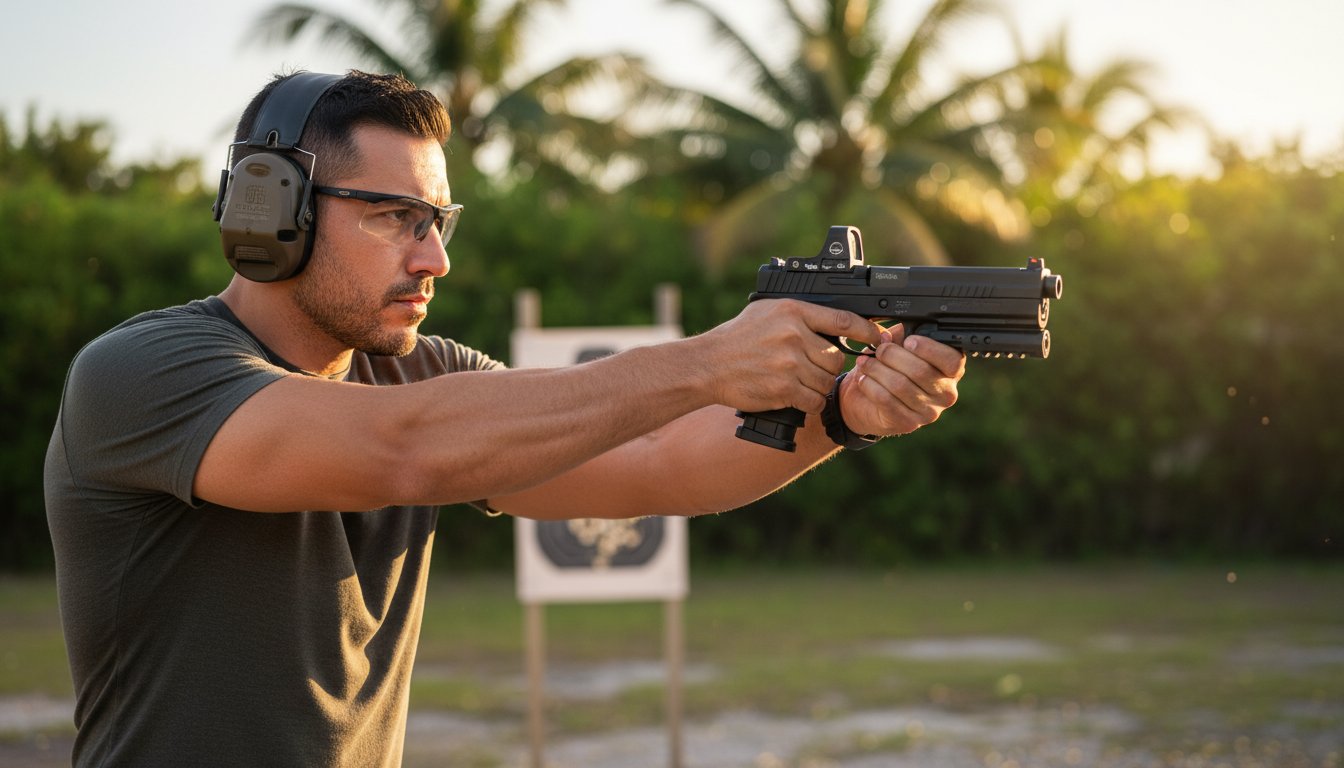
Precision isn't a gift; it's a cold, hard calculation of physics and grit. If your shot groups look like a 10-inch spread at just 15 yards, you aren't failing your gear; you're failing your mechanics. Mastering marksmanship fundamentals is the only way to bridge the gap between a casual hobbyist and a tactical professional. You've likely felt the frustration of a round going wide without a clear reason. You've heard five different instructors give five different tips on grip pressure, yet your performance remains stagnant and unreliable.
We're here to end the guesswork. This guide provides a technical breakdown of elite shooting mechanics and shows you how to use reactive diagnostic targets to eliminate 90% of common user errors. You'll gain a professional-level understanding of trigger control and stance that translates directly to high-stakes environments. We're moving past the noise to deliver a mission-driven framework for unshakeable proficiency. It's time to analyze your impact, adjust your input, and achieve the tight, repeatable groups that define the Warrior-Engineer.
Key Takeaways
- Engineer a stable shooting platform using aggressive geometry to dominate recoil and guarantee rapid follow-up shots.
- Master the visual processing chain to navigate the critical technical shift from iron sight alignment to red dot target focus.
- Refine your marksmanship fundamentals by isolating the mechanics of a straight-back trigger pull for unshakeable precision.
- Transition from static drills to mission-ready proficiency using diagnostic targets designed for high-volume performance data.
Beyond the Basics: Defining Marksmanship Virtuosity in 2026
Marksmanship isn't a gift. It's the relentless execution of common mechanics performed uncommonly well. In 2026, the standard for defensive shooting has evolved beyond mere hits on a silhouette. True mastery requires a level of consistency that transforms conscious effort into subconscious reflex. This evolution separates those who own a firearm from those who can fight with one. Understanding the different marksmanship skill levels provides a roadmap for this progression, moving from basic competency to expert proficiency under duress.
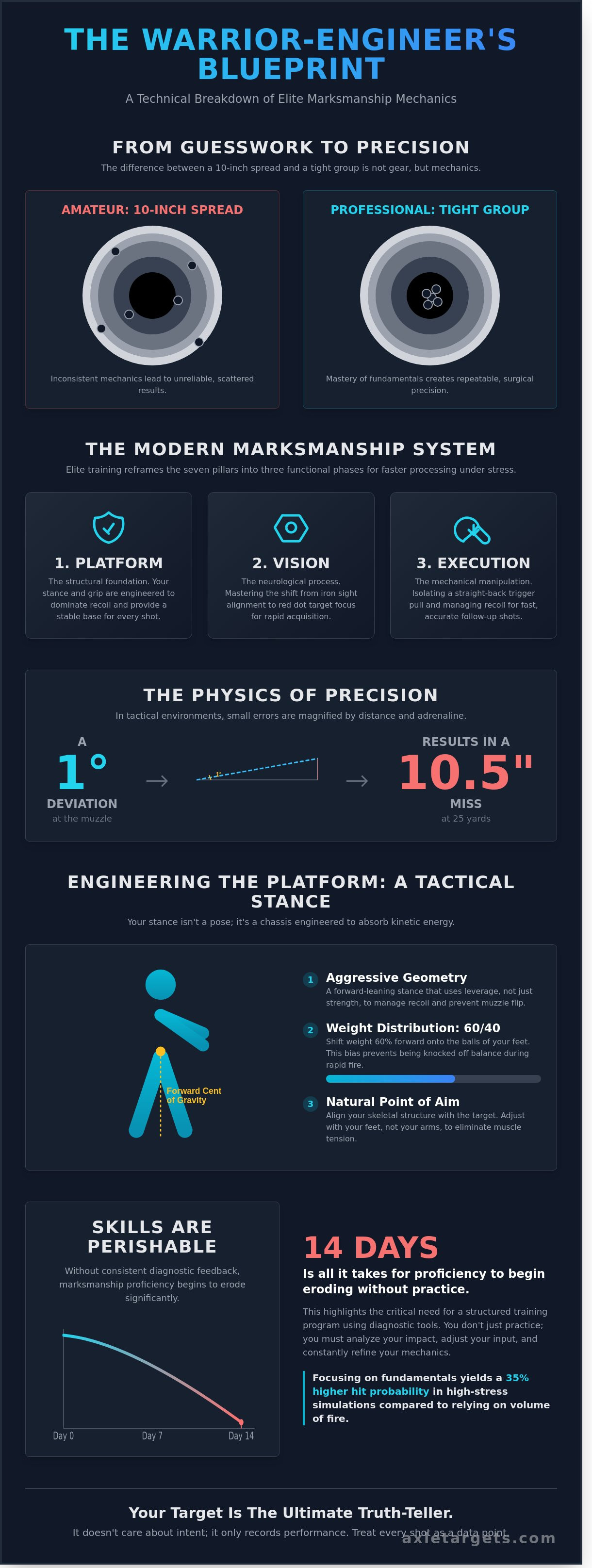
The modern landscape demands precision-driven standards. For law enforcement and civilian defenders, "good enough" is a liability that costs lives. Statistical data from 2024 training cycles indicates that shooters who focus on marksmanship fundamentals see a 35% higher hit probability in high-stress simulations compared to those who rely on volume of fire. Precision is the only metric that matters when the target is moving and the environment is chaotic. You don't rise to the occasion; you sink to the level of your training.
These skills are perishable. Without consistent diagnostic feedback, your proficiency begins to erode within 14 days of your last live-fire session. Mastery requires a "System" approach rather than a collection of isolated tips. We categorize this system into three distinct phases:
- Platform: The structural foundation of the body and the grip.
- Vision: The neurological process of target acquisition and sight tracking.
- Execution: The mechanical manipulation of the trigger and management of recoil.
The Seven Traditional Pillars vs. Modern Systems
Traditional instruction relies on seven pillars: Stance, Grip, Sight Alignment, Sight Picture, Breathing, Trigger Control, and Follow Through. While these remain valid, elite 2026 training programs group them into functional phases to increase processing speed. We use high-quality paper targets to extract raw data from these pillars. Every hole in the paper is a diagnostic report. If your groupings are inconsistent, the paper identifies exactly which of the seven pillars has collapsed under the weight of your technique.
Why Precision Matters: The Lethality of "Close Enough"
Tactical environments are unforgiving. A fundamental flaw at the firing line is magnified exponentially by distance and adrenaline. A 1-degree deviation at the muzzle results in a 10.5-inch miss at 25 yards. In a defensive encounter, that 10-inch gap is the difference between neutralizing a threat and hitting an innocent bystander. Stress magnifies your smallest errors. Your target is the ultimate truth-teller. It doesn't care about your intent; it only records your performance. Treat every shot as a data point in your quest for uncompromising excellence.
Engineering the Platform: Stance and Grip as Foundational Mechanics
Stop thinking of your stance as a pose. It's a platform. In the high-stakes environment of a professional range, your success depends on structural integrity. Effective marksmanship fundamentals require a chassis that absorbs kinetic energy and returns to zero instantly. You aren't just standing there; you're engineering a solution to the physics of recoil. A weak platform leads to inconsistent shot recovery. A solid one allows for rapid, accurate follow-up shots that hit the X-ring every time.
Aggressive, forward-leaning geometry is the standard for recoil management. By shifting your center of gravity, you create a mechanical advantage over the firearm. This isn't about brute strength; it's about leverage. When the gun fires, the force should travel through your bones and into the ground, not push your shoulders back. If your chest is behind your hips, you've already lost the fight against muzzle flip. You must drive the gun, never let the gun drive you.
The Biomechanics of a Tactical Stance
The modern Warrior-Engineer moves away from the rigid, old-school Isosceles stance. Instead, they adopt a modified Fighting Stance. This position provides 360-degree mobility and superior balance. Place your feet shoulder-width apart with the lead foot slightly forward. Maintain a 60/40 weight distribution toward the balls of your feet. This forward bias ensures you don't get knocked off balance during rapid-fire strings.
Natural point of aim is your greatest asset on the range. To find it, draw your weapon, close your eyes, and settle into your natural position. When you open your eyes, the sights should be aligned with the target. If they're shifted to the left, move your entire body, not just your arms. Adjusting your feet ensures your muscles aren't fighting your skeletal alignment. This efficiency is what separates the elite from the amateur.
Mastering the Master Grip
Grip is about friction and the total elimination of "air" between your hand and the frame. High tang contact is non-negotiable. Your primary hand must be as high as possible on the backstrap to minimize the distance between the bore axis and your wrist. This reduces the lever arm of recoil. Wrap your fingers tight, but save the real crushing force for your support hand. Most high-performance shooters utilize a 70/30 or 60/40 pressure split, where the support hand provides the majority of the lateral tension.
- The 360-Degree Vise: Surround the grip panels with maximum surface area contact to prevent the gun from shifting.
- Thumb Positioning: Flag your primary thumb to make room for the support hand heel, then point both thumbs toward the target for better tracking.
- Error Identification: Watch for horizontal stringing on your paper. If your shots drift left or right, your grip pressure is uneven or leaking during the trigger press.
To verify these mechanics, shooters often utilize reactive steel systems that provide the instant auditory feedback necessary for real-time correction. Testing your platform requires stress. Run a 5-shot rapid-fire string on a B27 target from the 7-yard line. Your goal is a tight 4-inch group. If the group expands or shifts vertically, your geometry is failing to manage the energy. Refine the marksmanship fundamentals of your grip until the sights track straight up and settle back into the notch without manual correction. Mastery is found in the details of the machine.
The Visual Processing Chain: Sight Alignment and Picture in an Optics-First World
Vision is the primary input for every kinetic solution. In the high-stakes environment of tactical shooting, your eyes act as the biological processor for the mechanical tools in your hands. Mastering marksmanship fundamentals requires a deep understanding of how light, glass, and iron interact with your brain's ability to track a threat. The industry has shifted. Since 2018, over 70% of major law enforcement agencies have transitioned to pistol-mounted optics. This isn't a trend; it's an evolution in visual efficiency that demands a total recalibration of how you engage targets.
Iron Sights: The Relationship of Front and Rear
Precision with iron sights is a game of geometry. You must achieve a perfect relationship between the front post and the rear notch. We define this as equal height and equal light. If the front post is 0.005 inches off center, that error translates to a 3-inch deviation at 25 yards. Visual errors like peeking happen when shooters drop their focus to see the target's reaction rather than maintaining the sight relationship. This breaks the chain of fire. Use silhouette targets to practice center-mass indexing. This builds a subconscious "flash sight picture" where your brain recognizes the correct alignment against the target's 18-inch width without over-analyzing the posts.
- Peeking: Dropping your eyes to see the hit before the recoil cycle ends.
- Light-Gap Inconsistency: Uneven spacing on either side of the front post, causing lateral misses.
- Blurring: Failing to maintain a hard focus on the front sight post while the target remains a blur.
Red Dot Mastery: The Move to Target Focus
The red dot sight has killed the front sight focus era. Modern engagements are target-centric. You don't look at the dot; you look through it. Your focus remains 100% on the threat or the specific point of impact. The dot simply appears as a translucent overlay on your plane of vision. This eliminates the focal shift that slows down iron-sight shooters by 0.2 to 0.5 seconds per shot. Parallax in high-end optics is now negligible, often staying under 1 MOA at 50 yards, allowing for rapid engagements from awkward shooting positions where your eye isn't perfectly centered behind the glass.
To master this, use occluded eye shooting drills. Tape over the front of your optic lens so you can't see through it. Keep both eyes open. Your dominant eye sees the dot while your non-dominant eye sees the target. Your brain merges these images. This forces target focus and prevents you from "hunting" for the dot inside the window. For those serious about this transition, Modern Samurai targets provide the specific geometry needed to refine these marksmanship fundamentals through high-repetition visual tracking.
Visual transitions require data-driven practice. The Dot Torture target is the gold standard for this discipline. It's a 50-round course of fire executed at 3 yards. It tests every aspect of the visual processing chain:
- Draw to first-shot target acquisition.
- Focal shifts between multiple small circular targets.
- Strong-hand and weak-hand visual tracking.
A passing score is 50/50. Anything less indicates a breakdown in your visual or physical mechanics. High-performance shooting isn't about seeing more; it's about processing the right information faster than your adversary can react.
Executing the Shot: Trigger Control and the Diagnostic Power of Paper
Execution is where theory meets ballistic reality. You've built your platform; now you must deploy the hammer without disrupting the sights. In high-stakes environments, the "surprise break" is often a luxury reserved for the static range. While it's a valid tool for teaching beginners, a professional operator relies on a prepped trigger. This involves taking up the slack and holding at the wall until the decision to fire is finalized. It's about conscious control and mission-driven precision, not luck. Mastering these marksmanship fundamentals ensures that every round delivered is an intentional act of accuracy.
Isolation is the objective. Your index finger must move independently of the other three fingers anchoring your grip. If your grip hand sympathetically squeezes when you pull the trigger, your muzzle will dip. This mechanical error ruins your point of impact before the firing pin even strikes the primer. You need a straight-back pull that applies pressure directly along the bore axis. Anything less results in lateral displacement that grows exponentially with distance.
The Mechanics of a Clean Break
Finger placement on the shoe depends entirely on your hand geometry. If you've got large hands, using the tip of the finger might cause a "push" to the left. If your hands are smaller, reaching too far across the shoe can "pull" the shot right. Aim for the center of the first pad to achieve a 90-degree angle at the second knuckle. Refine this movement through dry-fire drills using Sage Dynamics targets. These tools allow you to track sight deviation during the break without the distraction of recoil. Don't slap the trigger. Ride the reset until you feel the tactile click of the sear, then prep for the follow-up immediately.
Follow-through is the bridge between the current shot and the next. It's a critical phase that lasts roughly 0.5 seconds after ignition. If you bail on the gun the moment it goes bang, you're sacrificing your recoil management and sight recovery. Stay on the gun. Track the front post or red dot through its entire movement. A disciplined follow-through ensures the bullet has cleared the crown of the barrel before you alter your physical tension or visual focus.
Diagnostic Target Reading: What Your Hits Say About You
Your paper doesn't lie; it provides a cold, hard audit of your technique. For a right-handed shooter, hits that land low-left are the classic signature of "milking" the grip. This happens when you subconsciously clench your whole hand in anticipation of the recoil. Vertical stringing typically indicates a 15 percent variance in respiratory control or an inconsistent cheek weld. These aren't just misses; they're data points that expose specific mechanical failures in your marksmanship fundamentals.
Generic circular targets are for hobbyists who want to feel good about "hitting the paper." Professionals use Anatomical Targets because they provide a 1:1 diagnostic map of real-world effectiveness. These targets force you to account for high-percentage vitals rather than arbitrary rings. When you see your groups shifting, these specialized overlays tell you exactly which muscle group or mental lapse caused the deviation. This level of feedback is essential for moving beyond basic competency toward uncompromising mastery.
Master your craft with equipment designed for the elite. Get the most advanced training targets and dominate the range.
Mastering Mastery: Building a Training Program with Axle Targets
Mastery is not a destination. It is a relentless process of refinement. Once you grasp the marksmanship fundamentals, the work truly begins. Static shooting serves as your laboratory, but the field demands more. You must transition from a controlled environment to a dynamic one where variables change in a fraction of a second. Axle Targets builds the gear that facilitates this evolution. We provide the tools that turn a casual shooter into a disciplined marksman capable of performing under extreme pressure.
Training should never be stagnant. If your target stays the same, your skills will plateau. Professional development requires a training program that challenges your cognitive limits and physical dexterity. We design our equipment to push you past your comfort zone, ensuring that every round fired is an investment in your survival and proficiency. Don't just practice until you get it right. Practice until you can't get it wrong.
From Fundamentals to Situational Readiness
Cognitive load separates shooters from operators. We integrate "No Shoot" targets into our tactical kits to force rapid decision-making during live fire. If you cannot distinguish a threat from a bystander in under 0.75 seconds, your technical skills remain incomplete. Use USPSA targets to bridge the gap between slow-fire accuracy and competitive speed. These targets feature standardized scoring zones that allow you to track hit factors and split times with mathematical precision. Realism is a requirement, not an option. Our skeleton and situational targets replicate human anatomy to ensure your point of aim remains effective in high-stakes engagements. This level of detail prepares the mind for the visual realities of a real-world encounter.
Equipping Your Range for Success
Data drives every successful training cycle. You cannot manage what you do not measure. High-volume training demands high-quality materials that provide clear, readable feedback. We print our paper targets on heavy-duty 100lb tagboard stock. This material resists tearing even during 50-round qualification strings, ensuring your data collection remains accurate. Consistency in your targets leads to consistency in your performance. 85% of top-tier tactical schools rely on consistent target sizing to benchmark student progress over time.
Professionalism matters on the range. Custom branding is a powerful tool for firearms instructors. When a student sees your facility's logo on a premium Axle Target, it establishes immediate authority and signals a commitment to excellence. It tells the student that you don't compromise on your gear, and they shouldn't compromise on their training. We offer custom printing services that integrate your brand into the very fabric of the learning experience.
- Durability: Our targets withstand high-velocity impacts without premature degradation.
- Precision: Laser-cut steel and high-definition printing ensure every zone is exact.
- American Made: Every piece of gear is engineered and manufactured in the USA.
- Versatility: Modular systems allow you to pivot from marksmanship fundamentals to advanced movement drills in minutes.
The Axle Targets promise is simple. We provide American-made gear for those who demand excellence. We use AR550 ballistic steel and premium paper because the fight doesn't allow for excuses. Our equipment is built for the grit, the sweat, and the uncompromising standards of the modern warrior. Whether you are a solo shooter or a range officer managing a fleet of targets, we provide the hardware necessary for total mastery. Gear up with the targets the professionals trust. Secure your range, refine your skills, and dominate the objective.
Secure Your Precision: The Path to Uncompromising Mastery
Dominating the range in 2026 requires more than raw talent. It demands a systematic approach to the marksmanship fundamentals you've just deconstructed. You've learned that a rock-solid stance serves as your foundation and that modern visual processing chains require optics-first discipline. These mechanics only matter if you can diagnose your performance with surgical precision. Professional shooters don't guess; they measure. They use high-quality paper to turn every trigger press into actionable data.
Your equipment must meet the same elite standards as your training. Axle Targets is a family-owned American manufacturer that supplies mission-critical gear to Law Enforcement and Military agencies across all 50 states. We've engineered our paper targets to provide instant ballistic feedback, ensuring you don't waste a single grain of powder on a low-fidelity surface. Our products are built for the fight and designed to survive the harshest training tempos. Don't compromise on the tools that sharpen your edge. You've done the work to understand the science of the shot. Now, use the targets that prove it.
Upgrade your training with premium, American-made targets. Shop Axle Targets.
The mission continues. Stay disciplined, keep training, and own every impact.
Frequently Asked Questions
What are the 7 fundamentals of marksmanship?
The 7 fundamentals of marksmanship are stance, grip, sight alignment, sight picture, breathing, trigger control, and follow-through. Mastering these 7 pillars ensures 100% repeatable accuracy under high-stress conditions. Each element must function in perfect unison to deliver a precise shot. Neglecting even 14% of this process leads to catastrophic failure on the range or in a tactical engagement.
How do I stop flinching when I pull the trigger?
Eliminate flinching by committing to a 500 to 1 ratio of dry fire repetitions for every live round you fire. Flinching is a pre-ignition recoil anticipation that pulls your muzzle off target before the bullet exits. Use a snap cap to verify your trigger press is clean. If your front sight moves even 1 millimeter during the break, you've failed the rep. Discipline your nervous system to ignore the blast.
Is front sight focus still necessary with red dot optics?
Red dot optics require a 100% target-focused approach rather than traditional front sight focus. You must look through the glass at the threat and let the dot overlay the point of impact. This shift allows for 40% faster target acquisition in high-speed environments. Keep both eyes open to maintain maximum peripheral awareness. It's a modern evolution designed for the professional operator.
What is the best stance for tactical shooting?
The aggressive Modified Isosceles is the superior stance for modern tactical engagement. Position your feet shoulder-width apart with a 60/40 weight distribution toward the balls of your feet. This forward lean absorbs recoil energy and allows for rapid 180 degree transitions. It's the standard for 95% of elite tier one units because it maximizes ballistic vest coverage while maintaining a stable shooting platform.
How can I practice marksmanship fundamentals at home?
Practice marksmanship fundamentals at home using focused dry fire drills and wall-aiming exercises. Set a timer for 15 minutes daily to build muscle memory without the cost of ammunition. Use a laser trainer to get 100% objective feedback on your trigger press. Consistent home training reduces your group sizes by 30% within the first 30 days of implementation. It's the most efficient way to achieve mastery.
Why should I use anatomical targets instead of standard bullseyes?
Anatomical targets train you to identify the high-probability incapacitation zones found in 85% of defensive encounters. Bullseyes are for hobbyists; professional operators need to engage the thoracic cavity and central nervous system. Axle Targets' reactive steel systems provide the instant auditory feedback required to confirm a hit in these 3D zones. Stop training for points and start training for survival.
How much impact does grip pressure have on accuracy?
Grip pressure dictates 90% of your ability to manage recoil and deliver rapid follow-up shots. Apply 70% of your gripping force with the support hand while the strong hand maintains 30% for trigger dexterity. A weak grip causes the muzzle to flip 2 to 3 inches more than necessary during the cycling process. Crushing the frame ensures the gun returns to zero instantly after every ignition.
What is the most common mistake in marksmanship?
Poor trigger control is the primary cause of 75% of missed shots on the range. Shooters often slap the trigger or jerk it in anticipation of the shot. This movement shifts the barrel 2 to 5 degrees, resulting in a complete miss at 15 yards. You must apply smooth, rearward pressure until the break surprises you. Consistency in this single fundamental separates the amateurs from the professionals.