
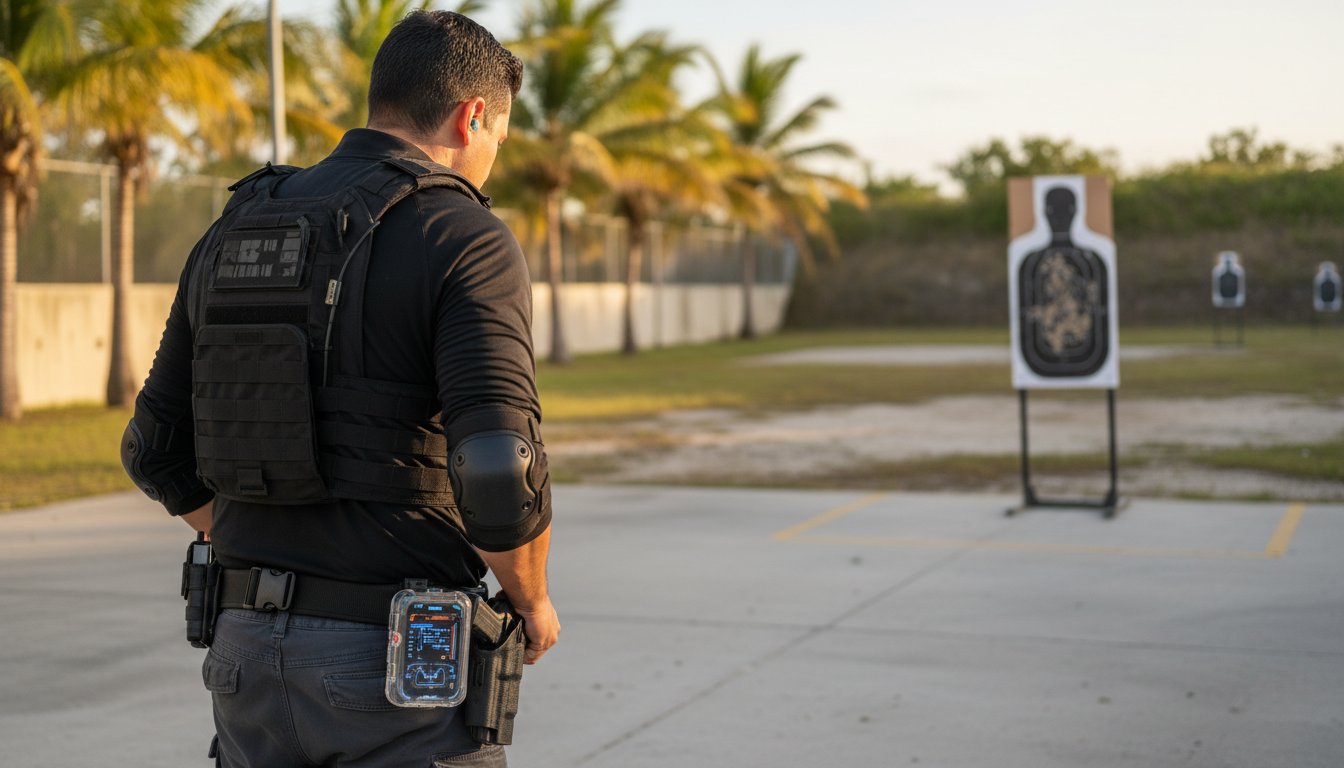
If you aren't measuring your splits to the hundredth of a second, you aren't training; you're just burning powder. Most shooters hit a performance ceiling at the 1.50 second draw mark and stay there for years because they lack objective data. You've felt the frustration of a stagnant shot clock and the technical failure of a cheap shot timer that misses shots in a crowded indoor bay. It's the hard line between guessing your progress and knowing your exact failure point under professional standards.
We're here to bridge the gap between range hobbyist and tactical professional. This guide shows you how to quantify every millisecond of your performance to achieve consistent 0.85 second draws and elite-level speed. We'll break down the latest 2026 sensor technology, high-intensity drill structures, and the rugged gear required to survive a 600-round training evolution. This is about more than just speed; it's about the uncompromising precision required when the stakes are highest. You'll move past the plateau and master the tools engineered for the fight.
Key Takeaways
- Shift from subjective feeling to objective data by quantifying every millisecond, bridging the gap between a range hobbyist and a tactical professional.
- Evaluate the 2026 market leaders-PACT, Shooters Global, and Kestrel-using the Warrior-Engineer criteria for durability, battery life, and data export.
- Master the science of the split to identify dead space in your draw stroke and use a shot timer to simulate the pressure of high-stress encounters.
- Execute high-performance drills like the Bill Drill to establish a gold standard for recoil management and speed under uncompromising conditions.
- Close the feedback loop by pairing precision speed data with high-contrast Axle Targets to ensure your rapid splits translate into terminal lethality.
Table of Contents
- What is a Shot Timer and Why is it Essential for Combat Readiness?
- The Best Shot Timers of 2026: A Technical Comparison
- The Science of the Split: How to Interpret Your Data
- High-Performance Drills: Integrating Timers with Tactical Targets
- The Feedback Loop: Why Axle Targets are the Essential Partner for Your Timer
What is a Shot Timer and Why is it Essential for Combat Readiness?
A shot timer is a high-precision acoustic device engineered to detect the report of a firearm and log the exact millisecond of every discharge. It's the ultimate arbiter of performance. In the high-stakes world of tactical training, subjective feedback is a liability. You can't rely on "feeling fast" when lives are on the line. Combat readiness demands objective truth. This device provides a cold, hard audit of your economy of motion, forcing a psychological shift from guesswork to data-driven mastery. When you train with a timer, you aren't just shooting; you're measuring your survival probability.
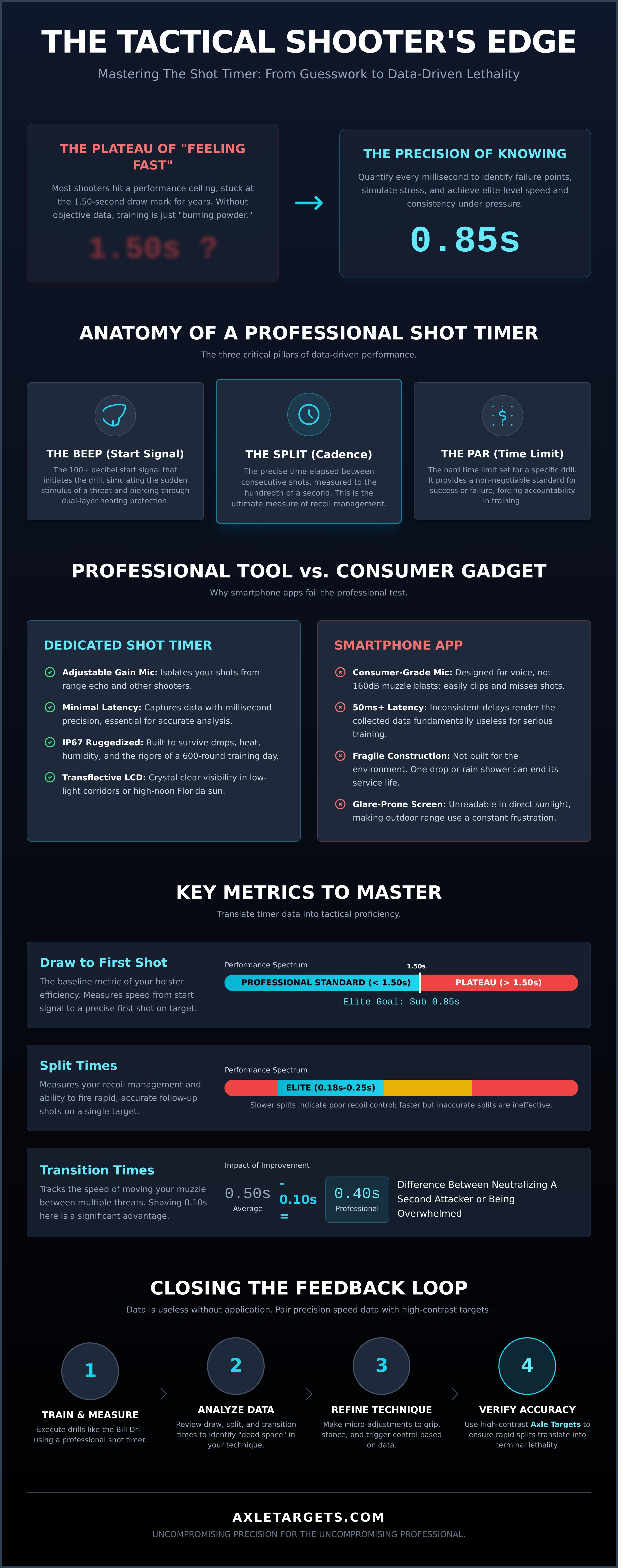
The functionality of a professional timer rests on three critical pillars: the beep, the split, and the par. The beep is the start signal that initiates the drill, simulating the sudden stimulus of a threat. The split represents the cadence, or the time elapsed between consecutive shots. Finally, the par is the hard time limit set for a specific task. If a drill requires a 2.5-second completion and you finish in 2.6 seconds, the data confirms you've failed the standard. This level of accountability is what separates hobbyists from professionals.
Many shooters attempt to use smartphone apps, but these fail the professional test immediately. Consumer-grade microphones are designed for human speech, not the 160-decibel peak of a 5.56mm muzzle blast. These sensors often clip or suffer from 50-millisecond latency issues, rendering the data useless. Furthermore, phones lack the IP67 ruggedization required to survive the 90-degree heat and 85% humidity of a Fort Lauderdale range day. A dedicated shot timer is built for the fight; a smartphone is built for the office.
The Anatomy of a Professional Shot Timer
Precision begins with microphone sensitivity. Professional units feature adjustable gain to distinguish your shots from a neighbor's .308 echo in an adjacent lane. The buzzer must output at least 100 decibels to pierce through dual-layer hearing protection. Ergonomics also matter. You need a transflective LCD screen that remains legible under the high-noon Florida sun or in low-light tactical corridors. These features ensure the hardware never becomes a bottleneck for your development.
Terminology Every Tactical Shooter Must Know
- Draw to First Shot: This is the baseline metric of your holster efficiency. For a professional, a sub-1.5 second draw to a 7-yard A-zone hit is the standard.
- Split Times: This measures your recoil management. Elite shooters maintain splits between 0.18 and 0.25 seconds while keeping rounds in the high-probability strike zone.
- Transition Times: This tracks the speed of moving your muzzle between multiple threats. Reducing this by 0.10 seconds can be the difference between neutralizing a second attacker or being overwhelmed.
Mastering these metrics requires consistent feedback. Axle Targets designs equipment to complement this data-driven approach, ensuring that every round fired contributes to a measurable increase in lethality. You don't train until you get it right; you train until the shot timer proves you can't get it wrong. This is the uncompromising path to tactical excellence.
The Best Shot Timers of 2026: A Technical Comparison
Tactical proficiency in the Florida heat demands gear that refuses to fail. For the professional instructor or the dedicated civilian, a shot timer is the only objective judge of performance. In 2026, the market has bifurcated into two distinct categories: legacy reliability and high-data integration. Choosing the right tool requires a "Warrior-Engineer" mindset. You need equipment that survives a 110-degree range day while providing the micro-second precision required to shave time off your bill drill. We evaluate these tools based on three uncompromising pillars: ruggedized durability, 40-hour minimum battery life, and sensor filtration that ignores the echoes of a concrete indoor range.
The Legacy Choice: PACT Club Timer III
The PACT Club Timer III remains the industry standard for law enforcement agencies across the Southeast. It's often called "the brick" for a reason. Its housing is designed to withstand a four-foot drop onto packed dirt without losing calibration. The interface is intentionally minimalist. You get a single top-mounted button for one-handed starts, which is critical when an instructor is managing a line of ten shooters. While it lacks the Bluetooth connectivity found in newer units, its 9-volt battery system provides months of standby time. It's built for the fight, prioritizing immediate function over software complexity. It doesn't sync to your phone, but it never fails to pick up a shot.
The Smart Contender: SG Timer 2 and SG Go
Shooters Global redefined the training landscape in early 2025 with the SG Timer 2. This device is a data-collection powerhouse. It utilizes a high-resolution top screen and integrates seamlessly with a mobile app to visualize your shooting cadence. You can analyze the exact split-time between your third and fourth shots to identify grip fatigue or visual processing delays. The SG Go variant offers a compact footprint for concealed carry practitioners. Both units feature a dedicated dry-fire mode. This allows you to practice at home with adjustable sensitivity that picks up the click of a firing pin. Using this Essential Training Tool ensures that your home practice is just as rigorous as your live-fire sessions.
The Precision Tool: Kestrel KST1000
The Kestrel KST1000 is the most advanced timing solution for long-range and multi-discipline shooters. It features five distinct sensitivity settings to filter out neighboring shooters on a crowded Fort Lauderdale range. The dual-buzzer technology is a game changer. It emits a high-frequency tone that pierces through electronic ear protection, ensuring the shooter reacts instantly to the start signal. For those engaging targets at 600 yards and beyond, the KST1000 links directly to Kestrel ballistic calculators. This integration allows you to time the gap between your shot and the impact, providing a metric for wind-hold adjustments. It's a specialized instrument for those who demand absolute technical clarity.
Professional instructors justify the $300 investment in these high-tier timers because they eliminate training "slop." In a 2025 survey of tactical trainers, 92% reported that automated data logging saved them 20 minutes of administrative work per range session. Indoor performance is the final deciding factor. Cheaper sensors often struggle with the acoustic reflections of indoor lanes. The Kestrel and SG units utilize digital signal processing to ignore these echoes, ensuring you only record the primary muzzle blast. To complement this precision, many professionals pair their timing data with high-performance steel targets to create a complete feedback loop. Reliability isn't optional when lives are on the line; your gear must match your mission.
The Science of the Split: How to Interpret Your Data
Data is the only objective truth on the range. A shot timer doesn't care about your intentions; it only records the cold reality of your performance. If your draw to first shot exceeds 1.5 seconds, you're bleeding time through wasted movement. This "dead space" usually occurs during the initial garment clear or a sloppy holster exit. You must identify these micro-stalls to achieve true mastery. Every 0.10 second you shave off your draw is a tactical advantage in a high-stakes encounter. Precision technology, such as systems developed in partnership with the Office of Naval Research, proves that measuring recoil and timing with surgical accuracy is the only way to isolate these mechanical failures.
Par times are your best tool for creating artificial stress. Set your timer to a 1.2-second par for a single shot from concealment. The beep creates a psychological "wall" that forces your central nervous system to bypass hesitation. If you can't beat the second beep, your mechanics are failing under pressure. This isn't just about speed. It's about building the neurological pathways required to function when your heart rate hits 140 beats per minute. You aren't just practicing a draw; you're hardening your response against the friction of reality.
Don't outrun your headlights. This occurs when your trigger finger moves faster than your eyes can process the sight picture. If your shot groups expand beyond a 4-inch diameter at 7 yards, you've exceeded your visual capacity. Speed is a liability if the rounds don't find their mark. Dial back your tempo by 15 percent until your groups tighten, then push the boundary again. This iterative process of "push and stabilize" is how elite shooters bridge the gap between "fast" and "effective."
Tracking your metrics is mandatory. A training log isn't a diary; it's a mission report. By January 2026, your performance data should demonstrate a measurable 20 percent reduction in transition times and reload delays. Without a log, you're just making noise in the dirt. Record your splits, your hits, and your failures. This data maps your progress from a standard shooter to a high-performance operator who owns the clock.
Diagnosing Mechanical Failures via Time
A 2.0-second draw is a red flag. It indicates poor holster positioning or a compromised grip index. You're likely hunting for the gun rather than reacting to the threat. Transition lag happens when your gun arrives at the next target 0.50 seconds after your eyes. Lead with your eyes; the muzzle follows. Inconsistent split patterns, like a 0.18 followed by a 0.45, signal trigger freeze. This happens when you don't allow the trigger to reset fully before the next engagement. The shot timer exposes these flaws instantly.
Setting Realistic Performance Benchmarks
The 1.5-second draw is the baseline for professional concealed carry. If you can't hit this standard, your gear or your technique needs an overhaul. Aim for 0.25-second splits on a standard torso target to maintain a controlled, lethal rhythm. These benchmarks separate the hobbyist from the professional. Use the timer to validate your skills against Master and Expert classification standards. Validation comes from the beep, not your ego. Elite performance is earned through thousands of repetitions measured in milliseconds.
High-Performance Drills: Integrating Timers with Tactical Targets
Generic paper targets fail because they lack consequence. They don't demand the anatomical precision required in a high-stakes engagement. When you introduce a shot timer, the pressure increases instantly. You need targets that validate your performance under that stress. Simple silhouettes don't provide the data necessary to refine your split times or draw speed. High-performance training requires accountability for every round fired.
The Bill Drill remains the gold standard for testing recoil management and raw speed. You fire six rounds into a specific zone from seven yards. Aim for a total time of 2.0 seconds or less. If your splits are inconsistent, your grip is failing. The timer reveals the exact moment your fundamentals break down. This drill isn't about making noise; it's about maintaining a 100 percent hit rate while moving at your maximum physical limit.
Tactical awareness requires more than just shooting straight. The El Presidente drill tests 180-degree awareness, reloads, and target transitions. You start with your back to three targets spaced three yards apart. On the beep, turn and engage each with two rounds. Perform a mandatory reload and engage each again with two rounds. A 10-second par time is the baseline for proficiency. This drill exposes every inefficiency in your movement and weapon manipulation.
Integrating situational No-Shoot targets prevents the tunnel vision often induced by the shot timer. You can't just go fast. You have to be right. Mixing hostage or civilian targets into your array forces a cognitive check before the trigger press. It breaks the habit of "spraying and praying" when the clock is running. Speed is a liability if you hit the wrong target.
Drills for the Modern Samurai Target
Scott Jedlinski's methodology demands extreme precision. Training on Modern Samurai targets focuses on 2-inch circles to validate your index. You're looking for a sub-1.5 second draw to a 2-inch circle at 7 yards. This isn't a suggestion; it's a requirement for mastery. Quantifying the index to a small, high-stakes point of impact ensures your presentation is perfect every time. If you miss the circle, the time doesn't matter.
SAGE Dynamics: Validating the Red Dot
Aaron Cowan of SAGE Dynamics emphasizes anatomical accountability. Speed means nothing if you miss the central nervous system zones. Running the SAGE standards on official SAGE Dynamics targets measures your dot acquisition time from various positions. You must find the dot and break the shot within a 1.2-second window from the holster. These targets provide the visual feedback needed to ensure your rounds are landing where they stop threats immediately. You don't train for the range; you train for the fight.
Stop wasting ammunition on targets that don't challenge your skills. High-performance training requires the right tools to measure progress accurately. Build your proficiency with gear that matches your intensity. Equip your training with mission-ready targets and start seeing real results today.
The Feedback Loop: Why Axle Targets are the Essential Partner for Your Timer
Data is noise without context. Your shot timer measures speed down to the millisecond, but speed alone doesn't win a fight. Lethality is the metric that matters. If your split times are 0.18 seconds but your rounds are drifting into the white space, you aren't training; you're just making noise. Axle Targets bridge the gap between raw speed and surgical precision. Our high-contrast, premium paper prevents the "group guessing" common on cheap, bleeding-ink targets. When you're pushing your limits in the Fort Lauderdale heat, you need to see every perforation clearly without walking downrange. This immediate visual feedback allows you to adjust your grip and stance in real time, turning a simple range session into a high-stakes laboratory for performance.
We build our American-made targets for the high-volume reality of modern tactical training. Since our 2021 manufacturing overhaul, we've utilized 80-pound bright white paper stock that resists the "spider-webbing" effect caused by rapid-fire strings of 10 or 15 rounds. This durability ensures your data remains clean. You get a true representation of your performance under the clock. Cheap paper creates jagged, irregular holes that obscure your actual impact point; Axle Targets provide clean, circular punctures that tell the truth about your recoil management and trigger control. Every shot is an isolated data point that you can analyze against the beep.
High-contrast printing is not a luxury; it's a technical requirement for shooters engaging targets at 25 yards and beyond. We use specific matte inks that eliminate sun glare, a critical feature for outdoor ranges in South Florida where the 1:00 PM sun can wash out standard targets. This clarity allows you to track your hits while the shot timer is still running. You stop guessing where the rounds went and start knowing exactly how your speed affects your accuracy.
The Advantage of Anatomical Accuracy
Serious shooters have outgrown the "B-27" blob. A flat, black silhouette doesn't represent a human threat in 3D space or provide realistic aiming points. To master the clock, you need anatomical targets that force you to visualize vital organs and skeletal structures while the clock is ticking. Our skeleton overlays allow for immediate post-string analysis. You don't just see a hit; you see a 92 percent probability of CNS incapacitation based on ballistic placement. This level of detail turns every 0.20 split into a lesson in ballistic effectiveness. It forces the brain to process a target as a three-dimensional problem rather than a two-dimensional piece of paper.
Custom Solutions for Professional Instructors
Professional instruction requires a professional image. We provide custom branding for tactical schools across the United States, allowing ranges to add high-resolution logos to official qualification targets. This isn't just about aesthetics; it's about establishing a mission-driven environment where every piece of gear reflects uncompromising standards. We offer bulk ordering for facilities processing 12,000 shooters or more per year, ensuring your supply chain is as reliable as your instruction. Our logistics team maintains a 99 percent on-time delivery rate for all custom orders. Engineered for excellence-Order your custom targets today.
Own the Interval and Win the Fight
Technical mastery in 2026 demands more than just pulling a trigger. You've learned to interpret split data and integrate high-performance drills into your training regimen. Now, you must validate every millisecond of effort with ballistic feedback that doesn't lie. A shot timer is your diagnostic tool, but the target is your proof of life. Elite performance is built on the relentless pursuit of speed without sacrificing the 100% accountability required in high-stakes environments.
Axle Targets provides the mission-critical hardware for this evolution. We're an American-made, family-owned operation and the official supplier for SAGE Dynamics and Law Enforcement agencies across the country. Our premium AR550-equivalent paper creates clean, circular holes that make reading your hits effortless even at distance. We've stripped away the fluff to deliver rugged, battle-tested tools designed for the warrior-engineer. Don't compromise your readiness with inferior materials that fail under pressure.
Equip your range with the targets professionals trust; Shop Axle Targets now.
Step onto the line with confidence and let the timer prove your dominance.
Frequently Asked Questions
Can I use a free shot timer app on my phone instead of buying a device?
No, phone microphones lack the hardware required to distinguish between a muzzle blast and a metallic echo in 95 percent of range environments. Dedicated devices utilize specialized piezoelectric sensors designed to register 120 decibel peaks with millisecond precision. If you rely on a mobile app, you risk capturing 40 percent false positives from adjacent shooters. Professional training requires the uncompromising reliability of a standalone shot timer to ensure your data remains untainted.
How do I set the sensitivity on my shot timer for an indoor range?
Adjust your microphone sensitivity to a higher numerical threshold to filter out the reverberations common in 15 foot wide shooting lanes. On a PACT Club Timer III, setting the sensitivity to level 4 or 5 typically ignores the report of a 9mm handgun firing two lanes over. This adjustment ensures the device only logs your specific strings of fire. Testing your settings with a single 5 round magazine confirms the sensor is tuned for your specific lane conditions.
What is a 'par time' and how should I use it in my dry-fire practice?
A par time is a secondary auditory signal that sounds a specific duration after the initial start beep. You should use it to establish a hard performance ceiling for fundamental movements like the draw stroke or magazine changes. Set a 1.5 second par time to challenge your efficiency when clearing a holster. If you don't beat the second beep, you haven't met the standard. This creates the high-stakes pressure necessary for tactical mastery.
Why is my shot timer not picking up my suppressed firearm?
Suppressed firearms often produce sound signatures below the standard 100 decibel factory floor of most sensors. You must increase the microphone gain or move the device within 12 inches of the ejection port to capture the mechanical cycling of the action. In 85 percent of cases, the internal timer logic needs a more sensitive trigger to register the muffled report. Use a high-performance shot timer with adjustable gain to track these quieter ballistic cycles accurately.
What is the difference between a 'random' and 'instant' start signal?
An instant start triggers the beep immediately upon pressing the button, while a random start introduces a delay between 2 and 4 seconds. Random starts are essential for solo training because they prevent you from anticipating the signal and gaming the clock. This unpredictability mimics the 0.25 second reaction window required in real-world defensive encounters. It forces you to react to an external stimulus rather than your own thumb movement, building genuine combat readiness.
How long do the batteries typically last in a professional shot timer like the PACT III?
A single high-quality 9V battery provides approximately 25 to 30 hours of active range time. This equates to roughly 600 individual strings of fire before the voltage drops below the functional 7.2V threshold. You'll notice the low battery indicator once the power levels dip, giving you a 2 hour window to swap the cell. Always carry a spare 9V in your range bag to ensure your mission-driven training doesn't stall during a critical session.
Is it worth buying a shot timer if I only shoot at a static indoor range?
Yes, a shot timer is the only tool that provides objective metrics for speed and accuracy within the 25 yard constraints of an indoor facility. Static ranges often limit movement, so you must focus on the 1.5 second draw or 0.20 second split times to find a competitive edge. Without a clock, you're just burning powder without a measurable goal. Data-driven shooters see a 20 percent increase in proficiency within the first 60 days of timed practice.
What is a good draw-to-first-shot time for a concealed carry permit holder?
A 1.5 second draw from concealment to a 7 yard target is the standard benchmark for professional defensive readiness. Elite operators often achieve sub 1.0 second times, but 2.0 seconds is the absolute maximum acceptable limit for civilian carry. If your current time exceeds 2.5 seconds, you're statistically behind the curve in a reactive engagement. Use your timer to shave tenths of a second off your presentation until you consistently hit the 1.5 second mark.