
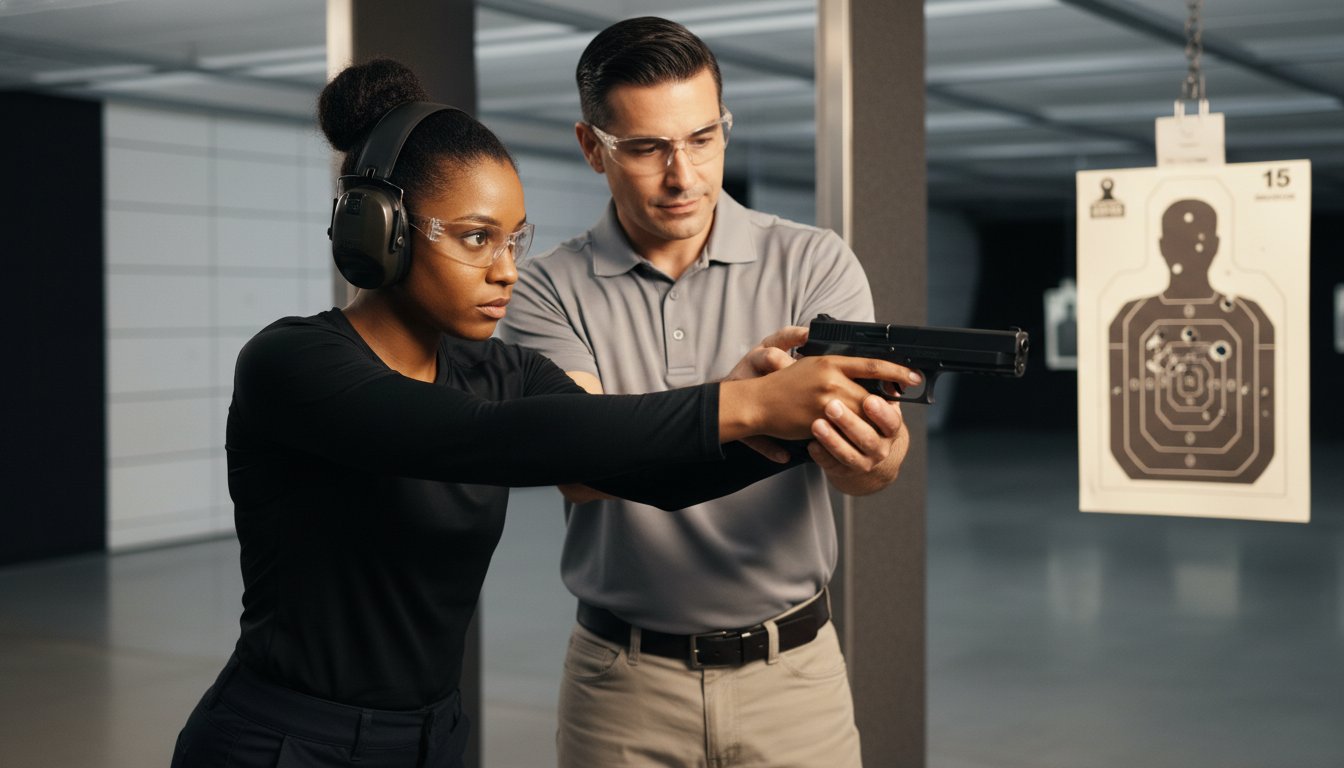
Confidence on the firing line isn't born; it's engineered through preparation and discipline. Industry reports indicate that 85% of new shooters experience high levels of anxiety regarding range etiquette and accidental discharges. It's natural to feel the weight of the moment when you don't know the lingo or the 4 universal firearm safety rules. You want to engage your targets without looking like an amateur or creating a safety hazard. Your first time at the shooting range should be a mission of mastery, not a lesson in embarrassment.
We've built this guide to provide the tactical clarity you need for a successful operation. You'll learn to decode range commands instantly and identify the 5 essential pieces of gear required for a high-performance session. By the time you finish reading, you'll possess the professional grit to step onto the line with absolute authority. We're covering everything from cold range protocols to the specific ballistic protection that keeps you in the fight. Prepare for your first mission; the line is waiting.
Key Takeaways
- Internalize the four cardinal rules to transform firearm safety from a suggestion into a non-negotiable tactical foundation.
- Deploy with a mission-ready loadout featuring ballistic-rated gear to ensure your first time at shooting range is focused on performance.
- Command the firing line by mastering range protocols and operating under the decisive authority of the Range Safety Officer.
- Select professional-grade targets like the B-27 silhouette to turn standard practice into a high-stakes qualification mission.
- Execute a disciplined after-action report using the 'Lock, Strip, Observe' method to guarantee absolute weapon security and lane integrity.
The Four Cardinal Rules: Your Foundation for Survival
Safety at a Fort Lauderdale firing line is not a suggestion. It is a non-negotiable tactical requirement. Your first time at shooting range facilities demands a mental shift from casual observer to disciplined operator. Professional environments operate on a zero-tolerance policy because the stakes are absolute. Mastery begins with internalizing the fundamental rules of firearm safety before you ever touch a magazine. This isn't about following local protocol; it's about adopting a warrior mindset that prioritizes life and equipment integrity.
Every firearm is loaded. Treat it that way 100% of the time. It doesn't matter if you just saw the chamber cleared or if the slide is locked back. Statistics from training incidents show that negligent discharges occur most frequently when a shooter "thought" the weapon was cold. You must personally verify the chamber is clear every single time you take possession of a firearm. This habit eliminates the margin for error and prevents 100% of accidents rooted in assumption.
Muzzle discipline is your primary fail-safe. Never point the weapon at anything you aren't prepared to destroy. In a high-performance range environment, your muzzle remains pointed downrange at the ballistic backstop. If you're clearing a malfunction or transitioning gear, that barrel stays oriented toward the impact zone. Parallel to this, keep your finger off the trigger. Your index finger stays high and flat against the frame, outside the trigger guard. It only moves to the trigger shoe when your sights are locked on the target and you've made the tactical decision to fire. These rules are binary. You're either in control, or you're a liability.
Understanding Your Target and What Lies Beyond
Bullets don't stop just because they hit paper. A standard 9mm projectile travels at roughly 1,150 feet per second and carries enough kinetic energy to penetrate multiple layers of drywall. You must understand the role of the backstop. Elite ranges use AR550 ballistic-rated steel or specialized rubber traps to safely dissipate this energy. Identify your no-shoot zones immediately. These include the floor, the ceiling, and the target retrieval tracks. Accuracy isn't just about hitting the bullseye; it's about ensuring every round is accounted for within the designated impact area.
The 'Cold Range' vs. 'Hot Range' Protocol
The status of the firing line dictates your every move. A 'Hot Range' signifies the line is active and shooters are cleared to engage targets. Conversely, a 'Cold Range' means all activity stops for target resets or maintenance. Your first time at shooting range training will involve hearing the 'Cease Fire' command. When this happens, stop immediately. Do not fire one last round. Do not clear your chamber. Place the firearm on the bench, muzzle downrange, and step behind the safety line. Handling any firearm while the range is cold is a primary safety violation that results in immediate removal. Absolute compliance ensures the safety of every person on the deck.
- Rule 1: Always treat the weapon as if it's loaded.
- Rule 2: Keep the muzzle pointed in a safe direction at all times.
- Rule 3: Keep your finger off the trigger until you are ready to shoot.
- Rule 4: Be certain of your target and what is behind it.
Professional shooting is a discipline of precision and hardware reliability. Axle Targets builds gear for those who understand that training is a high-stakes environment. By mastering these four cardinal rules, you move from being a novice to a serious student of the craft. Safety is the baseline for all high-performance results.
The Loadout: Essential Gear for Your First Session
Preparation is the difference between a productive session and a dangerous distraction. Your first time at shooting range requires a mindset focused on precision and safety. You don't just show up; you deploy with a loadout designed for high-performance training. Mission-ready gear eliminates variables. It allows you to master the fundamentals without fighting your equipment. Every piece of kit serves a tactical purpose in a live-fire environment.
Ballistic Eye and Ear Protection
Standard sunglasses fail under stress. You need ballistic-rated lenses meeting ANSI Z87.1+ standards. These lenses withstand high-velocity impacts that would shatter consumer-grade plastic. Spent brass exits the chamber at temperatures exceeding 1,100 degrees Fahrenheit. Wrap-around protection prevents these hot casings from reaching your eyes. It's about uncompromising safety in a high-stakes environment.
Indoor ranges amplify sound. Gunfire produces noise levels reaching 160 decibels. This causes immediate, permanent hearing damage. Electronic ear muffs provide a tactical advantage. They use internal circuitry to compress impulse noises above 85 decibels while amplifying range commands. For maximum suppression, use the double-plugging method. Insert foam plugs with a 32dB Noise Reduction Rating (NRR) under your electronic muffs. This setup ensures you hear the instructor while protecting your auditory health.
Clothing for the Range
Professional shooters avoid the "hot brass trap" by selecting functional apparel. Wear high-neck shirts and closed-toe shoes. A hot casing down a loose collar causes a reflexive movement that compromises muzzle discipline. This is a common failure point for those visiting for their first time at shooting range. Stay disciplined. Wear rugged, functional clothing that handles the grit of a professional training facility. Sturdy belts are also required to support the weight of a holster or magazine pouches.
Range Bag Essentials
Professional shooters carry more than just ammunition. Your range bag must include an Individual First Aid Kit (IFAK). A CAT Gen 7 tourniquet is a non-negotiable component. Training is about preparation for all outcomes; having medical gear on hand reflects a serious approach to the craft.
After your session, use specialized lead-removal wipes. These are 99% more effective than standard soap at removing heavy metal particles from your skin. Lead exposure is a cumulative risk that shooters must manage with engineering controls and personal hygiene. Finally, bring high-contrast paper targets to ensure your hits are visible at 25 yards. This instant feedback loop is essential for building accuracy. If you want to take your training to the next level, consider how advanced reactive targets can sharpen your reaction times through immediate auditory and visual cues.
- Ballistic Eyewear: Must meet ANSI Z87.1+ impact standards.
- Hearing Protection: Electronic muffs preferred for situational awareness.
- Medical: Carry a tourniquet and hemostatic gauze in your IFAK.
- Apparel: High collars and closed-toe shoes to prevent burns.
Range Protocol: Navigating the Firing Line
Precision on the range begins long before you pull the trigger. Discipline is the baseline for every elite shooter. When you arrive for your first time at shooting range in Fort Lauderdale, head directly to the check-in counter. You must present a valid government-issued photo ID. Most facilities require shooters to be at least 21 for handguns and 18 for long guns. Expect to spend 10 to 15 minutes completing a digital waiver and watching a mandatory safety briefing. This orientation covers the four universal firearm safety rules and specific house regulations. It isn't a formality; it is a tactical necessity.
Transporting your hardware requires strict adherence to protocol. Keep all firearms unloaded and secured in a case or range bag until you reach your assigned firing point. Do not uncase weapons in the lobby or at the retail counter. Walk directly to your lane with your gear. Only once you are inside the shooting booth, with the muzzle pointed directly downrange, should you remove the firearm from its case. This prevents accidental muzzle sweeps and ensures the safety of everyone on the line.
Lane etiquette is about situational awareness and professional courtesy. Most shooting booths provide a 3-foot wide tactical space. Stay within your designated area. Do not crowd the line or lean into adjacent lanes. If you are shooting a high-pressure caliber or a short-barreled rifle, warn your neighbors about the increased muzzle blast. Professionalism defines the environment. Respect the equipment, follow the 100% compliance rule for safety, and maintain a focused mindset throughout your session.
Interacting with the Range Safety Officer
The Range Safety Officer (RSO) is the commander of the firing line. They aren't there to critique your grip; they are there to ensure survival. Listen to every command immediately. If you experience a malfunction, such as a "stovepipe" or a "double feed," do not turn around with the weapon. Keep the muzzle pointed downrange. Raise your non-shooting hand to signal the RSO. They will assist in clearing the stoppage safely. Memorize the "Cease Fire" command. If you hear it, or see an RSO hold a closed fist high, stop shooting instantly. Place your weapon on the bench and step back behind the safety line.
Staging Your Equipment
Efficiency builds mastery. Organize your booth to maximize focus and minimize wasted movement. Place your ammunition, magazines, and tools on the bench in a logical order. Always keep the muzzle pointed toward the backstop, even when the firearm is unloaded. Never reach forward of the firing line for any reason. If you drop a magazine or a piece of gear past the bench, leave it. Reaching forward is a 90-degree safety violation that will result in immediate removal from the range. Wait for a cold range light or ask the RSO for assistance with a retrieval tool. Your first time at shooting range should prioritize these habits to build a foundation for high-performance training.

Selecting Your Mission: Why Target Choice Dictates Progress
Don't waste brass. If you are preparing for your first time at shooting range, you need a defined objective. Punching holes in a blank sheet is a hobby; training for a mission is a discipline. Axle Targets designs equipment for the elite who demand precision. Every round fired should serve a purpose, whether it's recoil management or rapid target acquisition. Without a specific target, you're just making noise.
The B-27 silhouette remains the gold standard for a reason. Law enforcement agencies, including the FBI, have utilized this 24 by 45 inch profile for decades to qualify officers. It provides a massive scoring area, but the center X-ring is where the fight is won. Training with a B-27 builds the muscle memory required to engage center-mass targets under stress. It transitions your focus from a tiny dot to a realistic human torso profile.
Defensive training requires shifting from bullseye shooting to anatomical targets. Bullseyes are for the Olympics; anatomical targets are for survival. These designs provide a 3D representation of human physiology, forcing you to recognize high-value zones like the thoracic cavity. You learn to aim for internal vitals rather than an arbitrary colored circle. This shift in perspective is critical for anyone visiting a first time at shooting range with self-defense in mind.
Axle Targets uses premium 100lb high-visibility paper stock. Standard range paper is thin and prone to tearing. It leaves jagged, "starburst" holes that obscure your actual point of impact. Our heavy-duty stock shears cleanly. This provides a crisp, circular hole that allows for immediate visual confirmation of your accuracy. When you are shooting at 15 yards, that clarity is the difference between correcting a mistake and repeating it.
Standard vs. Situational Targets
Utilize B-21 and B-29 targets to master the art of scale. A B-21 target is a 2/3 scale silhouette, while the B-29 is a 1/3 scale. Shooting a B-29 at 7 yards simulates the sight picture of a full-sized target at 21 yards. This allows you to train for long-distance engagements within the confines of a standard indoor range. It forces a tighter focus and punishes minor grip inconsistencies.
Situational targets introduce "no-shoot" icons, such as hostages or bystanders. This triggers a psychological shift. You are no longer just a shooter; you are a decision-maker. These targets force you to identify your backdrop and account for every projectile. High-grade paper offers superior feedback over cardboard backers, which often absorb grease and mask the precise entry point of a bullet. Paper tells the truth about your performance.
Reading Your Impacts for Immediate Feedback
Your target is a diagnostic tool. If your hits are consistently low and to the left, you are likely flinching. Your brain is anticipating the recoil and pushing the muzzle down before the shot breaks. If your shots are drifting low, you may be "milking" the grip, which means you are tightening your lower fingers as you pull the trigger. Recognizing these patterns instantly allows for mid-session corrections.
Visibility is mission-critical. Axle Targets employs high-contrast designs because aging eyes or low-light range conditions make standard black-on-tan targets difficult to track. We use bold, saturated inks that make your hits stand out from the firing line. You shouldn't need a spotting scope to see a 9mm hole at 10 yards. Heavyweight, professional-grade paper prevents fiber blow-out to ensure every round leaves a distinct, measurable signature for split-second accuracy tracking.
After Action Report: Closing Out the Session
The mission doesn't end when the last round hits the backstop. Professionalism at the range requires a disciplined exit. Your final actions dictate the safety of your transport and the quality of your training data. Precision shooters treat the post-session routine with the same intensity as the live-fire drill. It's about maintaining gear integrity and personal health.
Clear your weapon using the "Lock, Strip, Observe" method before anything else. First, lock the slide or bolt to the rear. Second, strip the magazine from the well. Third, physically and visually observe the chamber to ensure no brass remains. This triple-check protocol prevents 100% of negligent discharges during packing. Once the firearm is verified cold, leave the action open. This signals to the Range Safety Officer and everyone on the line that your weapon is inert.
Pack out your gear with the mindset of a professional. Leave the lane cleaner than you found it. Most Fort Lauderdale ranges expect you to sweep your spent brass forward of the firing line or into designated collection bins. Leaving a cluttered lane is a sign of an undisciplined shooter. Collect your ammunition boxes, tools, and personal protective equipment. Lead dust is a silent byproduct of every shot fired. Research shows that lead particles as small as 0.5 microns can cling to your skin and clothing for hours. Use specialized de-leading wipes or cold soap and water immediately. Never use warm water first; it opens your pores and allows lead toxins to enter your bloodstream.
Safe Casing and Transport
Protocol dictates that your firearm must be cased while you are still inside the shooting booth. Don't carry an uncased weapon through the facility. It's a major safety violation that can result in a permanent ban. Ensure all magazines are empty and stored in a separate compartment from the firearm. In Florida, 790.25 of the state statutes outlines specific carry requirements. Keeping ammunition and weapons in separate containers during transit adds a necessary layer of legal and physical security as you exit to the parking lot.
Analyzing Your Performance
Your first time at shooting range shouldn't end with your targets in the trash. Those paper sheets are raw data. Elite marksmen spend at least 12 minutes after a session analyzing their shot groups to identify mechanical failures. If your shots are consistently low and left, you're likely flinching or anticipating the recoil. Take high-resolution photos of your best 5-shot groups. This creates a digital logbook to track your growth over the next 6 months. Identify your primary weakness, whether it's grip tension or sight alignment, and make it the focus of your next mission. Ready for your next session? Gear up with Axle Targets’ professional line.
Maintaining this level of discipline ensures you transition from a novice to a proficient shooter. The range is a laboratory for skill development. Treat every minute on the premises as a tactical exercise. You've completed the first step; now prepare for the next engagement with better gear and sharper focus.
Dominate Your Progression
Your debut on the firing line is a mission to build a foundation of technical proficiency. You've internalized the 4 Cardinal Rules and selected a loadout designed for high-performance results. Every decision, from following range protocol to conducting a thorough After Action Report, separates the professional from the hobbyist. Walking into the facility for your first time at shooting range requires a mindset focused on uncompromising safety and tactical growth. Don't compromise your progress with inferior equipment. Axle Targets provides 100% American-made, family-owned gear engineered to meet Law Enforcement and Military Grade Standards. Our ballistic solutions are the trusted choice for elite firearms instructors across 50 states who demand absolute precision and gear that survives the grit of the range. You've got the professional roadmap to navigate your session with confidence. Now, secure the tools that match your ambition. You're ready to engage with the discipline of a professional.
Equip your training mission with Axle Targets' professional paper targets.
Stay sharp and make every round count.
Frequently Asked Questions
Do I need to own a gun to go to a shooting range for the first time?
No, you don't need to own a weapon to visit a facility. Most Fort Lauderdale ranges maintain rental fleets featuring 15 to 30 different firearm platforms. Renting provides access to high-performance gear without a heavy initial investment. This approach ensures you find a system that matches your grip and recoil management. It's the tactical choice for your first time at shooting range.
What should I wear to the shooting range to stay safe?
Wear high-neck shirts and closed-toe footwear to ensure maximum protection. Hot brass ejects at temperatures exceeding 500 degrees Fahrenheit; exposed skin is a serious liability in the bay. Sturdy boots provide the stable platform required for accurate engagement and balance. Avoid loose clothing that could snag on gear or trap spent casings against your body during a course of fire.
Can I bring my own targets and ammunition to the range?
You can bring personal gear, but range-specific regulations always apply. Approximately 85% of indoor facilities require you to use their ammunition in rental firearms to prevent mechanical malfunctions. Ensure your targets meet ballistic standards for the specific backstop. Axle Targets recommends AR550 steel for outdoor use, though most Fort Lauderdale indoor ranges limit you to paper or cardboard silhouettes.
What is the difference between an indoor and outdoor shooting range?
Indoor ranges provide climate-controlled environments with engagement distances typically capped at 25 yards. Outdoor facilities offer long-range opportunities up to 300 yards or more for rifle qualification. While indoor bays use automated retrieval systems, outdoor ranges often require manual target resets during scheduled cold range breaks. Choose your environment based on your specific training mission and the ballistic requirements of your caliber.
What happens if I accidentally drop my gun at the range?
Let the firearm hit the deck immediately. Never attempt to catch a falling weapon; this reflexive movement often leads to negligent discharges. Modern duty pistols feature internal drop safeties tested to withstand impacts from 6 feet or higher without firing. Once the weapon is stationary on the ground, notify the Range Safety Officer to oversee a safe recovery and inspection of the platform.
How much does a typical first-time range visit cost?
Budget between $55 and $110 for a complete training session. Lane rentals in Fort Lauderdale average $25 per hour for a single shooter. A 50-round box of 9mm ammunition currently costs roughly $20, while firearm rentals add another $15 to $20 to your total tab. Quality training requires a consistent investment in lead and lane time for your first time at shooting range.
Is it okay to go to the shooting range alone as a beginner?
You can go alone, but specific restrictions apply to equipment rentals. Approximately 75% of commercial ranges require pairs for firearm rentals unless you bring a personal weapon to the counter. This policy mitigates safety risks for the facility. If you're training solo, book a private instructor for 60 minutes to ensure you master the fundamentals and maintain strict range discipline from the start.