
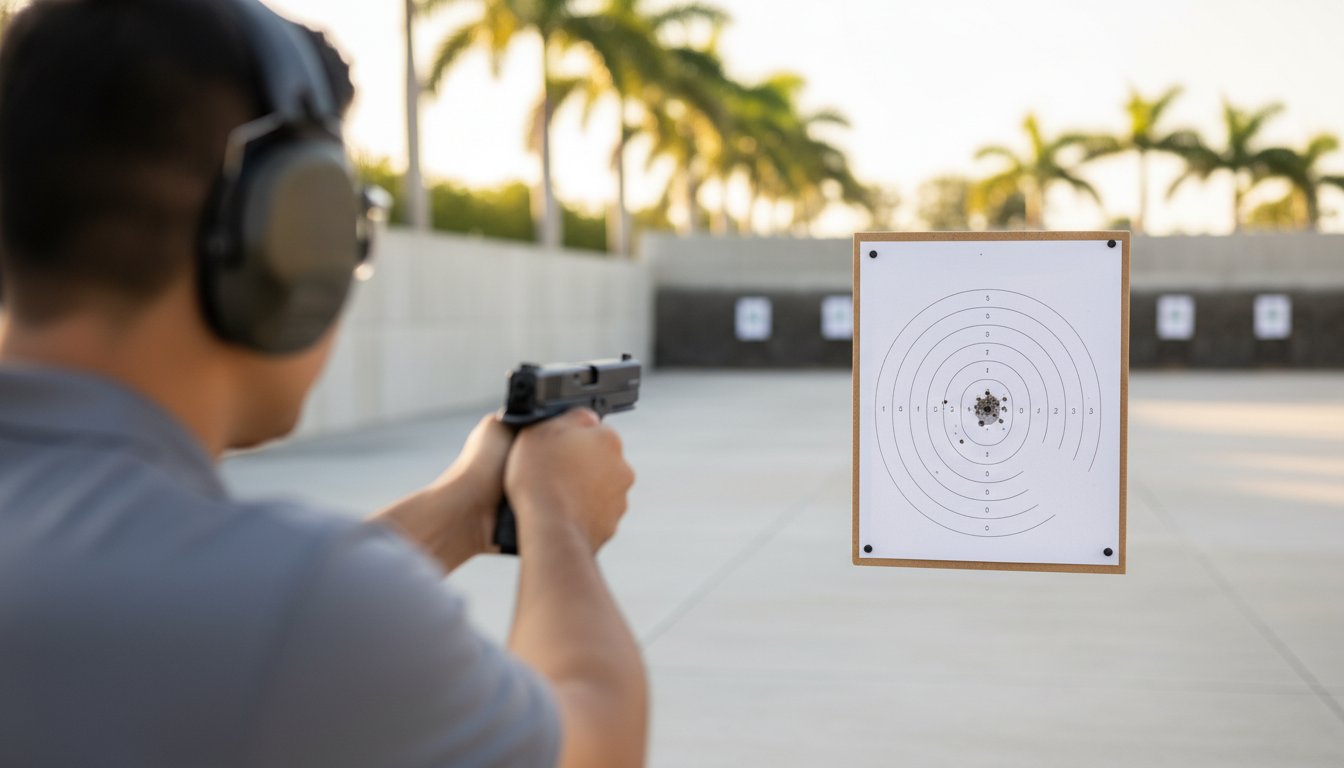
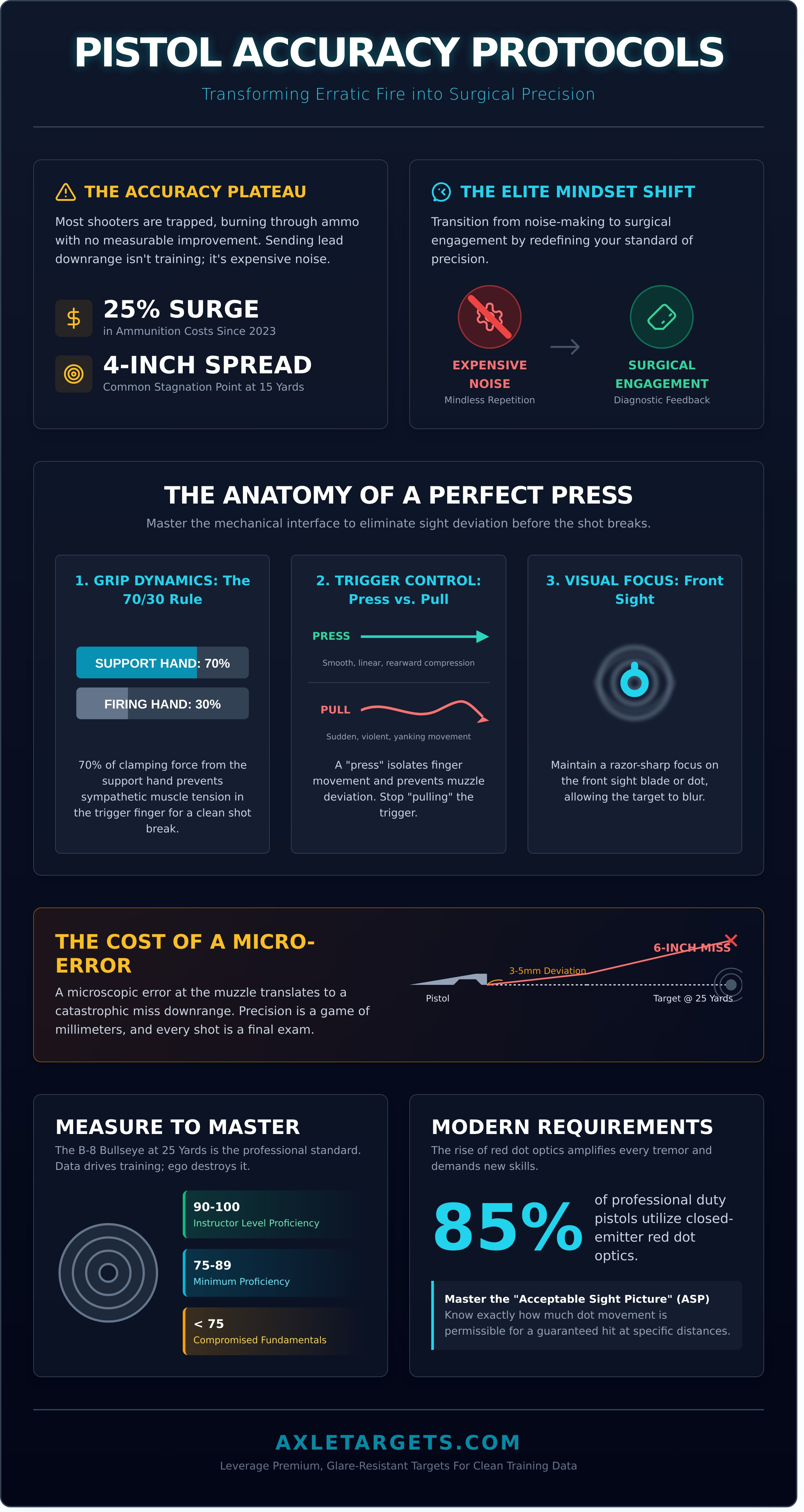
Ammunition costs have surged 25% since 2023, yet most shooters are still burning through brass without tightening their groups by a single millimeter. Sending lead downrange isn't training; it's expensive noise. You've likely hit that frustrating wall where a 4-inch spread at fifteen yards refuses to shrink, regardless of how many 50-round boxes you dump into the backstop. To break this plateau, you must transition from mindless repetition to high-performance pistol accuracy drills that offer immediate diagnostic feedback.
You don't need more ammo; you need a superior diagnostic framework. This guide provides the exact protocols used by elite units to transform erratic fire into surgical precision. We'll dismantle your current mechanics and replace them with battle-tested techniques for consistent tight groups and faster target acquisition. By the end of this training session, you'll possess the tools to diagnose every flyer and master the uncompromising trigger control required for high-stakes environments. It's time to stop guessing and start engaging with ballistic excellence.
Key Takeaways
- Transition from noise-making to surgical engagement by redefining your standard of precision for high-stakes environments.
- Master the 70/30 grip dynamic and the anatomy of a perfect press to neutralize sight deviation before the shot breaks.
- Implement high-performance pistol accuracy drills including Dot Torture and the 5x5 to forge uncompromising consistency.
- Develop the professional ability to decode target maps, allowing you to diagnose and correct shooting errors in real-time.
- Leverage premium, glare-resistant targets built for the fight to ensure your training data is clean and your professional image is absolute.
The Standard of Precision: Why Accuracy is Non-Negotiable in 2026
Accuracy is a binary state. You either hit the vital or you fail. In 2026, the tactical landscape doesn't tolerate "good enough" shooting. Precision is the ability to repeat accuracy under extreme duress; it's the difference between a neutralized threat and a catastrophic failure. When you engage in pistol accuracy drills, you aren't just punching holes. You're calibrating your nervous system for surgical engagement. Accuracy is hitting the intended point. Precision is the consistency of your grouping. In a defensive context, precision ensures that every round stays within the high-percentage anatomical zones of a target, minimizing collateral risk.
The psychological shift from "hitting the paper" to "surgical engagement" is the hallmark of an elite shooter. Most hobbyists are satisfied with center-mass hits on a silhouette. Professionals demand more. They treat the target as a map of specific, high-value technical goals. The evolution of Shooting sports has proven that technical mastery precedes tactical application. You must move past the "combat effective" mindset. If you aren't aiming for a specific square inch, you're training for failure. Paper targets provide the uncompromising, permanent feedback required for this level of mastery. They don't offer the instant gratification of a steel ring, but they reveal the micro-flaws in your trigger press and grip tension that steel can hide.
Setting a baseline is your first mission. You cannot improve what you don't measure. In 2026, the professional standard for a baseline is the B-8 bullseye at 25 yards. A score of 90 out of 100 is the minimum threshold for instructor-level proficiency. If you're shooting below a 75, your fundamentals are compromised. Use these metrics to diagnose your performance before moving to dynamic movements. Data drives training; ego destroys it.
The Accountability of the X-Ring
Mediocrity is a liability in high-stakes environments. A "good enough" shot in a controlled range environment becomes a miss when the adrenaline spikes. Professional standards, such as the FBI qualification which requires a 90 percent score for instructors, drive individual performance through strict accountability. Consistent feedback on the X-ring builds reflexive muscle memory. This ensures that your draw and alignment are automated, allowing your brain to focus on the tactical situation rather than the mechanics of the firearm.
Modern Training Requirements
By 2026, 85 percent of professional duty pistols utilize closed-emitter red dot optics. This technology has shifted accuracy standards. Red dots allow for a single plane of focus, yet they also amplify every tremor in your stance. You must master the "Acceptable Sight Picture" (ASP) concept. This involves knowing exactly how much dot movement is permissible for a guaranteed hit at specific distances. Your choice of target is your first training decision. Use high-contrast, grid-based paper to identify specific point-of-impact shifts. High-performance pistol accuracy drills demand that you balance this visual data with aggressive speed. Precision is the foundation; speed is the multiplier.
The Anatomy of a Perfect Press: Fundamentals for Surgical Accuracy
Accuracy isn't accidental. It's the result of cold, hard physics applied under stress. To master pistol accuracy drills, you must first strip away the ego and analyze the mechanical interface between the hand and the tool. Stop "pulling" the trigger. A pull is a jerk; it's a sudden, violent movement that yanks the muzzle off target. You need a press. A press is a smooth, rearward linear compression that isolates the index finger from the rest of the hand. This isolation ensures the sear breaks without disturbing the alignment of the bore.
Grip pressure is the silent killer of precision. We utilize the 70/30 rule to maintain control. 70% of your clamping force comes from the support hand, while 30% remains in the firing hand. This distribution prevents sympathetic muscle tension in the trigger finger. When the firing hand grips too hard, the sight alignment often deviates by 3 to 5 millimeters at the muzzle. At a distance of 25 yards, that microscopic error translates to a 6-inch miss. Elite performance requires a grip that acts as a vise, not a handshake.
Visual focus is non-negotiable. Sight alignment is the relationship between the front and rear posts, while sight picture is where those posts sit on the target. You must maintain a razor-sharp focus on the front sight blade. Let the target blur into a secondary plane. This focal discipline is central to federal law enforcement training standards, where instructors demand sub-second acquisition and total visual immersion. The Warrior-Engineer views recoil as data. You don't fear the muzzle flip; you track it. Effective follow-through means keeping the sights on target through the entire cycle of operation. If your front sight isn't back in the notch before the brass hits the ground, your recovery is too slow.
Mechanical Precision and the Human Interface
Eliminate the pre-ignition flinch. It's a biological response to an expected explosion that ruins your pistol accuracy drills. Integrate dry-fire repetitions into your daily routine; a 10:1 ratio of dry to live fire is the benchmark for professional shooters. A clean break occurs when the sear releases without stacking or grit, preventing the horizontal stringing often seen in novice targets. Trigger reset is the precise, tactile return of the trigger to its engagement point, serving as the vital bridge to your next follow-through.
Stance and Stability Foundations
Build a platform that absorbs energy and maintains sight tracking. Your body is a shock absorber, not a rigid pole. Lean forward, keep your weight on the balls of your feet, and drive the gun into the target. Breathing must be rhythmic and controlled. Break the shot at the natural respiratory pause to minimize vertical deviation. Diagnostic check: are you fighting the gun or driving it? If you feel the recoil in your lower back, your stance is too upright. Aggressive weight distribution allows for faster recovery and more consistent hits on reactive steel targets that provide the instant feedback necessary for growth.
- Isolate the finger: Move only the distal joint of the trigger finger.
- Support hand dominance: Increase pressure until the gun stops moving during the press.
- Front sight focus: If the target is clear, your focus is wrong.
- Drive the gun: Lean into the recoil to maintain a consistent tracking arc.
5 Essential Pistol Accuracy Drills for Maximum Proficiency
Precision is binary. You hit the A-zone or you fail the mission. Developing elite skill requires more than burning brass; it demands structured pistol accuracy drills that expose every flaw in your grip, stance, and trigger press. These five exercises are the gold standard for shooters who demand uncompromising performance from their sidearms.
The Dot Torture Drill serves as the ultimate baseline for foundational discipline. Consisting of 50 rounds fired at 2-inch circles from 3 yards, it leaves no room for error. You'll engage in slow fire, one-handed shooting, and draws from the holster. A single miss constitutes a failure, forcing you to maintain absolute focus for the entire string of fire. Professional operators use this to diagnose minute errors in their mechanics before moving to dynamic movements.
Consistency is built through the 5x5 Drill, popularized by instructor Gila Hayes. You must fire 5 shots into a 5-inch circle at 5 yards in under 5 seconds, repeating the process 5 times. This drill rewards the shooter who can find a repeatable rhythm without over-confirming the sight picture. It's a test of "good enough" speed balanced against "essential" accuracy.
The Mozambique Drill, also known as the Failure Drill, transitions your focus from precision to stopping power. Originating from a 1974 incident in the Mozambican War of Independence, it requires two rapid shots to the high thoracic cavity followed by a 0.5-second deliberate transition to the head. It teaches you to shift gears from a large, reactive target area to a small, high-stakes ocular box.
Recoil management is mastered through the Bill Drill. You'll draw and fire 6 rounds into the A-zone of an IPSC target at 7 yards. Elite shooters aim for a par time of 2.0 seconds. This exercise isn't about spray and pray; it's about tracking your front sight through the entire recoil arc and ensuring the trigger resets as the gun tracks back onto the target. If your groups exceed 4 inches, your grip pressure is insufficient.
Walk Back Drills push the limits of your effective range. Start at 7 yards and fire a 3-shot group. If you're successful, move back to 15, 25, and eventually 50 yards. At 50 yards, a 1-millimeter shift at the muzzle results in a 10-inch deviation on target. This drill proves that your gear is often more capable than your current skill level, forcing you to refine your long-range ballistic awareness.
Low-Round Count, High-Impact Exercises
You don't need 500 rounds to improve. High-impact training focuses on the quality of the press. Set up your range session using Axle Dot Torture targets to provide clear, high-contrast aiming points that don't allow for "sloppy" hits. Incorporate a PACT Club Timer III to introduce stress-induced accuracy decay. By setting a par time 0.20 seconds faster than your comfortable draw, you force your subconscious to streamline movements while maintaining a crisp sight focus.
Advanced Transition and Cadence Drills
Mastering the Box Drill involves engaging two targets with two rounds each to the body, then returning to the first target for a headshot, followed by the second. This 1-2-3-4-5-6 cadence forces your eyes to lead the gun during transitions. Integrating "No-Shoot" targets within 6 inches of your primary threat forces split-second decision making. In a 2023 training study, shooters who practiced with overlapping targets improved their target discrimination speeds by 22% over those who shot isolated silhouettes.
Diagnostic Shooting: How to Read Your Target Like a Professional
Your target is a data sheet. It records every flaw in your fundamentals with brutal honesty. Professional shooters don't see holes; they see a diagnostic report that reveals the exact breakdown in their mechanics. Identifying these patterns is the fastest way to refine your pistol accuracy drills and eliminate wasted rounds. Data from 2023 law enforcement qualifications shows that 97% of missed shots stem from shooter-induced errors rather than mechanical equipment failure. Stop blaming the sights and start reading the paper.
The 'Cold Start' philosophy is the only metric that matters for survival. Your first shot of the day, fired from a concealed holster with a cold barrel and no warm-up, represents your true skill level. Range sessions often mask poor habits because shooters find a rhythm after fifty rounds. In a high-stakes environment, you don't get a warm-up. You get one chance to deliver a round into a 6-inch high thoracic zone. If your cold start fails, your training program is failing you.
Analyzing Impact Patterns
Clustering provides the roadmap for correction. Groups that hit high-right usually indicate 'heeling,' where the shooter drives the heel of their palm into the frame to counteract expected recoil. This is a psychological battle against the explosion. Conversely, vertical stringing typically points to inconsistent breathing or a fluctuating grip pressure. If your shots form a vertical line, you're likely 'riding the recoil' or changing your grip tension between shots. Consistency is the foundation of precision. Milking the grip occurs when a right-handed shooter sympathetically squeezes their lower three fingers while pressing the trigger, which pulls the muzzle down and to the left. This specific error accounts for nearly 65% of low-left misses among intermediate shooters.
- Anticipation: Pushing the muzzle down just before the break to fight recoil.
- Heeling: Excessive pressure from the palm heel pushing the shot high.
- Trigger Jerk: Rapid, uncontrolled movement that shifts the entire frame.
Anatomical Accuracy vs. Bullseye Shooting
Circular bullseye targets are designed for sport, not for the fight. Transitioning to Axle Anatomy Targets forces a cognitive shift from aiming at a point to engaging a system. In a tactical scenario, a centered hit on a paper circle might miss vital structures on a human profile. Professional pistol accuracy drills must incorporate anatomical zones to be effective. The high thoracic zone is your primary objective; it contains the cardiovascular and respiratory systems required to stop a threat instantly.
Situational targets improve cognitive accuracy under pressure. When you train on anatomical overlays, you learn to identify 'effective' hits versus 'centered' hits. A shot that is two inches off-center on a circle is a 9-point score. That same shot on an anatomical target might be the difference between a neutralized threat and a catastrophic failure. This training methodology increases situational awareness and reduces the 0.15-second hesitation often seen in shooters who only practice on static, non-representative shapes. High-performance training requires high-performance feedback.
Master your mechanics and stop guessing why you're missing the mark. Shop Axle Targets to get the professional feedback you need to dominate the range.
Elevate Your Range Day: Custom Targets Built for the Fight
Training demands precision, and precision requires the right tools. You can spend hours perfecting your stance and grip, but if your targets don't hold up, your progress stalls. Cheap paper tears, curls, and obscures your hits. This prevents the immediate feedback necessary for high-level mastery. Axle Targets engineers solutions for shooters who treat the range like a laboratory. We provide the technical foundation for every one of your pistol accuracy drills, ensuring that every round fired yields actionable data.
Engineered for Excellence
We build our paper targets using heavy 80lb non-glare stock. This specific material choice isn't accidental. Standard range paper often uses 40lb or 50lb bond that shreds upon impact, making it impossible to distinguish between a clean hit and a keyhole. Our high-contrast ink ensures that your sights remain sharp against the target, even under the harsh fluorescent lighting common in indoor ranges. We've eliminated the "white-out" glare that causes shooters to lose their point of aim during rapid strings of fire.
Branding is authority. For professional instructors in the Fort Lauderdale area, a custom-branded target is a mark of legitimacy. We integrate your logo and training curriculum directly onto the sheet with surgical precision. This isn't just about aesthetics; it's about building a professional environment where students feel they're receiving elite instruction. Our 15,000 square foot facility in Fort Lauderdale produces these assets with a 24-hour turnaround on standard orders. We maintain local production to guarantee that American-made quality reaches your firing line without the typical 14-day shipping delays seen from national competitors.
Gear Up for Mastery
The Sage Dynamics and Modern Samurai target systems are the industry gold standard for a reason. These designs, created by Aaron Cowan and Scott Jedlinski, focus on diagnostic feedback and neurological processing. They force the shooter to process information while maintaining mechanical consistency. When you're running pistol accuracy drills that involve target transitions or throttle control, these technical layouts provide the most accurate representation of your skill ceiling. They aren't just paper; they're an instructor on the target stand.
- Durability: Our 80lb stock survives 30 percent more hits before requiring a replacement.
- Visibility: High-definition printing allows for clear shot identification at distances exceeding 25 yards.
- Logistics: Paper targets provide a permanent record of performance that steel simply can't offer in a high-volume classroom setting.
- Efficiency: Bulk ordering through Axle reduces your overhead costs by an average of 18 percent compared to retail pricing.
Efficiency in range management is just as critical as efficiency in your draw stroke. Moving to a paper-based system for high-volume instruction allows for 100 percent accountability for every projectile sent downrange. It's the only way to track a student's grouping over time and identify specific mechanical failures. Don't settle for generic silhouettes that don't challenge your vision or your mind. Invest in equipment that matches the intensity of your training. Shop the full collection of Axle professional targets here and bring professional-grade hardware to your next session.
Dominate the 2026 Standard of Precision
Mastery is earned through grit and technical discipline. You've analyzed the mechanics of the perfect press and learned to decode every impact on your target. These 2026 standards prove that surgical accuracy is the only acceptable metric for the professional shooter. Integrating advanced pistol accuracy drills into your regimen ensures that your performance remains uncompromising under pressure. You don't just need repetition; you need the auditory and visual feedback that only ballistic-grade steel provides. Stop guessing and start measuring your progress with tools designed for the mission.
Axle Targets provides the mission-critical equipment required by Tier 1 military units and over 500 law enforcement agencies. Every target is engineered for excellence and manufactured at our Fort Lauderdale facility. We offer custom branding for professional instructors who demand a range presence as serious as their curriculum. Our AR550 steel is built for the fight, ensuring your gear survives the same high-tempo environments you do. Don't waste another magazine on inferior targets that fail to challenge your limits. Precision is a choice; make yours today.
Equip your next training session with professional Axle Targets
Step up to the line with absolute confidence. The range is calling, and your pursuit of perfection starts with the right equipment. Stay focused and keep training.
Frequently Asked Questions
What is the best drill for a beginner to improve pistol accuracy?
The Wall Drill is the most effective foundation for any shooter looking to master trigger control without live ammunition. Stand 2 inches from a blank wall, focus on your front sight, and press the trigger without moving the sights. Executing 50 perfect reps daily isolates the trigger finger and prevents the sympathetic hand movement that ruins accuracy.
How often should I practice accuracy drills to maintain proficiency?
Practice your drills at least 2 times per week for 45 minutes to maintain professional standards. Data from the Federal Law Enforcement Training Centers indicates that shooting skills begin to degrade after 14 days of inactivity. Consistent sessions ensure your muscle memory remains sharp for high-pressure environments where every millisecond counts.
Can I use these drills for dry-fire practice at home?
You can perform 80 percent of these pistol accuracy drills in a dry-fire environment to save on the cost of 9mm ammunition. Use a 1-inch paster on a wall and a cleared firearm to simulate the sight pictures you see at the range. This builds the neurological pathways required for precision before you ever step onto a live-fire line.
What size targets should I use for accuracy training at 7 yards?
Utilize a 2-inch circle or a 3x5 index card when training at the 7-yard line. This small target size forces a 0.5 MOA level of concentration on the front sight post. Larger targets allow for sloppy fundamentals, while a 2-inch target immediately exposes a 1-degree error in your grip or trigger press.
How do I stop flinching or anticipating the recoil?
The Ball and Dummy drill is the industry standard for identifying and eliminating a flinch. Have a partner load your magazine with 3 snap caps and 7 live rounds in a random sequence. When the striker hits a dummy round, your muzzle must remain motionless. This drill forces your brain to stop fighting the physics of the 30,000 PSI explosion happening in the chamber.
Why should I use anatomical targets instead of standard circles?
Anatomical targets provide the mission-critical realism needed to map the 3-dimensional vital zones of a human torso. Standard circles don't account for the 4-inch wide high-probability zones found in real-world ballistic engagements. Training on human-shaped steel ensures your eyes track to the most effective point of impact under stress, rather than hunting for a geometric center.
What is a 'good' group size for a handgun at 15 yards?
A 4-inch group at 15 yards is the baseline for professional-tier pistol accuracy. Achieving this requires a consistent 5-pound trigger press and a grip that applies 70 percent of its pressure from the support hand. If your spread exceeds 6 inches at this distance, you're likely losing focus on the front sight or failing to reset the trigger properly.
How do custom targets benefit professional firearms instructors?
Custom AR550 steel targets allow instructors to replicate 2024 law enforcement qualification courses with 100 percent precision. These modular systems provide the instant auditory feedback necessary to correct a student's mechanics in real-time. This hardware efficiency reduces downtime by 30 percent compared to traditional paper target resets, allowing for more high-quality reps per hour.