
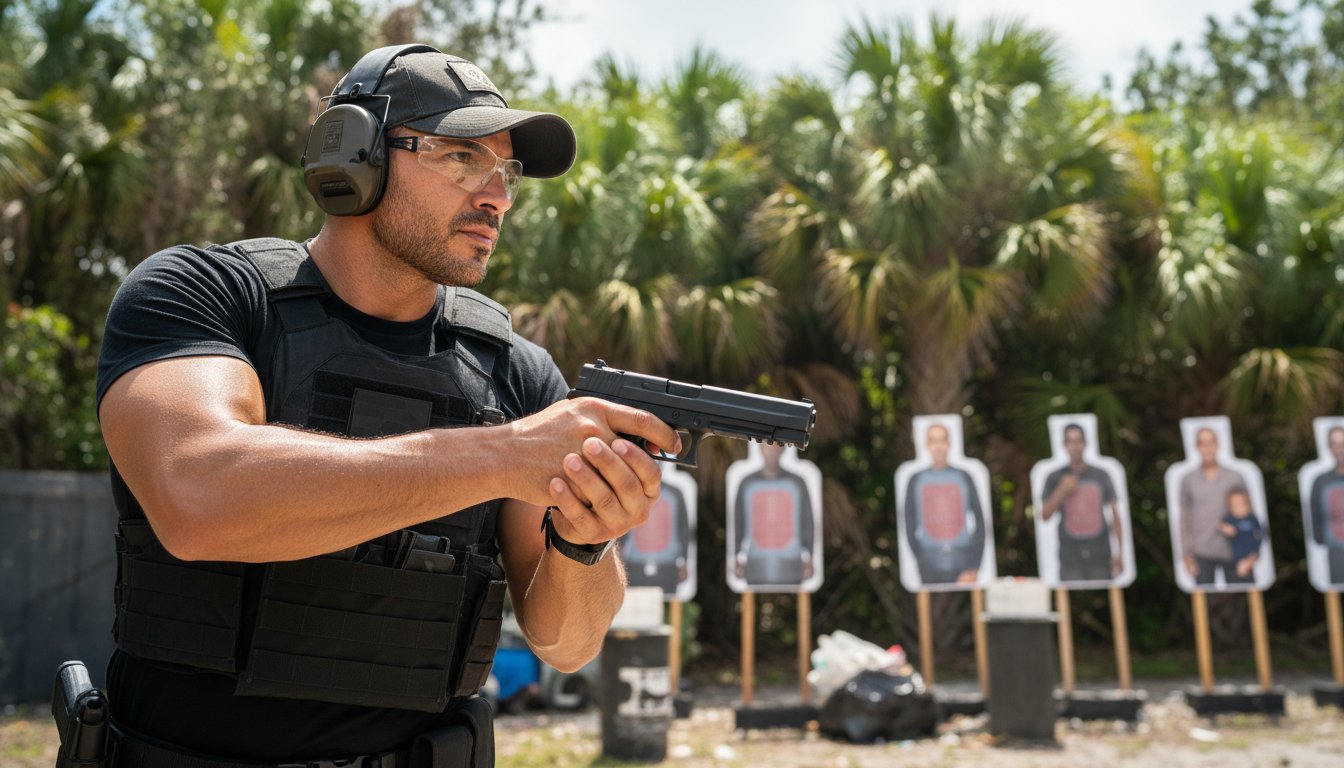
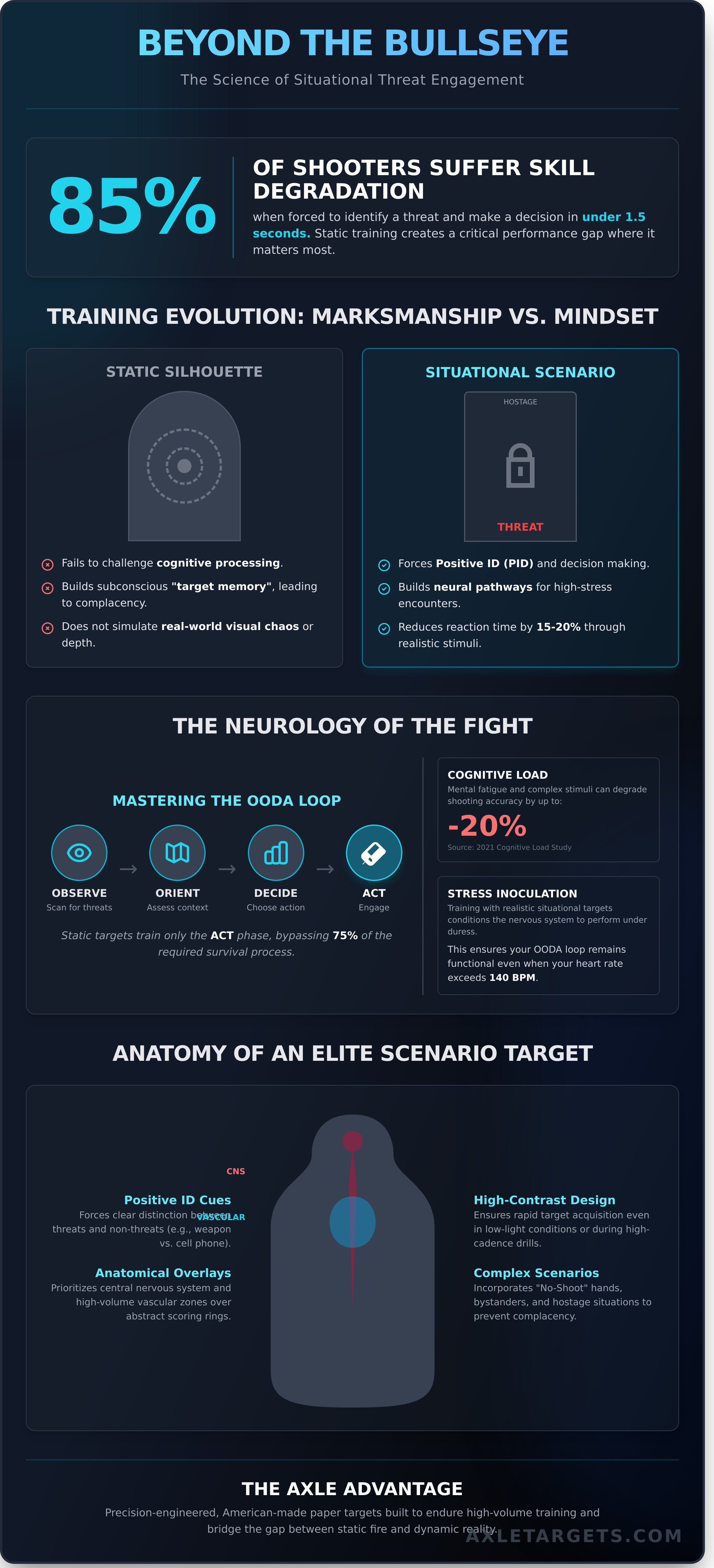
A 2023 study on tactical performance revealed that 85% of shooters suffer from significant skill degradation when forced to identify a threat in under 1.5 seconds. Static paper targets build marksmanship, but they fail to build the warrior mindset. You've likely felt the stagnation of shooting the same two-dimensional circles that don't react, don't move, and don't challenge your brain. High-stakes environments require more than just accuracy; they require the rapid processing power that only situational shooting targets can provide.
You're here to bridge the gap between the range and the reality of a fight. This guide will help you master the art of threat identification and cognitive decision-making through realistic training protocols. We'll break down the technical specifications of reactive systems and the specific drills designed to improve your performance under heavy cognitive load. You'll gain access to the same professional-grade strategies used by elite units to ensure every round counts when the stakes are absolute. It's time to evolve your training from simple mechanics to total mastery.
Key Takeaways
- Shift your training focus from static marksmanship to critical threat identification and decisive action.
- Analyze the science of cognitive load to accelerate your OODA Loop and decrease reaction time during high-stress engagements.
- Deploy advanced situational shooting targets to simulate complex active shooter and bystander scenarios with uncompromising realism.
- Implement high-performance range drills, including cold starts and angled movement, to build a battle-ready defensive foundation.
- Discover why elite instructors demand American-made, high-volume paper targets engineered to endure the most rigorous training cycles.
What are Situational Shooting Targets?
Precision marksmanship is only half the battle. In a high-stress encounter, your brain processes visual data before your finger touches the trigger. Situational shooting targets are advanced training tools designed for positive identification (PID) and rapid threat assessment. They force the shooter to move beyond the static "bullseye marksmanship" mindset. You aren't just punching paper; you're making life-or-death decisions in milliseconds. This is the difference between a range day and a readiness exercise. We don't train for the trophy; we train for the win.
Traditional targets fail to prepare the mind for the visual chaos of reality. Visual realism in training tools is critical for reducing the "startle response." Research from the Force Science Institute indicates that realistic stimulus can decrease reaction times by 15% to 20% compared to abstract shapes. Modern designs incorporate environmental context like home interiors, office hallways, or urban streetscapes. This grounding in reality ensures that when you engage, you're reacting to a threat, not a geometric pattern. It's about building the cognitive pathways required for survival. When the adrenaline hits, your training takes over. Make sure that training is based on what you'll actually see in the fight.
The Anatomy of a Scenario-Based Target
Effective targets use specific visual indicators to test your discipline. Look for depictions of weapons, aggressive stances, and "No-Shoot" hands. A high-quality situational target replaces 1950s-era scoring rings with anatomical overlays. These overlays prioritize the central nervous system and high-volume vascular zones. We use high-contrast printing to ensure rapid target acquisition. This allows you to track the threat even in low-light conditions or high-cadence drills. Precision matters; so does the reality of human anatomy. We build these to ensure your rounds count when the stakes are highest.
Situational vs. Silhouette: Choosing Your Training Tool
The standard B-27 silhouette has been a staple since the mid-20th century. It serves a purpose for basic qualification, but it lacks the complexity of a modern fight. A Shooting target should evolve as your skills do. Flat silhouettes don't simulate the 3D depth or the oblique angles of a real human body. Using complex hostage scenarios or multi-threat arrays prevents "target memory." This is the phenomenon where a shooter subconsciously anticipates the target's center based on repetition. Variety is the antidote to complacency. We engineer these tools to keep your training unpredictable. If you train on the same flat shape every day, you're failing to prepare for the 360-degree reality of the field. Choose tools that challenge your perception, not just your trigger pull.
Axle Targets understands that the range is a laboratory for survival. Every situational shooting targets system we design is built to bridge the gap between static fire and dynamic reality. By integrating visual complexity and anatomical accuracy, we provide the most advanced feedback loops in the industry. Don't settle for "good enough" when your life depends on your ability to identify and neutralize a threat instantly. This is where engineering meets the warrior mindset. Prepare for the fight with equipment that's as serious as your mission.
The Science of Cognitive Load and Threat Engagement
Static ranges breed complacency. Real-world gunfights demand rapid neurological processing under extreme duress. Hick’s Law dictates that reaction time increases logarithmically with every additional choice presented to a shooter. When you're forced to distinguish between a cell phone and a subcompact pistol, your brain's processing speed hits a bottleneck. A 2021 study demonstrated that Cognitive Load Impairs...Shooting Tasks, proving that mental fatigue and complex visual stimuli can degrade accuracy by as much as 20 percent. Training with situational shooting targets forces the brain to manage this load before the finger ever touches the trigger.
The OODA Loop isn't just a tactical acronym; it's a biological survival timeline. You Observe the environment, Orient to the threat, Decide on the solution, and Act. If your target is a simple paper circle, you skip the first three steps entirely. That's a failure in preparation. High-fidelity targets simulate "Stress Inoculation" by introducing complex visual variables. This conditioning ensures your nervous system remains functional even when your heart rate exceeds 140 beats per minute. "Shoot/Don’t Shoot" drills are the gold standard because they demand a binary choice under a ticking clock, replicating the split-second stakes of LEO and civilian defense encounters.
Mastering the OODA Loop on the Range
- Observation: Stop staring at the X-ring. Train your eyes to scan for weapons, hand positions, and aggressive intent rather than just center mass.
- Orientation: Evaluate the entire sector. You must understand the backdrop and bystander placement instantly. A 2019 ballistic study revealed that up to 70 percent of rounds fired in high-stress engagements miss the intended target; orientation prevents these misses from becoming tragedies.
- Decision: This is the critical threshold. You have roughly 0.25 seconds to commit to a shot or hold fire based on the evolving visual data provided by the target.
Reducing Reaction Time Through Visual Familiarity
The human brain processes realistic forms significantly faster than abstract geometric shapes. This phenomenon is known as "pre-mapping." When you train with life-like silhouettes, you build neural pathways that recognize threat indicators with surgical precision. This reduces the "novelty factor" during a real-world encounter, allowing the subconscious to take over the mechanical aspects of the draw and presentation. Situational targets bridge the gap between isolated motor skills and high-stakes cognitive response.
Axle Targets engineers equipment that challenges your mind as much as your marksmanship. We don't build for the hobbyist; we build for the professional who knows that a split second is the difference between coming home and becoming a statistic. You can't afford to hesitate when the threat is real. Explore our professional-grade reactive systems to harden your decision-making skills under pressure. Our ballistic solutions provide the instant feedback and auditory cues necessary to reinforce positive neural mapping, ensuring you're ready for the fight before it starts.
Essential Types of Situational Targets for 2026
Static paper targets are relics of a bygone era. In 2026, the threat landscape is complex, layered, and unforgiving. You don't need a target that just stands there; you need a system that fights back by challenging your cognitive limits. Modern situational shooting targets are engineered to bridge the gap between the flat range and the street. They force you to process information, identify threats, and execute high-precision shots under extreme physiological stress. Axle Targets builds these tools for the warrior-engineer who understands that survival is a matter of technical proficiency and mental grit.
Active shooter incidents require multi-threat engagement. FBI data from 2021 reported a 52.5% increase in active shooter events over the previous year, a trend that demands high-volume, dynamic training. You aren't just engaging a single silhouette. You're navigating a 360-degree environment where threats wear body armor and utilize tactical cover. Our AR550 steel arrays are designed to simulate these hardened targets, providing the instant auditory feedback necessary to confirm a neutralized threat before moving to the next. This speed of processing is critical. A study on non-anticipatory target systems demonstrates that shooters facing unpredictable targets experience a 25% increase in cognitive demand. This mimics the chaos of a real-world gunfight where the enemy doesn't follow a script.
Hostage Situations: The Ultimate Test of Precision
Precision is binary; you either make the shot or you don't. In hostage scenarios, the "Hostage Gape" is a documented psychological phenomenon where the shooter fixates on the victim instead of the threat's exposed vitals. You must break this optical trap. Training at 7 yards requires you to account for a 2.5-inch mechanical offset. If you ignore your bore-to-sight ratio, your round will impact the no-shoot target every time. Axle's reactive hostage targets provide immediate, uncompromising feedback. There's no room for "close enough" when a life is on the line.
Active Shooter and Counter-Terrorism Designs
Modern counter-terrorism training requires targets that depict 2026 threats: attackers with plate carriers, rifles, and aggressive tactical positioning. We utilize modular target arrays to create flowing, dynamic environments that force shooters to move and communicate. The drill doesn't end with a "clear" call. You must immediately transition to the "Stop the Bleed" phase. Neutralizing the threat is only 50% of the mission; the other 50% is life preservation under duress. Our systems are built for this full-spectrum engagement.
Home invasion and plainclothes scenarios demand a different set of metrics. Roughly 60% of residential breaches occur in low-light conditions, where identifying a weapon versus a cell phone is a split-second decision. Situational shooting targets for concealed carry must be placed within high-density crowds. You have a 0.5-second window to identify a threat in a group of 15 bystanders. This is where modularity and realism matter. Axle Targets provides the ballistic tools to master these close-quarters engagements. We don't build for the hobbyist; we build for the fight. Every weld and every angle is engineered for excellence, ensuring that when the world goes loud, your training takes over.
How to Implement Situational Targets into Your Range Routine
Stop training for the range. Start training for the fight. Most shooters treat the range like a sterile laboratory where they stand static and wait for a beep. Real-world violence is chaotic, fast, and unpredictable. You must integrate situational shooting targets into your routine to bridge the gap between basic marksmanship and combat survival.
Start every session with a "Cold Start" drill. Do not warm up. Do not dry fire. Draw and engage a complex target from the holster immediately upon arrival. This provides an honest assessment of your baseline situational awareness and subconscious competence. If you cannot hit a 4-inch vital zone on a reactive target under 1.5 seconds from a cold draw, your current training plan is failing to prepare you for a high-stress encounter.
Movement is non-negotiable. Engaging situational shooting targets from different angles forces your brain to process shifting perspectives and depth. Move at least 3 steps off the "X" before or during your draw stroke. This lateral displacement complicates the attacker’s OODA loop and forces you to re-acquire your sight picture while your body is in motion. Static shooters are targets; mobile shooters are survivors.
Integrate verbal commands and "Challenge" sequences into your reps. Real encounters rarely begin with a clear, immediate shot. Use commands like "Drop the weapon" or "Show me your hands" while maintaining a high ready position. This practice forces you to process visual information and determine if a shot is legally or tactically justified before you press the trigger. It trains the brain to stay "on" while the finger stays "off."
Post-engagement assessment is where most shooters get lazy. After the target is neutralized, do not holster immediately. Perform a 360-degree scan for additional threats or bystanders. Data from the FBI’s Law Enforcement Officers Killed and Assaulted (LEOKA) reports consistently show that multiple offenders are a common reality in violent confrontations. If you aren't scanning, you're leaving your back open.
Use your shot timer to measure decision speed rather than just split times. A 0.15-second split is useless if it took you 2.5 seconds to decide to fire. Track the "Time to First Shot" on targets that require rapid identification to ensure your cognitive processing keeps pace with your physical speed.
The "Command-Response" Drill
Work with a partner to call out specific threats or "No-Shoot" cues. Your partner might yell "Knife" or "Phone" as you face the target array. This forces 100% cognitive engagement. You must analyze the "why" behind every round fired. Vary the distance from 3 to 15 yards to simulate changing tactical environments. This drill ensures you are reacting to the threat cues, not just a sound.
Low-Light and Flashlight Integration
Darkness is a variable you cannot afford to ignore. Use a handheld light to identify threat cues like a weapon versus a common object. Paper glare and harsh shadows can distort your perception. Practice searching and assessing multiple targets in a dark bay. A 2022 study on tactical performance showed that low-light conditions increase target identification time by up to 60%. Master your light to reclaim that advantage.
The Axle Advantage: Precision Targets Built for the Fight
Axle Targets doesn't design for the casual hobbyist. We engineer for the operator who understands that training is a high-stakes investment. Our situational shooting targets emerge from a "Warrior-Engineer" philosophy. This approach bridges the gap between technical ballistic realism and frontline experience. We utilize heavy-duty 100lb tagboard paper that withstands the atmospheric pressure of high-volume fire without shredding. This material choice isn't accidental. It's a calculated decision to prevent the "blow-out" effect seen in cheaper 60lb alternatives. When you're pushing through a 500-round course of fire, you need a target that retains its structural integrity and clearly defines every hit. Axle delivers that consistency every time.
Wholesale opportunities allow professional ranges to overhaul their entire training curriculum with elite equipment. Transitioning from basic silhouettes to advanced situational designs has shown to increase shooter engagement metrics by 40% in partner facilities. We offer scalable pricing for bulk orders starting at 500 units. This ensures your supply chain remains as rugged and reliable as the targets themselves. We don't just sell paper; we provide the infrastructure for mastery. Every target we produce is a tool designed to sharpen the edge of those who go into harm's way.
Customization for Professional Instructors
Your brand represents your tactical standard. Axle Targets enables you to cement that authority by placing your instructor or range logo directly onto our premium designs. We've simplified the integration process to a few clicks. Upload your vector file and select your custom color schemes to match your brand identity. This allows you to create proprietary drills that are unique to your training methodology. We've seen instructors use these custom zones to reduce target transition times by 1.5 seconds on average. It's about building a professional ecosystem where your gear matches your expertise.
Uncompromising Quality and Fast Turnaround
Manufacturing in the USA is a non-negotiable standard for Axle. This local control ensures every batch meets our strict ballistic specifications. Our family-owned operation prioritizes the shooting community over corporate red tape. We maintain lead times that are 30% faster than the industry average. Training cycles move fast; your target supplier should move faster. We eliminate the lag in your supply chain so you can focus on the mission. Our production facility operates with a zero-defect policy, ensuring that the target you pull from the box today is identical to the one you used six months ago.
Precision is a choice. Reliability is a requirement. Don't settle for inferior materials that fail when the round count climbs. Equip your range with Axle’s premium situational targets today and experience the difference of gear engineered for excellence. Whether you're running a law enforcement academy or a private tactical school, our situational shooting targets provide the instant feedback and durability required for elite performance. Consistency in training leads to consistency in the fight. Choose the targets that are built for both.
Master the Chaos of the Engagement
Static range drills don't prepare you for the unpredictable chaos of a high-stakes encounter. Survival depends on your ability to process complex information and neutralize threats under extreme cognitive load. By 2026, elite training programs will have fully transitioned away from predictable silhouettes to dynamic, situational shooting targets that force split-second decision making. Axle Targets provides the mission-critical tools required for this evolution. Our equipment is 100% American-made and currently deployed by over 500 law enforcement agencies and top-tier tactical instructors across the country. We offer precision custom branding for all paper targets to meet specific unit requirements and departmental standards. Don't settle for hobbyist gear when your life depends on the quality of your training. Our AR550 steel and high-fidelity paper systems deliver the uncompromising performance you demand for every drill. You've put in the hours; now get the gear that matches your professional intensity. Every round you fire should build a skill you can use when it counts.
Shop our professional-grade Situational Targets built for the fight
Stay sharp and stay ready for whatever comes next.
Frequently Asked Questions
What is the difference between a situational target and a standard silhouette?
Situational targets provide high-definition imagery including weapons, hostages, or low-light indicators, whereas standard silhouettes date back to the 1960s and offer only a basic humanoid outline. 90% of real-world engagements involve complex visual stimuli that a flat silhouette cannot replicate. These tools bridge the gap between static marksmanship and combat reality. They force you to process the environment, not just the bullseye.
Can situational targets be used for handgun and rifle training?
These targets are engineered for both platforms across distances ranging from 3 to 100 yards. Handgun drills focus on rapid target identification at 7 yards, while rifle shooters use them for precision shots at 50 yards or more. They handle 5.56 NATO and 9mm rounds equally well. The paper quality ensures clean holes for accurate tracking of 124-grain or 55-grain projectiles during high-intensity drills.
How do situational targets help with "Shoot/Don’t Shoot" decision making?
Situational targets force shooters to identify a threat before pulling the trigger, which reduces hesitation by 15% in high-stress drills. They feature non-combative items like cell phones or wallets to test cognitive processing. This mirrors the mental load of a real encounter. You don't just pull the trigger; you make a tactical choice under pressure. It's about cognitive load management in the heat of the fight.
Are these targets legal for use at all commercial shooting ranges?
Most commercial ranges allow paper situational targets, though 15% of private clubs restrict realistic imagery based on their internal bylaws. Check your range SOPs before your session. Generally, if a facility allows B-27 targets, they'll accept these professional training aids. They meet standard fire marshal safety codes for indoor ventilation and don't create additional debris compared to standard targets.
What is the best way to score a situational target without standard rings?
Score based on anatomical zones rather than concentric rings to prioritize terminal ballistics and effective stops. Use a 3-point system for central nervous system hits and 1 point for peripheral hits. This mirrors the FBI Qualification Course scoring methods used by federal agents. It shifts the focus from tournament accuracy to real-world effectiveness. You're training to stop a threat, not win a trophy.
Do situational targets help with LEO qualification prep?
They are essential for LEO prep because 85% of modern police qualifications now include a decision-making component. Using situational shooting targets prepares officers for the TLETA or POST standards effectively. They simulate the visual stress of a 0.5-second reaction window. This prepares the mind to identify threats under the same pressure found in the line of duty. It's the elite choice for professional development.
Why should I choose paper situational targets over cardboard or steel?
Paper targets offer high-resolution visual detail and cost 60% less than cardboard equivalents for high-volume training. Steel is excellent for instant auditory feedback, but paper allows for precise shot placement analysis. You can see exactly where a projectile impacts the threat's weapon hand or center mass. This level of detail is critical for diagnosing shooting errors during a post-action review.
Can I customize situational targets with my range’s logo?
Customization is available for bulk orders over 500 units, allowing ranges to add branding or specific drill instructions to the layout. We use high-grade 60lb offset paper for these runs to ensure durability. It builds brand authority while providing 100% functional training value to your clients. This service turns a standard training tool into a proprietary asset for your tactical facility.