
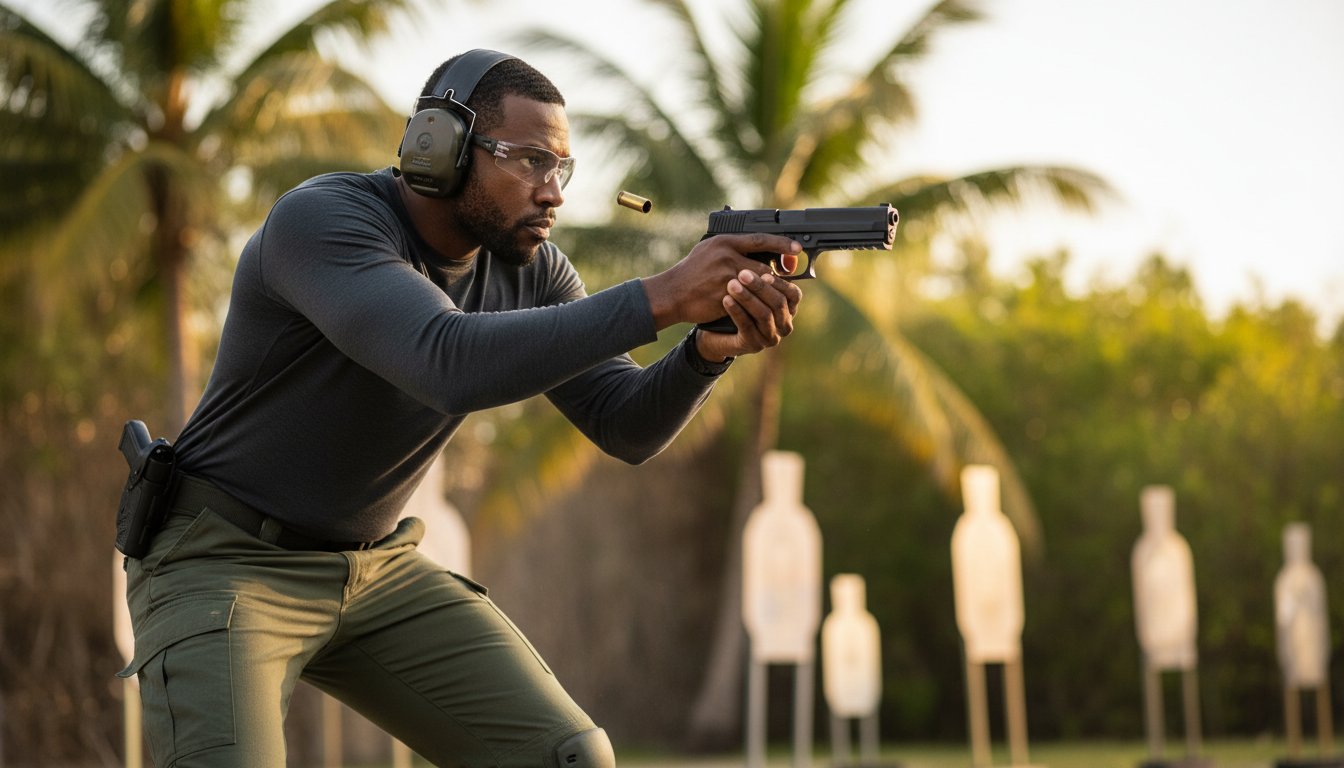
Most shooters burn through 500 rounds of ammunition every month without improving their split times by even 0.01 seconds. You know that punching holes in paper from a static stance isn't preparation for a real world engagement. It's frustrating to watch your training budget disappear into the backstop while your skills remain stagnant. Effective shooting drills are the only way to bridge the gap between casual plinking and the uncompromising standards of professional operators.
We've engineered this guide to transform your range sessions into high performance training cycles. You'll move beyond the basics to master advanced sequences that can cut your target acquisition time by 20% or more. We'll break down the world's most effective drills, provide a clear roadmap for every session, and show you how to build the confidence required for high stakes defensive scenarios. From sub second draws to complex reactive steel engagements, this is your blueprint for tactical mastery. Built for the fight, this is how you achieve excellence.
Key Takeaways
- Bridge the gap between conscious effort and unconscious excellence through structured, repeatable training protocols.
- Evaluate the differences between official law enforcement qualifications and civilian defensive requirements to validate your professional proficiency.
- Execute the world’s most effective shooting drills to master grip management, recoil control, and surgical trigger press.
- Replace static bullseye habits with anatomical training to prepare for the high-stakes reality of a tactical engagement.
- Discover how the "Warrior-Engineer" approach to target design provides the technical precision required for elite-level skill development.
The Science of Proficiency: Why Structured Shooting Drills Are Essential
A round fired without a specific purpose is a resource wasted. True marksmanship isn't born from casual plinking at a local lane; it's forged through shooting drills that are repeatable, measurable, and uncompromising. These exercises isolate core fundamentals such as grip pressure, sight recovery, and trigger reset. By isolating these variables, a shooter moves from conscious competence to unconscious excellence. This transition allows the mind to focus on the threat while the body executes the mechanics. Elite operators often cite the 3,000-repetition threshold as the point where a movement becomes hardwired into the cerebellum. You stop thinking about the draw and start thinking about the solution.
The history of combat shooting drills shows a clear evolution from static line firing to the high-stakes, dynamic environments seen in modern tactical training. Static shooting tests your aim. Dynamic drills test your soul. Real-world engagements don't happen on a flat range with perfect lighting and zero movement. They involve physical exertion, cognitive stress, and split-second decision-making. Incorporating movement into your shooting drills forces the brain to process environmental data while maintaining a 100% hit rate. This is the standard required for those who carry a weapon for professional duty or personal defense.
The shot timer serves as the only objective judge on the range. It doesn't care about your excuses or your gear's price tag. It records the cold, hard data of your performance. A 0.90-second draw to a first-round hit is a benchmark that separates the professional from the hobbyist. Without the timer, you're just guessing. With it, you're quantifying your lethality. Every millisecond shaved off a reload or a target transition is a tactical advantage gained. This data-driven approach turns the range into a laboratory for human performance, stripping away ego and replacing it with raw metrics.
The Feedback Loop: Auditory and Visual Cues
Instant feedback is the catalyst for rapid skill acquisition. When you engage a target, your brain needs immediate confirmation of success or failure to adjust the next shot. High-contrast target zones provide visual data, but the ring of high-grade ballistic steel provides the auditory cue that cements the correct motor pattern. The Feedback Loop in firearms training is the immediate data provided by the target to the shooter. This loop allows for the correction of a minor trigger pull error before the next round leaves the chamber. This speed of correction is why 85% of professional instructors prioritize reactive targets over static paper during intensive training cycles.
Quantifying Mastery: Standards and Metrics
Mastery isn't a feeling; it's a set of numbers. We track metrics like draw to first shot, split times between rounds, and transition speeds between multiple threats. Standardized drills allow shooters to compare their performance against LEO and military benchmarks established since the mid-1970s. Par times create a ceiling that you must break. If the standard for a drill is 5.0 seconds, your goal is 4.5. This relentless pursuit of speed and accuracy drives performance gains that are impossible to achieve through unstructured practice. You don't rise to the occasion; you sink to the level of your training. Discipline on the range ensures survival in the field.
Standardized Drills vs. Custom Training: Choosing Your Path
High-stakes performance requires a clear roadmap. You're either training to meet a standard or you're training to exceed it. Standardized shooting drills offer a measurable baseline for every shooter. Custom training protocols allow for specialized development. Choosing the right path depends on your specific mission profile and current skill level.
The Role of Official LEO and Military Targets
The B27 and FBI QIT-99 aren't just sheets of paper. They're professional benchmarks. Over 75% of law enforcement agencies in the United States rely on these specific silhouettes to certify their officers. The B27 utilizes a ring-based scoring system where a maximum 10-point shot requires hitting the 7-by-11-inch center mass. This system rewards consistent grouping in high-percentage zones. The QIT-99, or "bottle" target, narrows the margin for error. It prioritizes the high-chest and cranial regions, forcing the shooter to respect anatomical reality. Utilizing these Law Enforcement targets provides a level of professional credibility that generic civilian targets cannot match.
Effective training isn't a static event. It's a physiological process of adaptation. Integrating Progressive Firearms Training Principles into your routine ensures you aren't just burning through ammunition. These principles demand supervised instruction and the simulation of typical high-stress situations. They condition the shooter for 0.25-second decision windows. This methodology bridges the gap between casual range time and genuine combat readiness. It turns every shooting drills session into a data-driven exercise in survival.
Specialized instructors have pushed training evolution further. Targets from Sage Dynamics and Modern Samurai focus on specific anatomical zones or cognitive processing drills. These tools force the eye to track smaller, non-traditional shapes rather than a massive silhouette. It's a shift from "hitting the paper" to "surgical precision." This level of detail is what separates a weekend hobbyist from a professional operator who understands the nuance of point of aim versus point of impact.
Custom Branding: The Instructor’s Competitive Edge
Firearms academies in South Florida are increasingly adopting custom-branded targets to define their training environment. It's about more than aesthetics. When a student engages a target featuring an academy's unique logo, it creates a psychological bond with the specific curriculum. It legitimizes the "House Drills" used in the course. Recent industry data shows that students using proprietary, high-quality training materials report a 22% increase in the perceived value of their instruction. This professional polish builds immediate authority for the instructor.
Customizing your equipment is a decisive move. It tells the student that your standards are higher than off-the-shelf options. You can upgrade your range setup with custom steel and paper solutions that reflect your specific training philosophy. This creates a cohesive brand experience that lasts long after the student leaves the firing line. Consistency in targets leads to consistency in results.
- Brand Identity: Custom logos reinforce the instructor's expertise every time a shot is fired.
- Standardized Scoring: Custom targets allow for proprietary scoring systems that match specific course objectives.
- Professionalism: High-quality, rugged targets signal a commitment to excellence that cheaper alternatives lack.
- Student Retention: A unique training experience encourages students to return for advanced certifications.
Training for the fight requires tools that match the intensity of the mission. Whether you're running a standard FBI qualification or a specialized low-light drill, the target is the ultimate arbiter of your skill. Don't settle for mediocre gear when lives are on the line. Precision starts with the equipment you choose to engage.
Top 5 Shooting Drills for Uncompromising Accuracy and Speed
Mastery isn't an accident. It's the result of repetitive, high-stress shooting drills designed to expose weaknesses in your mechanics. The Bill Drill serves as the foundational test for grip and recoil management. You'll fire six rounds into an eight-inch A-zone from seven yards. Elite shooters aim for a sub-2.0 second total time. This drill forces you to track the front sight or red dot through the entire recoil cycle. If your grip is weak, your predictive track fails, and your hits will string vertically or drift. Don't just pull the trigger; manage the explosion.
Dot Torture is the ultimate discipline builder. This 50-round course of fire focuses on the absolute fundamentals of trigger press and sight alignment. You'll work from three yards, engaging two-inch circles with various requirements including strong-hand only and weak-hand only strings. It’s a low-speed, high-consequence drill. One miss means you failed the session. Incorporating research-based tips to improve your tactical shooting ensures you understand the cognitive load required for these precision movements. Precision is the baseline for all tactical applications.
The 1-to-5 Drill enhances target transitions and throttle control. Set up three targets at five yards. Fire one round on the first, two on the second, and three on the third, then reverse or vary the count. This teaches your brain to shift gears between high-speed transitions and controlled fire. You'll learn to drive the gun with your eyes. Move your vision to the next target before the gun arrives. This prevents overshooting the mark and wasting precious tenths of a second.
The Failure to Stop, or Mozambique, trains the critical transition from center-mass to the ocular cavity. Fire two rounds to the chest and one to the head. It's a response to a threat that doesn't immediately drop after initial hits. The El Presidente adds complexity with a 180-degree turn, a reload, and multiple target engagements. You'll start with your back to three targets, turn, draw, and fire two rounds into each. Perform a mandatory reload and repeat. A 10-second par time is the standard; professional operators often crush this in under six seconds.
Drill Execution and Target Selection
Success depends on the right glass and steel. For precision, use dedicated Dot Torture Drills paper targets to track every micro-movement of your muzzle. For reactive feedback, AR550 steel plates provide the auditory confirmation needed for high-speed transitions. Pro Tip: stop searching for the dot during the draw. If your index is correct, the reticle appears naturally. If you're hunting for it, your grip geometry is flawed. Fix the hands, and the eyes will follow.
Advanced Variants for Red Dot Users
Red dot shooters must master the transition from target focus to reticle awareness. Modern Samurai and Sage Dynamics targets are engineered to optimize the occlusion training method. By taping over the front of your optic, you force your brain to overlay the dot onto the target using binocular vision. This eliminates "front sight focus" habits that slow down modern shooters. Utilize Modern Samurai targets to achieve 20% faster target acquisition in high-speed shooting drills. This is where engineering meets the warrior mindset.
Tactical Application: Situational Drills and Anatomical Precision
Bullseye targets are a liability in defensive training. They promote a "center of paper" mindset that fails in a dynamic gunfight. You aren't aiming for a score; you're aiming for a physiological stop. Traditional rings don't exist on a human threat. This is why professional shooting drills must evolve past the static range mentality. When you train on circles, you develop a "range scar" where your brain looks for a geometric center rather than a vital organ. In a high-stress encounter, you'll default to this habit. If the threat is bladed or wearing heavy clothing, that geometric center might result in a complete miss of the vitals.Anatomical Targets: Training for Reality
Anatomical shooting targets bridge the gap between marksmanship and survival. Axle overlays use ghosted skeletal structures to show where the vitals actually sit. The "Ocular Cavity" is a 3x5 inch box where a hit disrupts the central nervous system instantly. This is the only "off switch" in a terminal encounter. High Center Mass isn't just the chest; it's the 6-inch zone containing the heart and great vessels. Training on these zones ensures 100% of your focus is on effective placement. You learn to see through the target to the internal structures that stop a fight. This visual processing is what separates a shooter from a marksman.
Decision-Making Drills with Situational Targets
Combat isn't just about pulling the trigger. It's about deciding when not to. Incorporating "No-Shoot" targets into your shooting drills forces target discrimination. Use the Command Drill: an instructor calls "Blue Three" or "Red Two" while you're at the high ready. You have 1.5 seconds to identify and engage the correct target among bystanders. Axle’s high-visibility paper is printed on 80-pound non-glare stock. It stays crisp through 400 rounds of high-volume fire without shredding or curling. This durability allows for extended training sessions where the focus remains on the cognitive load rather than fixing the target stand.
Precision requires understanding your equipment's geometry. At distances under 7 yards, your optic sits roughly 2.5 inches above the barrel. This mechanical offset means if you aim for the Ocular Cavity, you'll hit the jaw or neck. You must train to hold 2.5 inches high at close range. This isn't a suggestion; it's a ballistic reality. Failure to account for this 2.5-inch gap results in non-lethal hits when surgical precision is mandatory. Every drill should incorporate at least 20% of the volume at these "offset" distances to burn the correction into your muscle memory.
- Mechanical Offset: Account for the 2.5-inch height-over-bore at 5 yards.
- Target Discrimination: Use 1.5-second par times for threat identification.
- Physiological Stops: Focus on the 3x5 inch ocular window for CNS disruption.
- Durability: Train with 80-pound stock paper to maintain target clarity during long strings.
Don't settle for hobbyist gear when your life depends on your proficiency. You need tools that reflect the intensity of the fight. Axle Targets provides the ballistic feedback and visual realism required for elite performance. Stop shooting at circles and start training for the win.
Engineered for the Fight: Why Axle Targets Elevates Your Training
Superior marksmanship isn't an accident. It's the direct byproduct of the Warrior-Engineer philosophy. This mindset dictates that every piece of equipment, including the paper you engage, must meet a rigorous tactical standard. Axle Targets doesn't produce hobbyist supplies. We build mission-essential hardware. Our team consists of veteran shooters who understand that a target isn't just a destination for lead; it's a diagnostic tool. When you're running high-stress shooting drills in the Florida heat, you can't afford gear that fails to provide clear, actionable data. You need a platform that stands up to the abuse of rapid fire and high-volume training cycles.
Technical superiority starts with the substrate. Most commercial ranges use thin, 60 lb. paper that tears and "starbursts" upon impact. This distortion makes it impossible to call your shots accurately at 15 yards or beyond. Axle Targets utilizes premium, 100 lb. American-made tag board. This heavy-duty stock ensures that every round leaves a clean, circular hole. It eliminates the guesswork of scoring and allows for precise tracking of shot groups. For shooters in Fort Lauderdale and across the country, we provide a 48-hour turnaround on most custom orders. Whether you're a private instructor or a large-scale range facility, our logistics chain ensures your training schedule never skips a beat due to supply shortages.
The Axle Advantage: Quality You Can See and Hear
Visual feedback is a critical training metric. Our targets feature a high-contrast, matte finish that reduces sun glare by 25 percent. This allows for rapid target acquisition during outdoor shooting drills. We've developed mission-driven designs specifically for law enforcement and defensive shooters. These situational layouts force the brain to process information before the finger pulls the trigger. If you want to reinforce your brand while you train, we offer Custom shooting targets with logo options. This integrates professional identity with elite performance standards.
Building Your Mission-Ready Range Session
A disciplined training program requires a systematic approach to equipment. Don't waste rounds on substandard paper. Follow this 3-step protocol to optimize your next session:
- Identify Goal: Determine if you're training for speed, precision, or situational awareness.
- Select Standard: Choose the Axle target series that matches your specific mission profile, from B-27 variants to reactive silhouettes.
- Customize Branding: Upload your agency or range logo to create a cohesive, professional training environment.
Professional development is a continuous process. Tactical mastery requires uncompromising tools. Axle Targets provides the hardware needed to bridge the gap between basic competency and elite performance. We don't settle for "good enough" in our engineering because we know you don't settle for "good enough" in your training. Demand more from your equipment. Don't just shoot-train with intent using the most advanced targets in the industry.
Secure Your Tactical Advantage
Proficiency isn't an accident. It's the result of repeated, high-pressure shooting drills that bridge the gap between static range time and real-world combat. You've learned how the Bill Drill and the 1-to-5 Drill refine your split times and target transitions. Mastery requires more than just rounds downrange; it demands a 0.5-second reactive feedback loop that only professional-grade steel provides. You've got the knowledge. Now you need the hardware that holds up under fire.
Axle Targets delivers that edge. We manufacture every target in the USA using 100% certified AR550 ballistic steel. Our gear is currently deployed by 500+ law enforcement agencies and Tier 1 military units globally. We provide custom branding for elite instructors who demand equipment as resilient as their training programs. Don't settle for subpar gear that fails when the stakes are highest. Invest in tools built for the fight.
Upgrade Your Training: Shop Our Mission-Ready Targets Now
The path to mastery is paved with lead and persistence. Stay focused and keep training.
Frequently Asked Questions
What are the best shooting drills for beginners?
Start with the 5x5 Drill or the 1-Hole Drill to build a foundation. The 5x5 Drill requires you to fire 5 shots into a 5-inch circle at 5 yards in 5 seconds. It's a fundamental exercise that tests grip, sight alignment, and trigger control under a mild time constraint. These shooting drills establish the baseline proficiency required before you attempt dynamic movement or complex transitions.
How often should I practice shooting drills to see improvement?
Train with live fire at least 2 times per month and supplement with dry fire 4 days a week. A 15-minute dry fire session conducted 4 times weekly keeps your draw stroke and reloads sharp. Data from the 2022 Federal Law Enforcement Training Centers study indicates that marksmanship skills begin to degrade after only 14 days of inactivity. Consistency is the only path to mastery in high-stakes environments.
This principle of discipline and focus on proper ergonomics extends beyond the range. In other high-performance activities, such as competitive gaming, maintaining peak physical condition for hours is paramount. It's why resources like TopGamingChair.com dedicate themselves to reviewing the specialized equipment needed for sustained concentration.
Do I need a shot timer for effective shooting drills?
You must use a shot timer to quantify your performance and identify technical bottlenecks. Devices like the Pact Club Timer III track split times to the hundredth of a second. Without this data, you're guessing about your progress rather than measuring it. A timer adds the necessary stress of a "par time" to ensure your shooting drills mirror the urgency of a real-world engagement.
What is the "Dot Torture" drill and why is it so popular?
Dot Torture is a 50-round marksmanship test that focuses on extreme precision and fundamental discipline. It's popular because it forces shooters to execute complex tasks like weak-hand shooting and emergency reloads at 3 yards. David Blinder designed this drill to expose even the smallest flaws in your technique. If you miss a single shot out of 50, you fail the entire exercise.
Can I use standard paper targets for tactical drills?
You can use paper, but reactive AR550 steel targets provide the instant auditory feedback necessary for rapid skill acquisition. High-performance training requires immediate confirmation of a hit to build proper neural pathways. Paper targets force you to stop and use optics to check your work, which kills your training momentum. Steel allows you to stay focused on the threat while receiving 100% confirmation of every ballistic impact.
How many rounds do I need for a typical range session focused on drills?
Plan to expend 100 to 150 rounds during a structured training session. Firing 500 rounds without a plan results in "garbage reps" that reinforce poor habits. Allocate 50 rounds for a cold start and warm-up, 75 rounds for specific skill development, and 25 rounds for a final proficiency test. This disciplined approach ensures every round fired serves a tactical purpose.
What is a "Par Time" in shooting drills?
A par time is a fixed duration set on a shot timer to complete a specific action. For example, a 1.5-second par time for a draw-to-first-shot drill means you must break the shot before the second beep. It's a non-negotiable standard that forces you to eliminate wasted movement. If you can't beat the par time, your mechanics are inefficient and require correction.
Why are anatomical targets better than traditional bullseye targets for defensive training?
Anatomical targets train your brain to identify high-probability hit zones like the 10-inch thoracic cavity rather than a non-existent center point. Traditional bullseyes are for sport, but defensive training requires a focus on stopping power. Using targets with a 3-inch cranial box and realistic torso dimensions ensures your point of aim translates to real-world survival. It's the difference between hitting a score and winning a fight.