
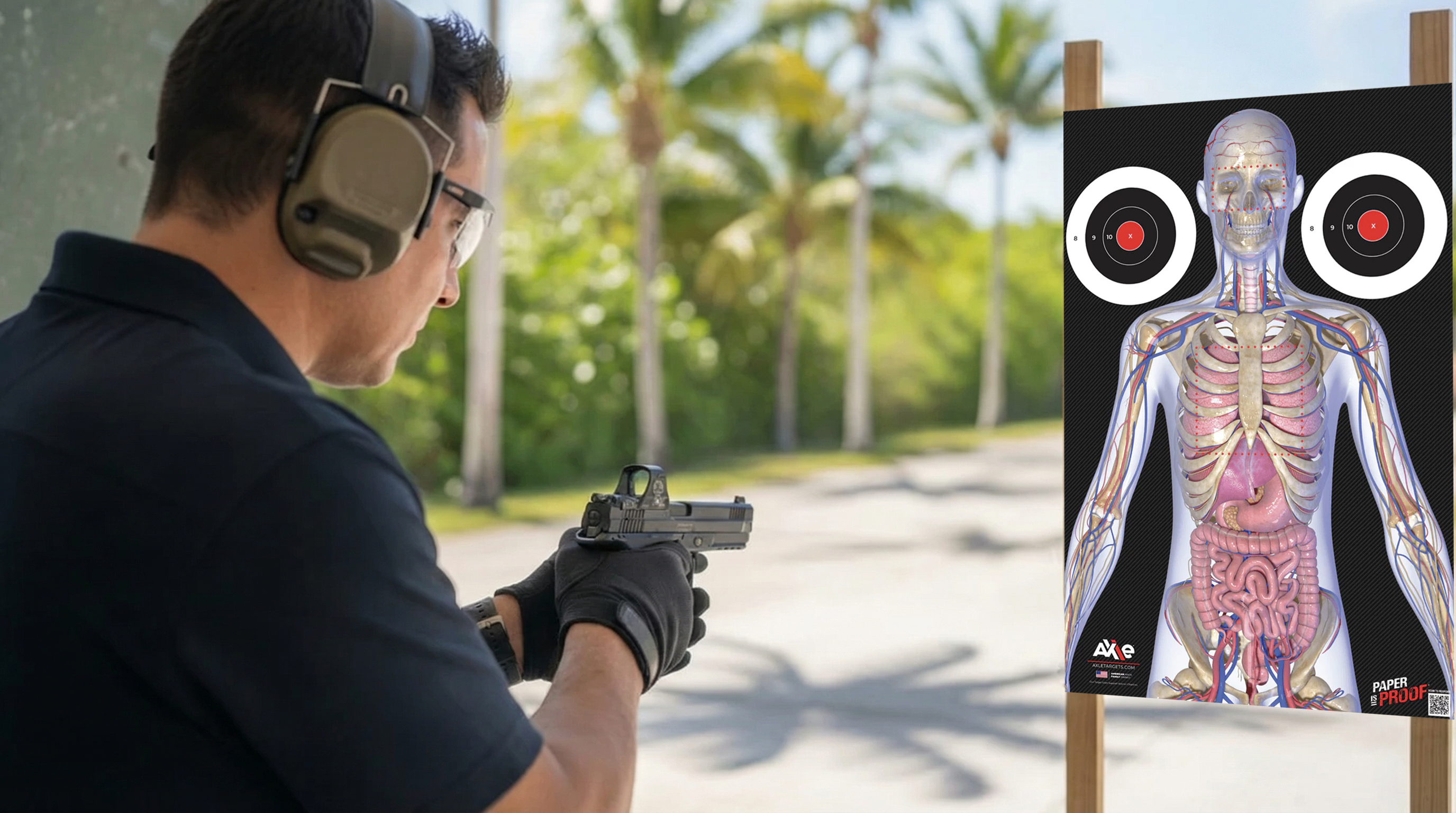
A target that shreds after three rounds isn't just a nuisance; it's a failure of engineering that compromises your combat readiness. Most shooters settle for 60-pound stock that bleeds ink the moment humidity hits 65 percent, turning precision drills into a messy guessing game. You've likely felt the frustration of pulling a target that's too damaged to provide meaningful diagnostic data. You need a clean record of every ballistic impact to ensure your training translates to the field.
This guide will help you master the science of paper shooting targets to transform your range sessions from casual plinking into high-performance tactical training. We'll move beyond the basics of paper weights to analyze how anatomical scoring zones and high-contrast inks influence your split times. You'll learn to identify the specific materials required for 500-round qualification courses and gain access to the professional-grade tools used by elite units. Stop guessing and start measuring with gear built for the fight.
Key Takeaways
- Identify and correct hidden shooter errors using the diagnostic precision that only high-contrast paper provides during high-volume training.
- Select the optimal paper shooting targets for your specific mission, from precision zeroing grids to official FBI and LEO qualifying standards.
- Combat range glare and environmental wear by understanding the material science behind tactical-grade paper weights and specialized ink technology.
- Execute advanced drills like the Dot Torture test to transform standard range sessions into high-performance fundamental masterclasses.
- Leverage American-made reliability and custom branding to ensure your training environment reflects professional standards and uncompromising elite performance.
Why Paper Shooting Targets Remain the Gold Standard for Training
Training for the fight requires more than just making noise. You need actionable data. High-performance shooters across South Florida recognize that while steel provides immediate gratification, paper shooting targets provide the technical truth. Every round fired is a data point in your progression toward mastery. You don't waste ammunition on vague results. You demand precision.
A standard Shooting target serves as the baseline for every professional training curriculum globally. In the tactical environment, accountability is everything. Paper provides a permanent, physical record of every micro-movement made during the trigger press. It captures the exact point of impact with zero ambiguity. For the shooter focused on tight groups and consistent split times, this feedback is non-negotiable.
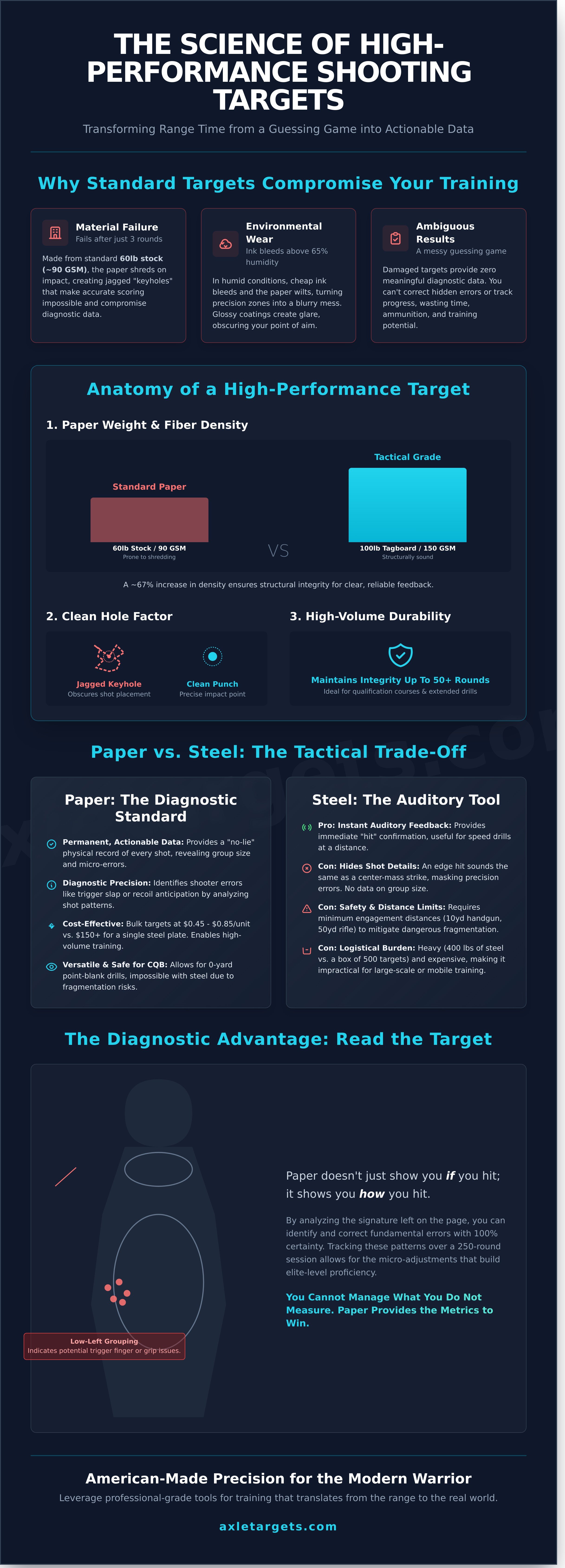
Cost-effectiveness remains a primary driver for high-volume training. A single AR550 steel torso can cost upwards of $150.00, while bulk paper shooting targets often price out at $0.45 to $0.85 per unit. This allows instructors to run 50-round qualification courses for dozens of students without the logistical overhead of heavy hardware. For mobile range setups in Fort Lauderdale, the ability to transport 500 targets in a single box outweighs the burden of hauling 400 pounds of reactive steel. Efficiency is a mission requirement.
Regulatory standards reinforce this dominance. The Florida Criminal Justice Standards and Training Commission (CJSTC) mandates specific paper silhouettes for Law Enforcement Officer (LEO) qualifications. Rule 11B-35.0024 requires these physical records for legal and professional accountability. If you are training for duty or self-defense, you must train to the standard that will be used to judge your performance in a courtroom or a debrief.
Paper vs. Steel: The Tactical Trade-off
Steel offers instant auditory feedback, but it hides the details of a poor shot. A hit on the edge of a plate sounds the same as a center-mass strike. Paper demands more. It reveals the difference between a 2-inch group and a 6-inch spread. Safety is also a factor. Steel requires a minimum engagement distance of 10 yards for handguns and 50 yards for rifles to mitigate fragmentation risks. Paper allows for 0-yard, point-blank contact drills. It is the safer, more versatile medium for close-quarters battle (CQB) training.
The Role of Paper in Diagnostic Marksmanship
Paper is the ultimate diagnostic tool. A grouping that drifts low-left reveals a specific grip or trigger finger issue that a ringing steel plate would ignore. By analyzing the signature left on the page, you can identify trigger slap or recoil anticipation with 100% certainty. This "no-lie" nature of paper forces shooters to confront their weaknesses. Tracking these patterns over a 250-round training session allows for micro-adjustments that lead to elite-level proficiency. You cannot manage what you do not measure. Paper gives you the metrics to win.
The Anatomy of a High-Performance Paper Target
A target isn't just a piece of paper. It's a critical diagnostic tool. Professional shooters know that cheap materials lead to sloppy data. High-performance paper shooting targets must withstand the violence of high-velocity impacts while providing clear, undeniable feedback. In the harsh environment of a South Florida range, where humidity averages 74% and the sun is relentless, your gear cannot fail. If your target sags, wilts, or tears, your training session is a waste of expensive ammunition. Precision training requires precision equipment.
Paper Weight and Fiber Density
Standard 60lb paper is for office printers, not the firing line. At roughly 90 GSM, this thin stock shreds when struck. It creates jagged "keyholes" that make accurate scoring impossible. Axle Targets utilizes 100lb tagboard, which translates to a robust 150 GSM density. This extra weight ensures the fibers hold their shape under stress. When a round passes through, it punches a clean, circular hole. This "clean hole" factor is mission-critical for identifying tight shot groups and tracking point-of-aim vs. point-of-impact. Our premium stock maintains structural integrity even after 50 rounds have passed through center mass. This level of durability aligns with the rigorous requirements found in federal firearms instructor training standards, ensuring your practice matches professional qualification environments. Dimensional accuracy is non-negotiable. Every scoring ring is calibrated to official agency specifications. If the target says you hit the 10-ring, you earned it.
Visual Engineering and Contrast
Light management is a tactical necessity. Cheap, glossy coatings reflect the midday sun, creating a blinding glare that obscures your sight picture. We use matte-finish inks that absorb light rather than reflecting it. This ensures high-contrast visibility at 7 yards or 75 yards. Color science plays a role here too. We utilize specific shades of high-visibility red and deep tactical black to define "no-shoot" zones and vital organs. These colors don't bleed when wet. If a sudden Fort Lauderdale rain shower hits, your target won't transform into a gray smear. The non-bleeding ink technology keeps your aiming points sharp and defined. This clarity allows for precision long-range tracking and rapid target acquisition during high-stress drills. You don't have time to squint at your target. You need to see the threat, engage, and move to the next. For those who demand this level of reliability, choosing professional-grade targets is the only way to ensure your training stays on track. We don't build for the hobbyist; we build for the fight.
- 100lb Tagboard: Prevents jagged tearing for easier scoring.
- Matte Finishing: Eliminates sun glare during noon-day training sessions.
- Weather Resistance: Handles 80% humidity without disintegrating.
- Non-Bleeding Ink: Maintains high-contrast lines for precision tracking.
Every specification serves a purpose. From the fiber density to the ink chemistry, these targets are engineered to survive the range and provide the feedback necessary for mastery. When you use paper shooting targets designed for the professional, you eliminate variables and focus entirely on your marksmanship.
Mission-Specific Selection: Choosing the Right Target for the Fight
You don't just go to the range to burn brass. You train for an outcome. Precision starts with the right foundation, and that begins with high-quality paper shooting targets designed for specific ballistic objectives. Bullseyes and grid targets are the non-negotiable tools for the initial phase of any range session. You need a 1-MOA (Minute of Angle) level of feedback to confirm your zero. If your optic isn't dialed at 25 or 50 yards, your tactical drills are a waste of time. Axle's grid targets provide clear 1-inch increments, allowing for immediate mechanical offset adjustments without the guesswork.
Standard Qualification Targets (B-27, B-21, USPSA)
The B-27 silhouette is the industry veteran for a reason. This 24 by 45 inch target has defined law enforcement proficiency standards since its introduction in the 1960s. It provides a massive scoring area, but elite shooters focus on the 10-ring. The FBI QIT-99 target takes it a step further. It forces a narrower focus on the "bottle" shape, requiring an 80% hit rate across 60 rounds to pass the standard tactical qualification. If you're training for competition, USPSA targets are your metric. They force you to balance 0.20-second split times with the demand for A-zone hits. When range space is limited, we use B-29 scaled targets. These allow you to simulate 50-yard engagements on a 15-yard line with mathematical precision.
Anatomical and Skeleton Targets
Center mass is a concept for beginners; terminal ballistics is the reality for professionals. Generic silhouettes build the dangerous habit of aiming at the center of a piece of paper rather than a vital organ. Axle's anatomical targets utilize skeleton overlays to teach the "Warrior-Engineer" mindset. You learn to target the high-thoracic cavity and the central nervous system (CNS). Data from the Force Science Institute indicates that training with realistic visual cues can reduce shooter hesitation by 15% in high-stress encounters. You aren't just looking for a hit; you're looking for the "switch." These paper shooting targets bridge the gap between marksmanship and combat effectiveness by emphasizing the T-box and spine.
Situational and Hostage Targets
The brain is the most important weapon on the range. Situational targets introduce the "No-Shoot" principle, which is essential for cognitive processing under pressure. If you only shoot at lone silhouettes, you develop a "target-only" tunnel vision that leads to catastrophic errors in real-world environments. Axle's proprietary situational designs force you to identify threats in under 0.5 seconds while avoiding bystanders. This training builds the discipline required to hold fire when a hostage is in the frame.
- Cognitive Load: Forces the shooter to process visual information before engaging the trigger.
- Precision Under Pressure: Hostage scenarios often leave only a 2-inch "A-zone" of the threat exposed.
- Dynamic Identification: Breaks the habit of "silhouette hunting" by using varied clothing and stances.
Training shouldn't be comfortable. It should be a relentless pursuit of mastery. By selecting mission-specific targets, you ensure that every round fired is an investment in your survival. Axle Targets provides the high-fidelity tools needed to move beyond the basics and into the realm of elite performance.
Maximizing Range Time: Drills and Diagnostic Reading
Elite performance requires surgical precision. Your range setup dictates your training outcome. Mount your paper shooting targets at a height of 5.5 feet to simulate a standing threat's center of mass. Engage from 3, 5, and 7 yards. These distances cover over 90% of documented defensive engagements. Integrate a shot timer like the PACT Club Timer III to track your split times and draw speed. Without a timer, you're just making noise. With one, you're collecting combat-relevant data.
The Dot Torture test serves as a 50-round masterclass in fundamental discipline. Developed by the late Todd Louis Green, this drill forces you to execute every core skill under a single standard. You'll engage 2-inch circles from 3 yards. It covers draws, reloads, and strong-hand-only strings. If you drop a single shot outside the line, you've failed the mission. This isn't a drill for the casual shooter. It's for those who demand total mastery of their weapon system.
Paper targets provide a permanent record of your mechanical failures. A "low-left" cluster for a right-handed shooter reveals a lack of trigger isolation or recoil anticipation. Vertical stringing typically indicates inconsistent breathing or sight alignment shifts. If your groups exceed 2 inches at 7 yards, your grip pressure is likely uneven. Analyze every hole. The paper is a diagnostic tool that identifies exactly where your technique breaks down under the clock.
The Diagnostic Process: Step-by-Step
Step 1: Fire a 5-round group at a clean bullseye from 5 yards to establish your baseline. Step 2: Analyze the group shape. Horizontal dispersion indicates poor trigger finger placement or shifting grip pressure. Step 3: Adjust your mechanics. Ensure you're using the distal pad of your finger and maintaining a 70/30 support-hand grip ratio. Step 4: Repeat the drill with a "No-Shoot" distraction target placed 4 inches from your primary bullseye. This tests your ability to maintain focus and accuracy while processing high-stakes visual information.
Advanced Training Protocols
Specialized instructors like Aaron Cowan of Sage Dynamics and Scott Jedlinski of Modern Samurai Project utilize technical paper shooting targets designed for red dot mastery. Use 1-inch squares to refine your zero and mechanical offset at close range. Practice transition drills by moving between anatomical zones, such as the ocular cavity and high center mass, on a single sheet. Always use adhesive pasters to cover your hits. This practice extends the life of a single sheet by 300% and ensures your sight picture remains uncluttered for the next string of fire. Precision is the only metric that matters.
Build your training kit with professional-grade range equipment designed for the mission.
The Axle Advantage: American-Made Precision for the Modern Warrior
Axle Targets operates on a single, uncompromising truth: your training is only as effective as your feedback. We're a family-owned operation that understands the grit required for high-level proficiency. Since our founding, we've focused on providing the American shooting community with tools that don't just exist but excel. We're not a massive, faceless conglomerate. We're shooters, engineers, and patriots who recognize that every round sent downrange is an investment in skill. Our commitment to the community means we treat every order as a mission-critical shipment.
Quality control is our obsession. While many competitors outsource their production to save on overhead, we keep everything domestic. This allows us to monitor every stage of the manufacturing process. Standard retail paper shooting targets often utilize 60-pound paper that buckles in the South Florida humidity or shreds into unreadable messes during rapid-fire drills. We don't settle for those failures. We utilize 100-pound heavy-duty tagboard that provides clean, circular holes for precise shot placement analysis. This weight ensures your target stays flat and functional, even when the wind kicks up at an outdoor range.
Time is your most valuable asset. We've optimized our logistics to ensure you aren't waiting weeks for supplies. Most of our standard inventory ships within 48 hours. We know that range days don't wait for backorders. By maintaining a lean, efficient production cycle, we keep you on the firing line with mission-ready supplies that arrive exactly when you need them. You focus on the trigger press; we'll handle the logistics of the steel and paper.
Custom Targets for Professional Instructors
Your brand represents your standard of excellence. Don't let your curriculum be represented by generic, low-quality silhouettes. We've partnered with over 350 professional instructors to integrate custom logos and proprietary scoring zones into their training materials. Whether you need specific hit boxes for a Tier 1 qualification or a unique layout for a civilian CCW course, we build it to your exact specifications. This creates a cohesive, professional environment that reinforces your authority on the range. Contact Axle for a custom quote on branded targets to elevate your training business today.
To fully round out your professional branding with other custom gear, you can visit Rally Towels for a wide range of promotional products.
Built for the Fight: Our Manufacturing Ethos
Our reach extends from our Fort Lauderdale roots to the front lines of national law enforcement training. We've delivered over 1.2 million targets to ranges across all 50 states, maintaining a 99.8% satisfaction rate. Manufacturing in the USA isn't just about a label; it's about reliability. By sourcing 100% of our raw materials from American suppliers, we bypass the supply chain failures that plague international brands. This domestic focus ensures that every paper shooting targets batch we produce meets the same ballistic training standards, regardless of the order volume.
Professional ranges are already looking toward 2026 as they upgrade their facilities for modern combat simulations. They trust Axle Targets because we understand the psychological and physical demands of the warrior mindset. We produce gear that survives the dirt, the sweat, and the high-volume fire of a legitimate training cycle. Our equipment is engineered for those who demand the absolute best from their gear. Join the elite tier of shooters who refuse to compromise on their training tools. When you choose Axle, you choose American-made precision that's built for the fight.
Master the Standard and Own the Fight
Precision isn't a suggestion; it's a requirement. High-performance paper shooting targets provide the 100% shot accountability necessary to diagnose grip, trigger control, and sight alignment with surgical accuracy. You can't improve what you can't measure. By selecting mission-specific targets, you ensure every trigger press translates directly to combat readiness. Axle Targets delivers this edge through 100% American-made engineering. We're a family-owned company and a trusted supplier to Tier 1 LEO and Military agencies nationwide. We don't build gear for hobbyists. We build tools for professionals who demand uncompromising standards. Our custom branding options allow ranges to project that same elite authority to every shooter on the line. Don't waste lead on inferior materials that fail under pressure. It's time to elevate your training with the most advanced paper in the industry. Equip your range with Axle's premium paper targets today and turn every training session into a masterclass in marksmanship. Your progress starts with the right foundation.
Frequently Asked Questions
What is the best paper weight for shooting targets?
Professional shooters demand 60 lb. to 100 lb. offset or tagboard paper for maximum durability. This weight prevents tearing and provides clean bullet holes for accurate scoring. Lightweight 20 lb. bond paper shreds under rapid fire. High-performance training requires paper shooting targets that stand up to 50 rounds without losing structural integrity. Axle Targets recommends 80 lb. stock for all tactical drills in Fort Lauderdale.
How do I choose between a B-27 and a B-21 target?
Choose the B-27 for comprehensive duty qualification and the B-21 for focused torso engagements. The B-27 measures 24 by 45 inches and includes the full pelvic region. The B-21 is a shorter 24 by 35 inch silhouette used by 15 percent of law enforcement agencies for specialized drills. Both options provide critical hit zones for defensive training. Select the B-27 to simulate full-scale human threats during qualification.
Are paper targets better than steel for beginners?
Paper targets offer a superior learning platform for beginners by providing a physical record of every shot fired. You can't analyze a miss on a steel plate. A 100-sheet pack of paper shooting targets allows a novice to track their 2-inch group as it tightens over a 4-hour session. Steel provides instant auditory feedback but hides the subtle mechanical errors that paper exposes. Master the fundamentals on paper first.
Can I use paper targets at an indoor range?
You can use paper targets at every indoor range in Florida to prevent dangerous ricochets. Most facilities prohibit steel targets because backstops are designed for lead capture; they aren't built for fragmentation. Paper creates zero ballistic splashback at 7-yard distances. Ensure your target is 24 inches wide to fit standard motorized carrier systems. Indoor training requires clean, non-reflective surfaces for optimal visibility under 500-lumen range lighting.
What are 'no-shoot' targets used for?
Use 'no-shoot' targets to develop 100 percent target identification accuracy under intense stress. These targets are often colored high-visibility white or blue to contrast with threat silhouettes. Failing to identify a bystander in a drill results in an automatic disqualification in 90 percent of tactical competitions. Integrating these into your course of fire forces the brain to process information before pulling the trigger. Precision isn't just about hitting the bullseye.
How do I read my shot groups on a paper target to fix my aim?
Identify mechanical flaws by observing where your 5-shot group clusters on the paper. Hits at the 7 o'clock position indicate you're jerking the trigger. Shots high at 12 o'clock often mean you're anticipating recoil. Professional instructors use 1-inch grid overlays to measure these deviations with mathematical precision. Correcting a 3-inch shift in your grip can move your entire group into the X-ring. Data-driven training turns holes into lessons.
Does the color of the target affect my training?
Target color significantly impacts your 0.2-second split times by improving front-sight focus. Black silhouettes provide a traditional sight picture, while neon reactive targets show a bright halo around every hit. Florida's 10,000-lux sunlight makes high-contrast colors essential for outdoor ranges. Use tan or "buff" paper to reduce eye strain during 8-hour training cycles. Optimal color choice ensures you spend less time searching for the target and more time engaging it.
Where can I buy bulk paper targets for my shooting range?
Purchase 500-count bulk packs from Axle Targets to reduce your cost per unit by 30 percent. Tactical facilities in Fort Lauderdale require high-volume supplies to maintain 24/7 readiness. Sourcing directly from the manufacturer ensures consistent 80 lb. paper quality and official NRA or LE dimensions. Don't settle for thin, hobbyist-grade paper when your mission depends on professional gear. Order your bulk supplies today to ensure your range is built for the fight.