

Most shooters burn through 40% of their first 1,000 rounds without making a single meaningful adjustment to their grip or stance. It's a waste of lead and time. If you can't see your impact clearly from the 10-yard line, you aren't training; you're just making noise. Selecting the right beginner shooting targets is the difference between stagnant hobby shooting and professional skill development. You understand that every round counts and that subpar materials lead to subpar results.
You deserve gear that works as hard as you do. This guide ensures you master the fundamentals of marksmanship by choosing targets designed for technical feedback and rapid skill progression. We'll analyze the ballistic advantages of reactive steel, the clarity of high-visibility scoring zones, and the durability of professional-grade materials that don't tear under pressure. You'll learn exactly which tools help you diagnose errors instantly and turn every range session into a mission-critical success.
Key Takeaways
- Master the marksmanship feedback loop by selecting targets that provide immediate, high-visibility technical data.
- Compare bullseye and silhouette beginner shooting targets to build a foundation in both precision and defensive engagement.
- Eliminate technical failure by choosing premium materials that deliver clean holes and high-contrast visibility at distance.
- Implement the Dot Torture drill and other professional-grade exercises to turn every round into a measurable skill gain.
- Learn why elite instructors rely on American-made, battle-tested targets to bridge the gap between training and reality.
What Are Beginner Shooting Targets and Why Do They Matter?
Precision isn't born; it's engineered through disciplined repetition. Beginner shooting targets are specialized training tools designed to provide high-visibility feedback and clear scoring zones for those entering the world of tactical marksmanship. These aren't just pieces of paper or scrap metal. They're technical interfaces that facilitate a 0.5-second feedback loop between the shooter's trigger press and the visual or auditory result.
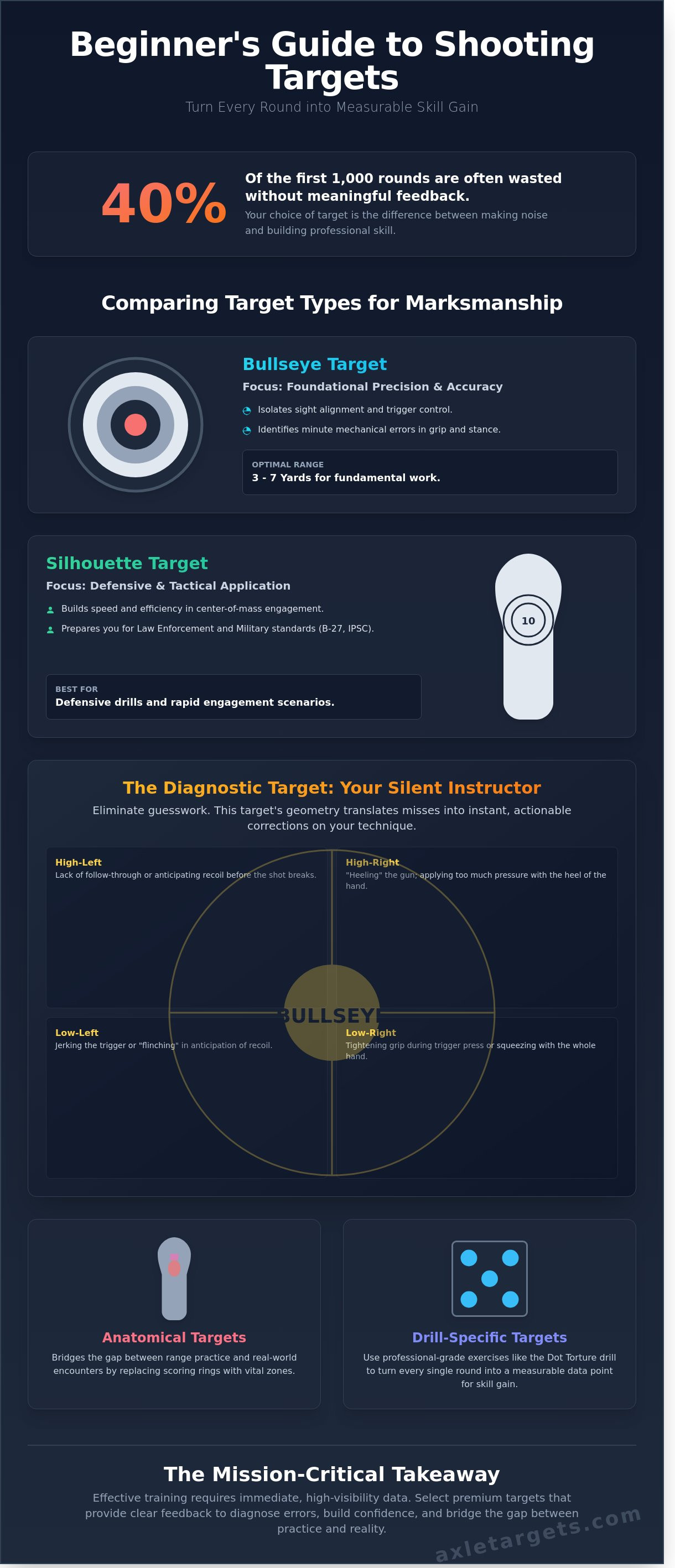
Most novice shooters make the mistake of using standard bullseye targets. These generic rings actually hide your mechanical flaws. A 10-ring hit on a circular target doesn't tell you if your grip is failing or if you're anticipating recoil. Professional-grade targets, like those based on B-27 or IPSC standards, use specific geometry to reveal shot patterns. This data allows you to diagnose and fix errors before they become permanent habits. Training with equipment that mirrors Law Enforcement and Military standards ensures your skills transition from the range to the real world without friction.
- Instant Diagnostics: Specialized zones identify exactly why a shot went low or left.
- High Visibility: High-contrast colors and reactive surfaces ensure you see your impact from 25 yards out.
- Mission Focus: Training on regulation sizes prepares you for the high-stakes reality of defensive shooting.
The Psychology of Target Feedback
Confidence comes from certainty. When you engage a target, instant visual or auditory confirmation builds the neural pathways required for muscle memory. The "aim small, miss small" philosophy isn't just a catchphrase; it's a technical requirement for tightening groups. Axle Targets focuses on reactive feedback because it eliminates the lag in the learning process. Don't fall into the trap of "plinking" without an objective. Every round of 9mm or 5.56 costs money. Every shot without a technical goal is a wasted opportunity to improve your lethality and precision.
Transitioning from Hobbyist to Professional Standards
Axle Targets prioritizes regulation sizes, such as the 12x20 inch torso, for all skill levels. We don't believe in "dumbing down" equipment for new shooters. Hobbyist targets focus on entertainment, while mission-driven materials focus on survival and mastery. Using AR550 steel ensures that the target stays flat and predictable, shot after shot. A beginner shooting target is a tool for technical diagnostic feedback designed to isolate and correct mechanical errors in real-time. Whether you're on a flat range or a tactical course, your gear must demand excellence from the first trigger press.
Comparing Target Types for Fundamental Marksmanship
Precision is a byproduct of high-quality data. You cannot fix what you cannot measure. Choosing the correct beginner shooting targets is the first step in building a repeatable, lethal skillset. Different target geometries serve specific training objectives. Bullseye targets are the foundation of accuracy. They isolate your ability to maintain sight alignment and execute a clean trigger press without disturbing the muzzle. If you cannot hold a 2-inch group at 5 yards on a bullseye, you aren't ready for advanced movement drills.
Silhouette targets like the B27 or B21 shift the focus to tactical application. These designs prioritize center-of-mass engagement. They teach you where to put rounds to stop a threat effectively. Anatomical targets take this further by replacing scoring rings with actual physiological vitals. This prepares you for the reality of a high-stakes environment where there are no colored lines to guide your aim. For those seeking the ultimate edge, professional-grade training solutions provide the durability needed for high-volume sessions.
- Bullseye: Best for identifying minute mechanical errors in grip and stance.
- Silhouette: Essential for building speed and transitioning between target zones.
- Diagnostic: A mechanical "cheat code" that translates misses into actionable corrections.
- Anatomical: Bridges the gap between range practice and real-world defensive encounters.
When to Use Silhouette vs. Bullseye
Distance dictates your target choice. Use bullseyes for precision work at 3 to 7 yards. This range exposes every flaw in your fundamentals. Silhouettes are built for defensive drills and rapid engagement. The B27 target has been the standard for law enforcement qualifications since the 1960s. Beginners should aim for the 9 and 10 rings to simulate effective stopping power. Mastering these targets prepares you for the 80 percent accuracy threshold required by most professional agencies. It builds the confidence needed to operate under pressure.
The Power of Diagnostic Targets
Diagnostic targets are your silent instructor. They eliminate guesswork. When your shots consistently land low-left, the target tells you that you're flinching or anticipating the recoil. If you're "heeling" the gun, the paper shows it instantly. These targets save you the $100 per hour cost of a private coach by providing immediate self-diagnosis. Every beginner should keep a 25-pack of correctional paper in their range bag. This ensures every round fired contributes to a measurable increase in skill. Efficiency is the mark of a professional. Don't waste lead on targets that don't talk back.
Why Material Matters: The Case for Premium Paper Targets
Most shooters view paper as a disposable commodity. That is a tactical error. Low-grade 20lb bond paper fails under ballistic stress; it shreds, sags, and lies to you. Premium 60lb or 80lb tagboard provides the structural integrity required for precise diagnostics. If your target cannot withstand the kinetic energy of a 115-grain 9mm projectile without disintegrating, your data is compromised. Axle Targets treats paper as a precision instrument, not a grocery list.
Clean Holes vs. Ragged Tears
Precision requires data. Cheap beginner shooting targets create star-bursting tears that can artificially expand a 0.5-inch group into a 1.5-inch mess. You cannot measure Minute of Angle (MOA) accuracy with ragged edges. Axle selects a specific 175 GSM paper weight to ensure the projectile shears the fibers cleanly. This engineering choice creates a distinct cookie-cutter hole. You see exactly where the lead broke the plane. No ambiguity. No guessed measurements.
Visibility and Contrast Engineering
Effective training must combat eye fatigue. We use high-density, non-reflective inks to produce deep blacks and high-visibility reds that provide a 98% contrast ratio. This allows shooters to track hits at 25 yards without reaching for a spotting scope. While "splatter" targets offer instant gratification, they often obscure the point of aim after just three shots. Our flat-finish paper eliminates glare in 10,000-lumen indoor ranges or high-noon desert sun. You focus on the front sight, not the reflection on the page.
Premium paper also offers superior environmental resilience. Consider these technical advantages:
- Humidity Resistance: Cheap paper absorbs moisture and becomes a wet rag in 65% relative humidity. Premium paper maintains its "snap" and rigidity.
- Auditory Feedback: When a round breaks a high-tension sheet, it produces a distinct, crisp crack. Cardboard is "dead" and swallows the sound; premium paper reflects it.
- Ink Saturation: Specialized coatings prevent ink bleeding, ensuring that 1-inch grids remain exactly 1 inch, even in damp conditions.
Training on inferior materials builds a foundation of guesswork. When you use professional-grade beginner shooting targets, you remove the variables. You stop wondering if the wind tore the paper or if you pulled the shot. The paper tells the truth. Every hit is a data point, and every data point is a step toward mastery. Axle Targets ensures that the only thing failing on the range is your old personal best.
Implementation: Beginner Drills for Maximum Proficiency
Execution defines the shooter. Owning the best beginner shooting targets is only half the battle; you must deploy them with tactical intent. Follow this four step progression to turn raw potential into repeatable skill. Training isn't about burning brass; it's about measurable growth.
- Step 1: The Cold Start. Fire five rounds at a two inch bullseye from three yards. No warm up. This evaluates your baseline mechanics and reveals how you'll perform when the adrenaline hits.
- Step 2: The Dot Torture Drill. This is the gold standard for fundamental mastery. It forces discipline across 50 rounds of varying complexity.
- Step 3: Controlled Pairs on Silhouette. Move to seven yards. Engage the high center mass with two rapid shots. Focus on the sight recovery and the tactile reset of the trigger between rounds.
- Step 4: Self-Correction. Use diagnostic targets to identify mid-session errors. If your shots pull low and left, the target provides the data to fix your anticipation or grip immediately.
Mastering the Dot Torture Target
The Dot Torture drill is a 50 round gauntlet that builds absolute trigger control. It demands perfection at short distances, typically three to five yards. You'll engage small circles through draws, strong hand only, and weak hand only sequences. It's the ultimate test for any shooter because it leaves no room for sloppy habits. Check out our Dot Torture targets for your next session to begin your path to professional mastery.
Introduction to Situational Awareness
Static range time often ignores the mental aspect of a fight. Integrate "No-Shoot" targets into your array to train the brain to identify threats before the finger touches the trigger. Anatomical targets bridge the gap between paper and reality by showing where vital zones actually sit within a silhouette. Set up a three target array with 18 inches of lateral spacing. Practice transitioning between targets while maintaining a consistent 0.75 second split. This builds the spatial awareness required for advanced tactical environments and ensures your beginner shooting targets serve a high-performance purpose.
Axle Targets: Engineered for the Fight
The Axle Difference
High-volume training requires reliable logistics. We deliver fast. Our premium materials withstand the heat of intense range sessions without curling or tearing. We provide the industry standards, from USPSA competition zones to the rigorous FBI QIT-99 qualification. Our paper is battle-tested for both the civilian and professional market. It offers superior ink adhesion and high-contrast lines. This ensures you can see your hits clearly from 25 yards out. We prioritize ballistic clarity. Every hit counts when you're training for survival. Custom logos on our targets turn a standard range day into a branded experience. We work with hundreds of ranges to provide bespoke solutions that elevate their training programs.
Getting Started with Axle
Choosing your first set of beginner shooting targets shouldn't be a guess. We suggest a 100-count bulk pack for your first season. This inventory allows for consistent practice without the fear of running low. Anatomical and situational targets offer the best prep for home defense. They bridge the gap between static range work and real-world application. These targets demand target identification and precise shot placement. Don't settle for inferior, thin paper that falls apart in the wind.
- Bulk packs for sustained skill development.
- Anatomical designs for realistic defensive preparation.
- Situational overlays for advanced cognitive training.
Our gear is engineered for the fight. We don't compromise, and neither should you. Equip your training with professional-grade Axle Targets today.
Master Every Shot with Precision Engineering
Your training evolution starts with the gear you put on the line. Mastery isn't born from luck; it's forged through deliberate practice on the right equipment. High-performance beginner shooting targets provide the essential feedback loop required for rapid proficiency. By utilizing 80lb premium-weight paper, you eliminate the frustration of target tearing and focus entirely on shot placement. Axle Targets are 100% American-made and trusted by instructors from over 50 Law Enforcement and Military agencies to build foundational accuracy. Don't settle for flimsy hobbyist gear that fails during high-intensity drills. Demand the same high-visibility clarity and durability used by professionals to sharpen their tactical edge. Every round downrange should count toward your survival and skill. Our targets withstand 500 rounds of sustained fire without losing structural integrity, ensuring your session stays focused on the mission. You've got the drive to improve. Now, get the tools that match your commitment to excellence. Secure the gear that professionals rely on to stay sharp.
Upgrade your training with Axle Targets: Engineered for Excellence
Stay focused, keep training, and dominate the range.
Frequently Asked Questions
What are the best targets for a brand new shooter?
High-contrast paper targets with 1-inch grid patterns provide the most effective feedback for novice marksmen. These beginner shooting targets allow you to track 100% of your impacts without the visual clutter of complex silhouettes. Start with 12x18 inch sheets to ensure every round is accounted for during initial grouping exercises. Accuracy begins with visibility; don't compromise on clarity when building your foundation. Built for the fight.
How far away should I place my targets as a beginner?
Set your target stands at a distance of 3 to 7 yards for initial handgun training. This range ensures 90% of shots land on paper, allowing for immediate correction of grip and trigger press errors. For rifle foundational work, start at 25 yards to establish a zero before moving to 50 yards. Proximity builds confidence and provides the data needed to refine your mechanics before increasing the difficulty.
Why should I use paper targets instead of steel as a beginner?
Paper targets are superior for beginners because they record the exact point of impact for every round fired. Steel targets provide instant auditory feedback, but they don't show the 2-inch deviations that indicate a flinch or poor trigger control. Use 60-pound cardstock to prevent tearing and ensure clean holes. Master the fundamentals on paper first; then move to Axle AR550 steel once you achieve 4-inch groups consistently.
What is a diagnostic shooting target and how does it work?
A diagnostic target is a training tool divided into 8 or 12 labeled sectors that correlate shot placement with specific shooter errors. If your shots consistently land in the 7 o'clock zone, the target indicates a "jerking trigger" error. These tools function as a silent instructor on the range. They provide immediate, actionable data that reduces training time by 40% compared to standard bullseye targets. Engineered for excellence.
How many targets do I need for a typical range session?
Carry 10 high-quality beginner shooting targets for a standard 100-round session to ensure a fresh surface for every 10-round string. Shooting at a "shot out" target with 50 holes makes it impossible to track your progress or identify new errors. Professional shooters swap targets frequently to maintain a clean visual field. This discipline ensures every trigger press is evaluated with 100% accuracy. Don't settle for crowded paper.
Can I use these targets for both handguns and rifles?
Most paper targets accommodate both platforms, but rifle training requires 1-inch or smaller aiming points to account for 1x to 6x magnification. Handgun targets often feature larger 4-inch to 6-inch vital zones for rapid engagement. If you're using steel, ensure it's rated for rifle velocities, which typically requires AR550 steel at distances exceeding 100 yards. Always verify your backstop is rated for the specific caliber you're deploying.
What is the difference between a B27 and a B21 target?
The B27 measures 24 by 45 inches and serves as the standard for FBI and NRA law enforcement qualifications. The B21 is a reduced-size 22.5 by 35 inch silhouette that forces a tighter focus on the high-chest area. Using the B21 increases training difficulty by approximately 20% due to the reduced surface area. Both are engineered for high-volume duty fire and provide reliable scoring zones for professional development.
Are these targets official for USPSA or IDPA practice?
Practice targets are often cardboard replicas of the official USPSA Metric or IDPA silhouettes. Official USPSA targets utilize an 18 by 30 inch "Metric" shape with specific A, C, and D scoring zones. IDPA targets feature a 12 by 18 inch "0" zone designed to simulate the human thorax. Using targets with these exact dimensions ensures your transitions translate directly to match day. Training with anything less creates a 15% performance gap.