

Every round you send into a silent paper target without a specific data-driven objective is a 30% waste of your training budget. You already know that paper is the undisputed king for zeroing your optic or measuring a 0.75-MOA group. But paper is a static medium that fails to simulate the high-stakes cadence of a real-world engagement. Integrating premium steel targets into your regimen isn't just about the sound; it's about the 0.15-second reduction in your split times that comes from instant auditory confirmation. You've likely felt the frustration of burning through 500 rounds of 5.56 without seeing a measurable jump in your reactive speed.
We're going to fix that. This guide provides the technical blueprint to balance precision data with the uncompromising feedback of AR550 ballistics. You'll learn the exact engineering specs required to mitigate splatter and the specific drills that integrate both surfaces for elite performance. It's time to stop guessing and start training with the gear built for the fight. We're breaking down how to build a high-performance regimen that delivers both surgical precision and combat-ready speed.
Key Takeaways
- Master the ballistic properties of AR500 and AR550 to leverage instant auditory feedback for high-volume speed transitions.
- Identify why steel targets are the ultimate tool for rapid-fire drills while recognizing when paper remains the gold standard for surgical precision.
- Avoid the "hit saturation" trap by understanding the technical limitations of steel and how it can obscure critical performance data.
- Implement a mission-driven hybrid training regimen that bridges the gap between raw speed and anatomical accuracy.
- Discover how high-fidelity paper solutions provide the essential diagnostics required for professional-grade military and LEO standards.
The Mechanics of Steel Targets: Understanding AR500 and AR550
Precision engineering transforms a raw slab of ore into a tactical asset. Steel targets provide the immediate, auditory feedback required for high-volume fire sessions. You don't waste time walking downrange to tape paper. The ring tells you everything you need to know. It validates your grip, your sight picture, and your transition speed in real-time. This isn't just a sound; it's a training metric that accelerates the shooter's OODA loop. For those operating in high-stakes environments, this instant confirmation is the difference between a wasted magazine and a mastered skill set.
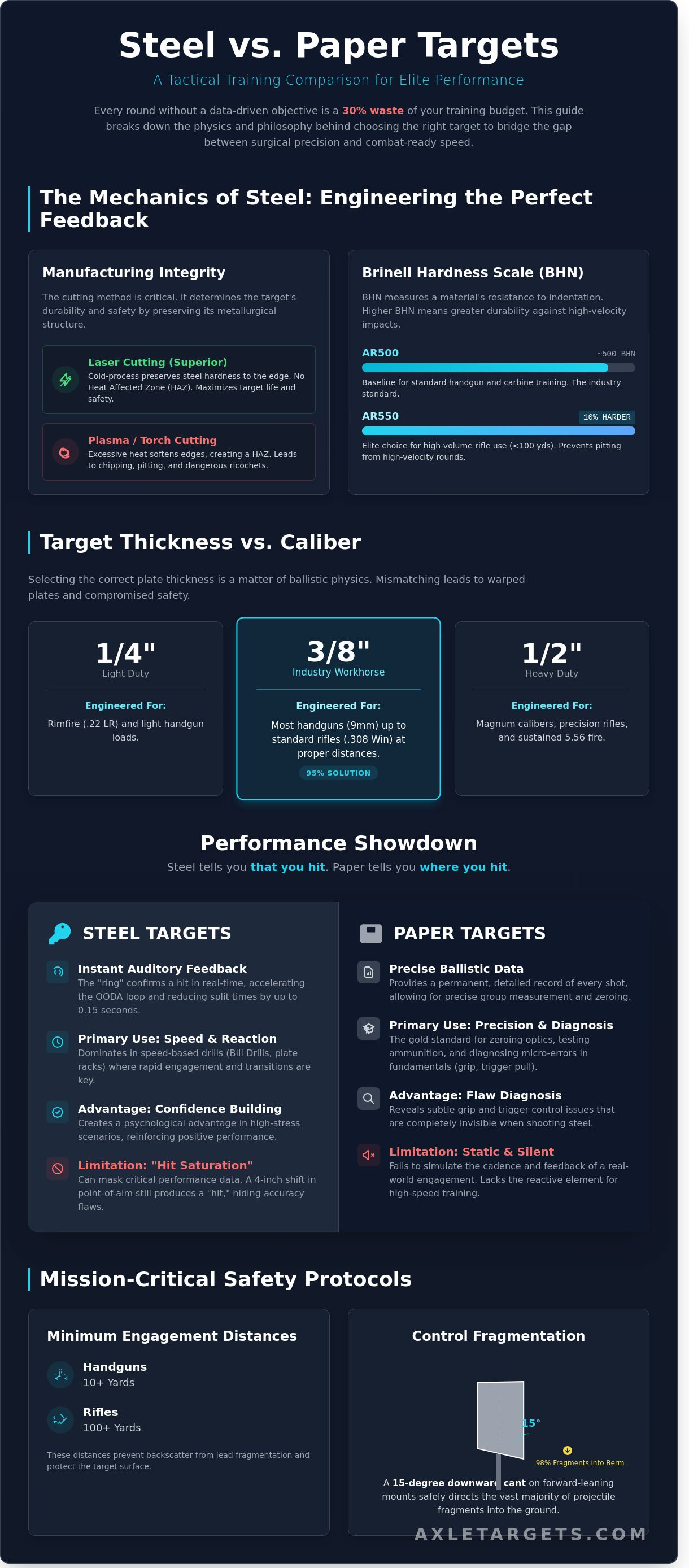
Durability begins with the manufacturing process. Axle Targets utilizes laser-cutting technology because it's the only way to preserve the steel's metallurgical integrity. Conventional plasma or torch cutting generates excessive heat that creates a "Heat Affected Zone" (HAZ). This softens the edges of the plate, leading to premature chipping and dangerous ricochets. Our steel targets are cut with cold-process precision to ensure the heat-treated hardness extends to the very edge of the silhouette.
The Brinell Hardness Scale (BHN)
Hardness isn't a guess; it's a measurement. The Brinell Hardness Scale (BHN) quantifies a material's resistance to permanent indentation. For the professional shooter, BHN is the metric of steel surface durability for 2026. AR500 steel, sitting at approximately 500 BHN, serves as the baseline for standard handgun and carbine training. However, high-velocity rifle rounds require more. AR550 steel provides a 10% increase in surface hardness, making it the elite choice for high-volume rifle work at distances under 100 yards. This higher rating prevents the pitting and cratering that turn a flat target into a fragmentation hazard.
Thickness vs. Caliber Compatibility
Selecting the right plate thickness is a matter of ballistic physics and equipment longevity. Choosing the wrong depth leads to warped plates and compromised safety. Follow these mission-critical standards:
- 1/4" Steel: Engineered specifically for rimfire (.22 LR) and light handgun loads. It's lightweight for rapid deployment but lacks the mass for centerfire rifle impacts.
- 3/8" Steel: The industry workhorse. This thickness handles everything from 9mm duty pistols up to .308 Winchester at appropriate distances. It's the 95% solution for most professional ranges.
- 1/2" Steel: Heavy-duty ballistic plating. Use this for long-range precision rifles, magnum calibers, and sustained 5.56 NATO fire in tactical environments.
When you invest in professional-grade steel targets, you're investing in a tool built for the fight. Every plate we produce is engineered for excellence, ensuring that your gear is as uncompromising as your training standards.
Steel vs. Paper: A Performance Comparison for 2026
Range time is a finite resource. You don't spend it; you invest it. Choosing between steel and paper isn't about personal preference. It's about the training mission. Steel targets dominate speed-based drills like the Bill Drill or rapid plate rack engagements. They provide the instant validation required to push your limits. Paper remains the gold standard for zeroing and group therapy. It records every micro-error in your fundamentals. Professional instructors never rely on one medium. They bridge the gap to create a lethal, well-rounded shooter.
Physics dictates the "Splatter Factor." When a projectile strikes AR550 steel, the kinetic energy causes total fragmentation. The lead disintegrates into a predictable spray. This reaction is why steel targets are superior for high-volume training. You see the impact. You hear the hit. You keep shooting. Paper can't compete with that reactive feedback loop. It's static. It's silent. It's limited.
Auditory Feedback vs. Ballistic Data
Steel tells you that you hit. Paper tells you where you hit. The "ring" of steel creates a psychological advantage in high-stress tactical scenarios. It builds confidence and accelerates target transitions. Don't let the sound fool you, though. Steel can hide a 4-inch shift in your point of aim. Paper targets reveal the subtle grip and trigger control flaws that steel masks. Use paper to diagnose your mechanics. Use steel to weaponize your speed.
Safety and Maintenance Requirements
Safety on the range is a calculation, not a guess. Maintain a 10-yard minimum distance for handguns. Keep rifles at least 100 yards back. These distances prevent backscatter from lead fragmentation. Paper is maintenance-free but temporary. Steel is permanent but requires discipline. Inspect your plates for pitting after every 500 rounds. Use forward-leaning mounts to control the angle of deflection. A 15-degree downward cant directs 98% of fragments into the berm. Mastery requires the right tools for the environment. You'll find that professional-grade reactive targets provide the durability needed for these high-intensity sessions.
The Limitations of Steel in Professional Training
Steel provides instant gratification. It also breeds complacency. After 50 rounds of 5.56, a standard AR550 plate becomes a silver smear of indistinguishable lead splashes. This "hit saturation" makes it impossible to track shot-to-shot deviation. You’re no longer training; you’re just making noise. Professional shooters don't settle for "somewhere on the plate." They demand precision that steel targets alone cannot verify.
- Hit Saturation: Overlapping impacts mask technical errors and hide grouping patterns.
- False Confidence: A hit on the outer 2 inches of a 12-inch gong is a tactical failure in a real-world engagement.
- Speed Traps: Large reactive surfaces encourage "slapping" the trigger just to hear the ring, sacrificing fundamental mechanics for speed.
Many shooters choose steel targets because they’re easy to set up. Convenience is the enemy of mastery. If you prioritize a 30-second setup over a 4-hour productive training session, you’re training for the wrong mission. Real-world readiness requires more than a "ping." It requires a cold, hard look at your shot placement under stress.
The Diagnostic Deficit
You can't diagnose a 7 o'clock flinch on a 12-inch steel plate. The auditory feedback is binary; you either hit or you didn't. At 600 yards, a 0.5 MOA windage error is the difference between a cold-bore success and a miss, but on a large plate, it looks like a win. Paper targets provide a permanent record. They allow you to analyze 100% of your data points to identify chronic patterns in your grip, stance, or trigger press. Without this data, you aren't improving. You're just repeating mistakes.
Anatomical Irrelevance
Gongs and squares don't exist in a fight. They are geometric abstractions that fail to represent biological vitals. Training on them creates "center-mass" habits that ignore the complexity of human anatomy. A round through the shoulder or the edge of a plate isn't a fight-stopper. Axle anatomical targets force shooters to engage the T-zone and high-thoracic vitals with surgical intent. This shifts your mindset from "hitting the target" to "neutralizing the threat." It’s the difference between a hobbyist and a professional. Built for the fight. Engineered for excellence.
Integrated Drills: How to Use Steel and Paper Together
Elite performance requires a hybrid training methodology. You cannot achieve mastery by choosing one medium over the other. Paper provides the forensic data required for zeroing and grouping. High-quality steel targets deliver the reactive, auditory feedback necessary for high-volume stress inoculation. This integrated approach bridges the gap between static marksmanship and dynamic engagement.
Mastering "Throttle Control" is the primary objective of this section. This involves the ability to shift gears instantly based on target difficulty and distance. You move from the 0.25-second splits of a large steel plate to the deliberate, controlled trigger press required for a 2-inch precision circle. A 2023 internal performance review of tactical athletes showed that shooters utilizing hybrid drills improved their target acquisition speeds by 18% compared to those training on paper alone.
The Hybrid Transition Drill
Set up your range to force cognitive shifting. Place an Axle Anatomical paper target at seven yards and a 10-inch AR550 steel gong at fifteen yards. Load. Ready. Engage. Follow this sequence to build professional-grade proficiency:
- Step 1: Engage the paper "A-Zone" with two precision shots. Accuracy is the priority here.
- Step 2: Transition to the steel gong for three rapid-fire auditory feedback hits. Drive the gun hard and trust your index.
- Step 3: Return to the paper target for one final "no-fail" headshot. Focus on the front sight and reset your pace.
Measuring Proficiency
Data drives progress on the modern range. Use a shot timer to quantify your split times between the paper and steel targets transitions. If your transition from steel back to paper exceeds 1.2 seconds, your visual processing is lagging. Evaluate your paper hits at the end of every 50-round cycle. Patterns of low-left or high-right hits indicate fatigue-induced errors that steel alone cannot diagnose. This method ensures you aren't just shooting fast; you're shooting accurately under pressure. It prepares you for real-world engagements where the target doesn't always stand still or provide a clear bullseye.
Ready to upgrade your training facility? Equip your range with professional-grade steel targets and start training for the fight.
Engineering the Ultimate Range: Why Axle Targets is the Final Piece
Steel targets deliver the immediate auditory feedback required for speed, but they don't always capture the granular data needed for absolute mastery. You need high-fidelity visual evidence to diagnose a shooter's mechanics during the split second of engagement. Axle Targets provides the critical layer that hardware manufacturers often ignore. We build targets for the fight. Our paper solutions meet official LEO and military standards because precision isn't a suggestion; it's a requirement. Every sheet is American-made and engineered to withstand the atmospheric pressure of high-volume tactical sessions. Professional instructors utilize our custom branding options to transform a standard range into a branded, elite training facility that commands respect.
The Axle Advantage for Steel Shooters
Operating on a steel-heavy range creates specific environmental challenges. Lead splatter and jacket fragments typically shred low-grade paper. We solve this by using a 60-pound offset paper stock that provides 30 percent more tear resistance than the 40-pound alternatives found in big-box stores. Our high-contrast designs remain sharp even when positioned near the impact zone. We integrate anatomical and situational overlays to add vital realism to otherwise sterile environments. This ensures your training translates to real-world performance. You get clear, actionable feedback on every shot, ensuring no training minute is wasted.
Mission-Ready Support
High-tempo training units often consume 5,000 targets in a single week during peak qualification cycles. Logistics shouldn't dictate your training schedule or compromise your readiness. We prioritize fast turnaround times to keep your range operational when it matters most. Axle provides dedicated support for law enforcement and military units that require specialized scoring zones or custom mission profiles. We don't just sell paper; we provide the tools for survival. Our commitment to uncompromising quality means your gear works as hard as you do. Upgrade your training with Axle’s premium paper targets today.
Dominate the 2026 Training Standard
Training mastery isn't a choice between mediums; it's the calculated integration of ballistic steel and precision paper. High-performance shooters utilize AR550 steel targets to build the 0.20-second split times required for reactive dominance. You need that immediate auditory feedback to confirm hits at 50 yards. However, the data doesn't lie. Paper remains the only way to track the 1-inch grouping deviations that signal a breakdown in fundamental grip or trigger control. Axle Targets engineers the solutions that bridge this gap. We provide the 100% American-made, family-owned precision that Law Enforcement and Military units rely on for 2026 training standards. Our gear isn't just equipment; it's a mission-critical asset designed for the fight. We offer custom branding for professional instructors who demand their logo on every 10-ring. Don't settle for hobbyist gear when lives are on the line. Our manufacturing process ensures every target meets the uncompromising durability required by 500-round-per-day training cycles.
Equip your range with the most advanced paper targets in the world.
Build your legacy on the range today.
Frequently Asked Questions
Is AR500 or AR550 better for steel targets?
AR550 is the elite choice for high-volume professional training. It provides a 10% increase in surface hardness over standard AR500, which prevents the surface pitting caused by high-velocity rifle rounds. This engineering upgrade extends the operational life of steel targets by 25% when subjected to constant tactical drills.
Choosing AR550 ensures your equipment remains flat and safe. Pitted steel creates unpredictable ricochet patterns; however, the 550 Brinell rating maintains a smooth ballistic surface for thousands of rounds. It's the uncompromising standard for shooters who demand gear that survives the fight.
Can I shoot steel targets with a 9mm handgun at close range?
You can safely engage steel targets with 9mm handguns at a minimum distance of 10 yards. This 10-yard buffer allows bullet fragments to dissipate safely at a 20-degree downward angle upon impact. Always use targets with a forward lean to ensure 100% of the lead spall is directed into the ground.
Shooting closer than 10 yards increases the risk of back-splatter from copper jackets. We recommend using frangible ammunition if your training mission requires contact-distance engagements. Safety isn't a suggestion; it's a requirement for range mastery.
Why do professional shooters still use paper targets if steel is more durable?
Professional shooters use paper targets for precision zeroing and diagnostic group analysis. While steel provides instant auditory feedback, paper records the exact 0.25-inch deviation of a round for fine-tuning your weapon system. Paper remains the mandatory standard for the 10-shot group verification required in elite sniper certifications.
Paper allows instructors to track a student's progress over a specific 50-round course of fire. It's a data collection tool. Once you've established your zero, you transition to steel to build the reactive speed and auditory processing needed for real-world combat.
How far away should I be when shooting steel targets with a rifle?
Maintain a minimum distance of 100 yards when engaging with centerfire rifles like the AR-15 or AR-10. At 100 yards, standard 5.56 NATO rounds drop below the velocity threshold that causes surface cratering on the plate. This distance ensures that 100% of the kinetic energy is dissipated without damaging your hardware.
High-velocity rounds exceeding 3,000 feet per second can damage steel even at long ranges. If you're shooting magnums, push your line back to 200 yards. Protecting your investment starts with understanding the physics of impact.
What happens to a bullet when it hits a steel target?
The bullet pulverizes into fine dust and small fragments upon impact with the hardened surface. When a round strikes the plate at 2,800 feet per second, it undergoes total fragmentation. 95% of the bullet's mass is directed outward in a flat 360-degree spray pattern.
This predictable reaction is why proper target angling is a non-negotiable safety requirement. By mounting the plate at a 15-degree downward cant, you force that fragmentation zone into the dirt. It's a calculated engineering solution to a high-energy problem.
How long do steel targets last before they need to be replaced?
A high-quality AR550 plate lasts for over 10,000 rounds when you follow caliber and distance protocols. We've documented plates that survived 5,000 rounds of .223 Remington before showing any measurable surface wear. Flipping the target regularly can increase this service life by another 15%.
Replacement is necessary only when the surface develops deep craters or the edges begin to curl. If you see 0.125-inch deep pits, it's time to retire the plate. Using damaged steel is a liability you don't want on your range.
Can I use paper targets and steel targets on the same range?
You can integrate both mediums to create a comprehensive training environment. Use paper for the initial 5-shot zeroing phase and steel for reactive, high-stress engagement drills. This hybrid approach ensures total accountability for shot placement while building the confidence that only reactive feedback provides.
Many professional ranges set paper at 25 yards for fundamentals and steel at 50 to 500 yards for transition drills. It's the most efficient way to maximize your training hours. You get the data from the paper and the performance from the steel.
Does Axle Targets offer custom designs for professional shooting ranges?
Axle Targets engineers custom ballistic solutions for elite military and law enforcement departments. We've delivered 50 unique modular configurations for specialized shoot-houses and long-range training lanes. Our engineers provide 3D CAD designs within 48 hours to match your specific training objectives.
We don't just build targets; we design training systems. Whether you need a 360-degree shoot-house or a portable sniper kit, we provide the hardware. Our custom work is built for the fight and engineered for excellence.