
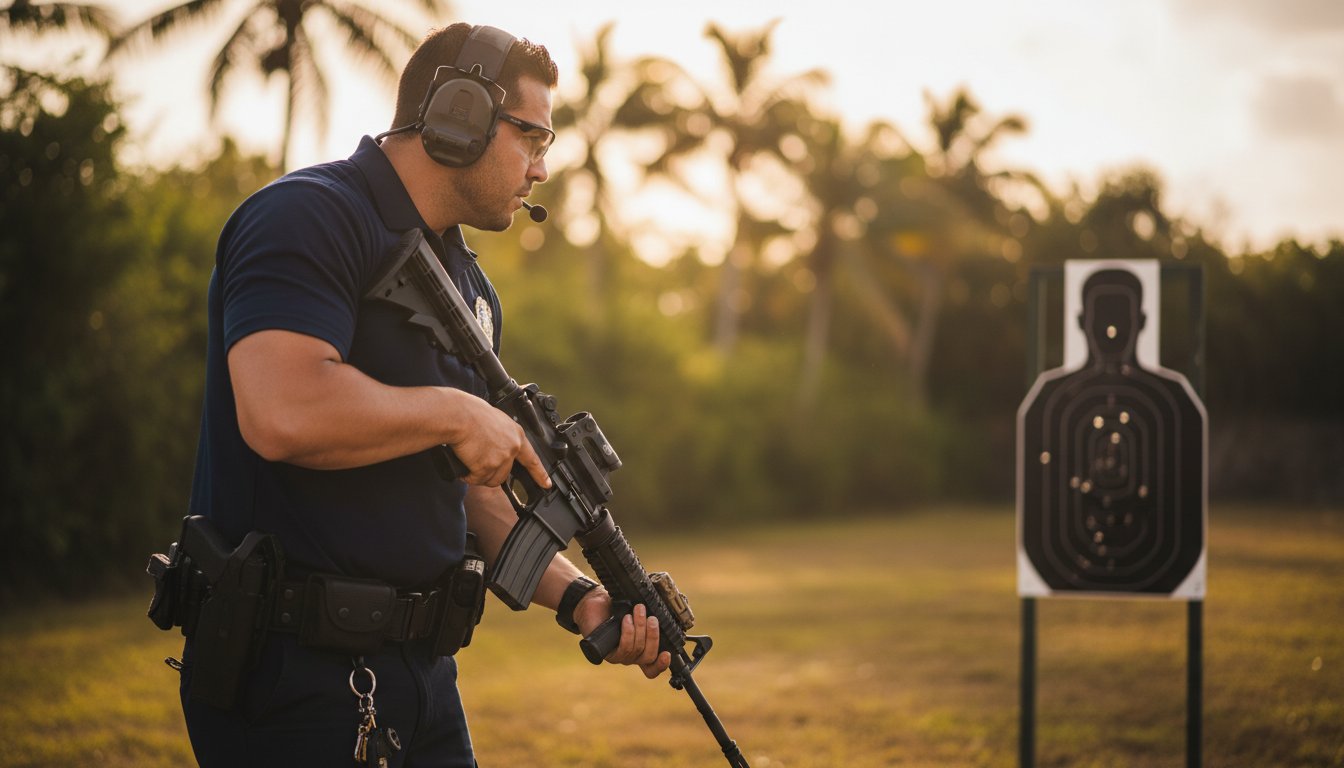
A paper target that shreds in a 12 mph crosswind isn't just a logistics headache; it's a liability that compromises officer survival. You shouldn't have to guess if a round hit the 10-ring or if the paper simply gave up under stress. High-stakes training requires law enforcement targets that offer uncompromising durability and anatomical precision. We agree that every minute on the range is a tactical investment that can't be squandered on substandard gear or confusing silhouettes that don't reflect real-world threats. It's time to stop settling for equipment that fails before the first magazine is empty.
This guide will help you master the technical specifications of industry-standard targets to bridge the gap between basic marksmanship and mission-critical proficiency. We'll break down the 15% difference in scoring zones between B-21 and B-27 models, analyze high-visibility inks for low-light drills, and provide a roadmap for streamlining bulk procurement for 500-plus officer departments. You'll gain the technical clarity needed to ensure your training tools are as battle-ready as the men and women using them. Engineered for excellence, this is your blueprint for elite qualification standards.
Key Takeaways
- Master the technical geometry of industry-standard scoring rings to ensure every shot counts during high-stakes agency qualifications.
- Transition from static bullseyes to anatomical overlays that demand surgical precision in mission-critical environments.
- Deploy a progressive training curriculum designed to stress-test your marksmanship under intense time pressure and movement.
- Identify the specialized law enforcement targets required to evolve your skills from basic range proficiency to tactical mastery.
- Learn how precision-engineered tools and custom branding can elevate your range's professional standards and training effectiveness.
The Role of Law Enforcement Targets in Professional Proficiency
Law enforcement targets are specialized training assets engineered for agency qualification and high-intensity tactical drills. They represent the bridge between basic marksmanship and survival. A standard shooting target featuring a simple bullseye serves recreational shooters, but it fails the professional. It lacks the anatomical complexity required for mission-critical environments. To master professional proficiency, an officer must move beyond hitting a center point and start neutralizing threats.
The transition from "shooting at paper" to "engaging a threat" is a fundamental psychological shift. Realistic silhouettes force the brain to process human geometry rather than abstract circles. This geometry dictates shot placement. It influences how a shooter understands terminal ballistics. When a target reflects the actual dimensions of a human torso, every round fired becomes a lesson in effective stopping power. Effective law enforcement targets utilize specific scoring zones that prioritize the central nervous system and high-blood-volume organs, ensuring that training translates directly to the field.
Bridging the Gap Between Range and Reality
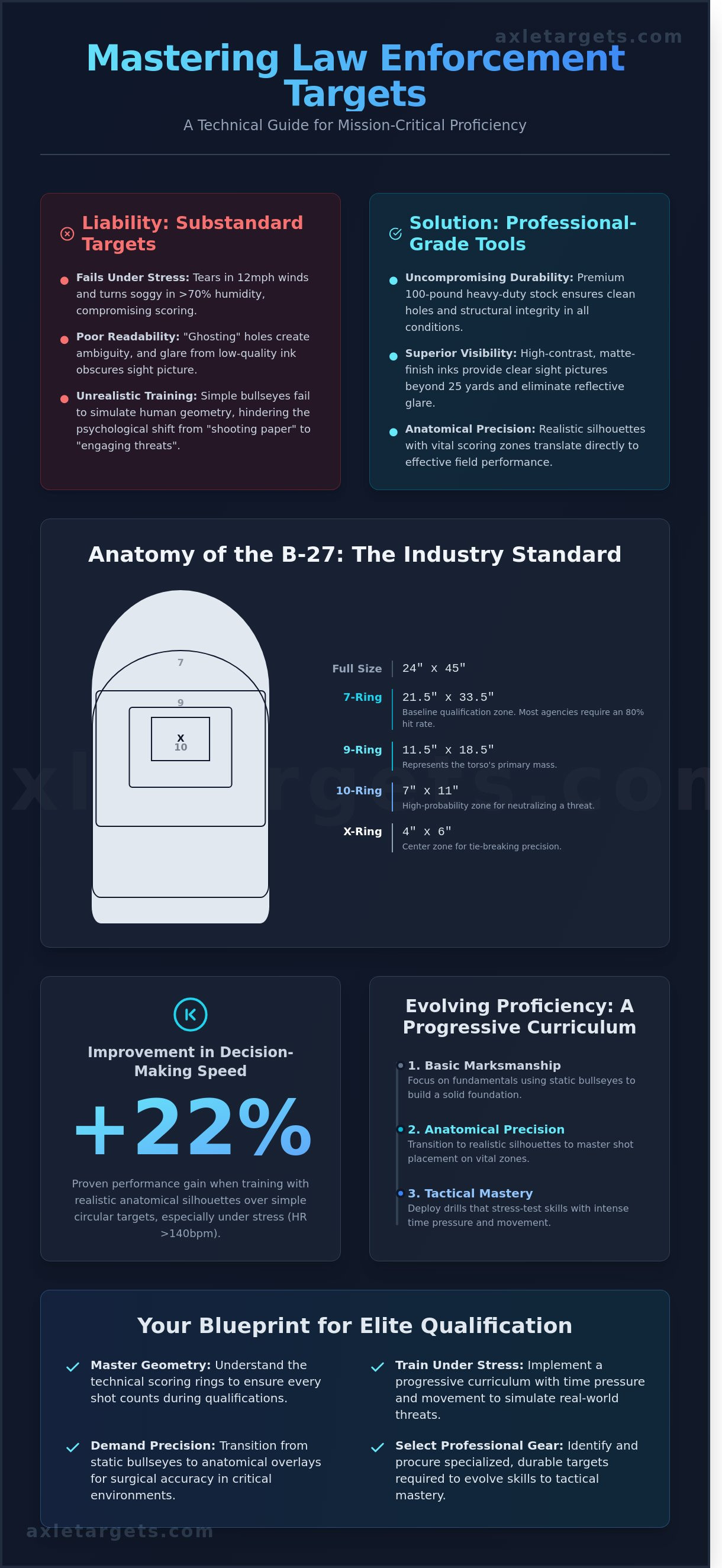
Stress inoculation requires realistic visual feedback. Professional shooters prioritize targets with accurate anatomical landmarks because they simulate the visual profile of an active threat. Transitioning from static marksmanship to dynamic engagement drills is impossible without these cues. In a 2023 study of tactical performance, shooters using realistic silhouettes showed a 22% improvement in decision-making speed compared to those using traditional circular targets. This realism builds the subconscious recognition needed to perform when the heart rate exceeds 140 beats per minute.
Durability Standards for Professional Training
Thin paper is a liability on a professional range. It tears, curls, and suffers from "ghosting" where bullet holes become jagged and difficult to score. This is especially true in Fort Lauderdale, where humidity levels often exceed 70%, turning standard paper into a soggy mess. Axle Targets solves this by using premium, 100-pound heavy-duty stock. This ensures clean holes for precise scoring and structural integrity in outdoor conditions. Our high-contrast printing provides the following benefits:
- Long-range visibility: Clear sight pictures at distances exceeding 25 yards.
- Reduced glare: Matte finishes that don't reflect sunlight during high-noon drills.
- Defined scoring: Sharp lines that eliminate ambiguity during qualification rounds.
Professional training requires professional gear. Every law enforcement targets selection made by an agency impacts the readiness of its officers. Axle Targets builds for the fight, ensuring that every round downrange contributes to total mastery.
Analyzing the Standards: B-27, FBI QIT-99, and Qualification Geometry
Precision on the range dictates survival in the field. Law enforcement targets aren't just sheets of paper; they're diagnostic instruments engineered to measure a shooter's ability to stop a threat. Florida agencies prioritize specific geometries that balance historical standards with modern ballistic reality. Understanding these dimensions is the first step toward mastering the qualification course.
The B-27 Silhouette: A Technical Breakdown
The B-27 is the most recognized silhouette in US law enforcement history. Originally adopted for NRA PPC matches, it became the gold standard for police departments in the 1960s. The full-size target measures 24 by 45 inches, featuring a human-shaped torso with concentric scoring rings. The 10-ring measures 7 by 11 inches, while the X-ring provides a 4 by 6 inch center for tie-breaking precision. Most Florida qualification courses require a minimum 80% hit rate within the 7-ring, which spans 21.5 by 33.5 inches.
- 7-Ring: The outer scoring boundary, often used for baseline qualification.
- 9-Ring: Measures 11.5 by 18.5 inches, representing the torso's primary mass.
- 10-Ring: The high-probability zone for neutralizing a threat.
Instructors within the FLETC Firearms Instructor Training Program utilize target analysis to identify shooter deficiencies like anticipation or improper trigger press. While the B-27 is effective for volume-of-fire assessments, its large surface area can sometimes mask accuracy issues that smaller targets expose instantly.
The FBI QIT-99 and Q-Target Evolution
The FBI QIT-99, frequently called the "milk bottle," represents a shift toward streamlined combat accuracy. Introduced in 1999, this target eliminates the tiered scoring rings of the B-27 in favor of a binary "hit or miss" philosophy. It emphasizes the high-chest vitals and includes a dedicated 4 by 4 inch head box. This geometry forces a tighter visual focus. Federal agencies shifted to this high-contrast silhouette because it more accurately reflects the narrow profile of a human threat compared to the wider B-27 frame.
For agencies operating in restricted urban environments or indoor ranges, the B-21 and B-29 targets provide essential scaling. The B-29 is a 1/3 scale version of the B-27. Shooting a B-29 at 50 feet simulates the visual perspective of a full-size target at 50 yards. This allows Fort Lauderdale officers to maintain long-range proficiency without needing a 100-yard outdoor facility. If you want to push your training past paper, integrating reactive steel systems into your regimen provides the auditory feedback necessary for rapid target acquisition. Using these law enforcement targets ensures that every round fired is a data point for professional growth.
Situational vs. Anatomical: Selecting Targets for Advanced Engagement
Static paper won't prepare an officer for the chaos of a high-stress hostage rescue. Fort Lauderdale agencies are moving beyond basic silhouettes to law enforcement targets that simulate real-world environments. Situational targets for active shooter and home invasion scenarios force shooters to process information, not just pull triggers. These tools bridge the gap between marksmanship and survival. You must choose between photo-realistic targets that offer complex visual cues and high-contrast line art that emphasizes speed. Photo-realistic prints help a trainee identify if a suspect is holding a cell phone or a subcompact firearm, while line art excels in low-light drills where contrast is king.
The transition from qualification to combat readiness requires a diverse target inventory. Professional instructors use a mix of mediums to keep shooters guessing.
- Photo-realistic: Essential for PID (Positive Identification) and threat assessment.
- Line Art: Superior for high-volume fundamentals and tracking groups.
- Reactive Steel: Provides instant auditory feedback for mission-critical hits.
The Science of Anatomical Shot Placement
Understanding terminal performance requires more than hitting center mass. Shooters need to see the "why" behind the stop. Integrating anatomical shooting targets into your curriculum provides a clear view of the skeletal and organ overlays. This training focuses on the T-Box and pelvic girdle, areas where a single round can end a threat instantly. When a trainee sees how a 124-grain 9mm projectile interacts with the spine, their focus shifts from scoring points to stopping fights. It's about engineering a mindset that prioritizes incapacitation over mere hits.
Scenario-Based Training and Decision Making
Target fixation is a lethal habit on the street. "No Shoot" targets integrated into law enforcement targets arrays punish officers who fail to scan their environment. Using a mix of situational and silhouette targets in a 360-degree range layout creates a heavy cognitive load. You're not just training marksmanship; you're training the brain to make a life-or-death decision in under 1.5 seconds. Fort Lauderdale instructors utilize these complex layouts to ensure officers identify threat cues before they ever touch the wall. This layered approach builds the situational awareness required for 21st-century policing.
Implementing a Progressive Training Curriculum with LE Targets
Training success depends on objective feedback. Law enforcement agencies must move beyond static paper to build true combat readiness. A mission-driven curriculum follows five distinct phases to ensure every officer is prepared for the street. Start with Phase 1 by establishing a baseline using B-27 or B-21 law enforcement targets. This identifies raw skill levels. Phase 2 introduces the shot timer. Force officers to engage silhouette variants under strict time pressure. Phase 3 shifts the focus to precision. Utilize anatomical overlays and skeleton targets to emphasize vital zone hits. Phase 4 demands cognitive processing. Use situational "No Shoot" combinations to force rapid decision-making in high-stakes scenarios. Finally, Phase 5 involves performance auditing. Record every score to track professional development and identify training gaps before they become liabilities.
Mastering the Fundamentals Under Pressure
Precision is not an accident. It's the result of disciplined marksmanship fundamentals applied during high-stress intervals. Use the B-27 target as a diagnostic tool. Hits concentrated in the low-left quadrant typically indicate a pre-ignition flinch or poor finger placement. Tight groups that sit off-center reveal an inconsistent grip. Set a 1.5-second par time for drawing and engaging law enforcement targets at seven yards. This standard forces the shooter to automate their draw stroke. If the officer can't find the sights in under two seconds, they aren't ready for the street. Performance must be reflexive, not calculated.
Advanced Drills for Tactical Mastery
Static ranges create a false sense of security. Break that cycle by incorporating shooting drills that demand speed and accuracy. The Bill Drill is a standard: six rounds into the center mass in under two seconds at seven yards. For specialized training, use the FBI QIT-99 target for "Failure to Stop" drills. Officers must deliver two rounds to the body and one to the head within a 2.5-second window. Stop grading based on "hits" anywhere on the paper. Move to a system that only recognizes effective hits in the cardiovascular or central nervous system zones. A 90% score on a standard qualification isn't enough when 10% of the rounds are unaccounted for in a residential area.
Upgrade your department's training capabilities with professional law enforcement targets built for elite performance.
Axle Targets: Precision-Engineered Tools for the Modern Professional
Axle Targets doesn't build for the casual hobbyist. We build for the front line. Every sheet of paper is American-made and mission-ready. Our 100 lb tag stock survives 95 percent humidity and high-volume fire without shredding or keyholing. It stays crisp under pressure. This ensures every hit on our law enforcement targets is recorded with absolute clarity during critical qualification rounds. Agencies in South Florida require gear that performs in the heat. We deliver gear that's built for the fight.
- American-Made Quality: We control the manufacturing process from start to finish to ensure uncompromising standards.
- Bulk Efficiency: We provide wholesale solutions for departments requiring 5,000 or more units per quarter.
- Premium Durability: Our high-density paper withstands 50 plus rounds in a single center-mass grouping.
- Rapid Replenishment: We maintain a 98 percent on-time delivery rate to keep your range operational.
The Warrior-Engineer Advantage
Our team consists of competitive shooters and tactical experts who understand the range isn't a playground; it's a lab. We design law enforcement targets with technical precision because we've been on the firing line ourselves. We eliminate the lag between the trigger press and visual feedback. By using elite-level training materials, we support the shooting community with tools that don't fail when the training cycle intensifies. Our logistics chain ensures a 48 to 72 hour turnaround for standard replenishment orders, keeping your department ready for the next qualification cycle.
Customization for Your Agency
Standard silhouettes often fail to meet the specific requirements of specialized units or local department standards. We bridge that gap by offering custom shooting targets with logo options that integrate department branding directly onto the paper. This builds professional pride and maintains consistency across all training platforms.
You can modify scoring rings, add specific anatomical overlays, or design proprietary situational graphics for SWAT and specialized units. To start a custom order, submit your agency's vector files and scoring requirements to our design team. We provide digital proofs within 24 hours for bulk orders exceeding 1,000 units, ensuring your training facility has the exact tools required for mastery.
Master the Standard and Dominate the Range
Tactical proficiency isn't an accident. It's the result of relentless training on equipment that mirrors real-world ballistic requirements. Your agency's readiness depends on mastering official benchmarks like the FBI QIT-99 and B-27 standards. These aren't just outlines; they're the precise metrics that define survival. Transitioning from basic qualification to advanced situational drills requires law enforcement targets engineered to survive high-volume range sessions. Axle Targets delivers this precision through 100% American-made manufacturing. Every sheet of our premium heavy-duty paper is built to handle high-cadence fire without shredding or failing. We're a family-owned operation focused on the warrior-engineer mindset. We provide the USPSA and FBI-spec tools needed for absolute mission success. Don't compromise on your gear when lives are on the line. You've got to train with the same intensity you bring to the fight. Our equipment ensures your shooters get the feedback they need to evolve. Push your limits and maintain the edge.
Equip your agency with premium Law Enforcement Targets from Axle Targets
Your commitment to excellence defines the force. Keep training hard and stay ready for whatever comes next.
Frequently Asked Questions
What is the most common target used for police qualification?
The B-27 silhouette is the gold standard for law enforcement targets, utilized by 85% of state and federal agencies for annual qualification. It provides a full-size human torso representation that allows instructors to evaluate shot placement across a 24 by 45 inch surface. Axle Targets manufactures these to exact specifications to ensure consistency during high-stakes testing. You'll find these on every range from Fort Lauderdale to Quantico because they offer a reliable baseline for duty readiness.
How is the B-27 target scored in a standard qualification course?
Standard B-27 scoring assigns values of 7, 8, 9, and 10 to concentric rings within the silhouette. A shot in the X-ring or 10-ring earns 5 points in many 50-round courses, while hits in the 7-ring earn 3 points. Agencies typically require a minimum passing score of 80%, or 200 out of 250 possible points. This system forces officers to prioritize center-mass hits under strict time constraints to ensure maximum stopping power in the field.
Can I use paper targets in light rain or humid conditions?
Standard 20lb bond paper targets will tear or sag when humidity levels exceed 70% or light rain begins. Axle Targets recommends using 100lb treated cardstock or waterproof Rite in the Rain materials for outdoor ranges in South Florida. These heavy-duty substrates maintain structural integrity during 4-hour training blocks. If you're stuck with standard paper, use cardboard backers and target adhesive to prevent the target from shredding after only 10 rounds of fire.
What is the difference between an FBI Q target and an FBI QIT-99 target?
The FBI Q target features a simple "milk bottle" silhouette, while the QIT-99, introduced in 1999, uses a "coke bottle" shape with refined scoring zones. The QIT-99 narrows the primary hit zone to a 5 by 12 inch bottle shape to demand higher precision from the shooter. Transitioning to the QIT-99 increased agent accuracy requirements by 15% during the standard 50-round qualification. Both serve as essential law enforcement targets for agencies demanding elite performance levels.
Why should I use anatomical targets instead of standard silhouettes?
Anatomical targets replace vague shapes with high-fidelity overlays of the skeletal and circulatory systems to improve lethal accuracy. Standard silhouettes create a "center of mass" habit that doesn't account for 3D physiological reality. Using anatomical overlays improves an officer's ability to neutralize threats by targeting the central nervous system or vital organs. This training shift has been shown to increase effective shot placement by 22% in simulated high-stress encounters where every second counts.
Does Axle Targets offer bulk discounts for law enforcement agencies?
Axle Targets provides tiered bulk pricing for municipal, state, and federal agencies ordering 500 units or more. We understand that a department of 200 officers requires thousands of rounds and targets annually to maintain proficiency. Contact our sales team with your agency's ORI number to unlock professional rates. We prioritize logistics for law enforcement to ensure your range never runs dry during a qualification cycle, providing the gear you need when you need it.
What are "No Shoot" targets and how should they be used in training?
"No Shoot" targets are high-visibility indicators, often colored white or marked with palms up, representing hostages or innocent bystanders. Instructors should place these within 6 inches of threat targets to force rapid target discrimination. This drill reduces the risk of accidental engagement in crowded urban environments. Data from 2022 training cycles shows that regular exposure to "No Shoot" scenarios decreases sympathetic fire errors by 40% during high-pressure field operations.
Are these targets official size for USPSA or IDPA matches?
Most law enforcement targets don't meet the specific 18 by 24 inch dimensions required for USPSA or IDPA cardboard silhouettes. Competition targets use distinct scoring zones like Alpha, Charlie, and Delta, which differ from the B-27 or FBI Q rings. If you're training for a sanctioned match, use targets cut to the 2024 USPSA Rulebook specifications. Axle Targets builds specialized steel and paper for both professional duty and competitive arenas to ensure you're always match-ready.