

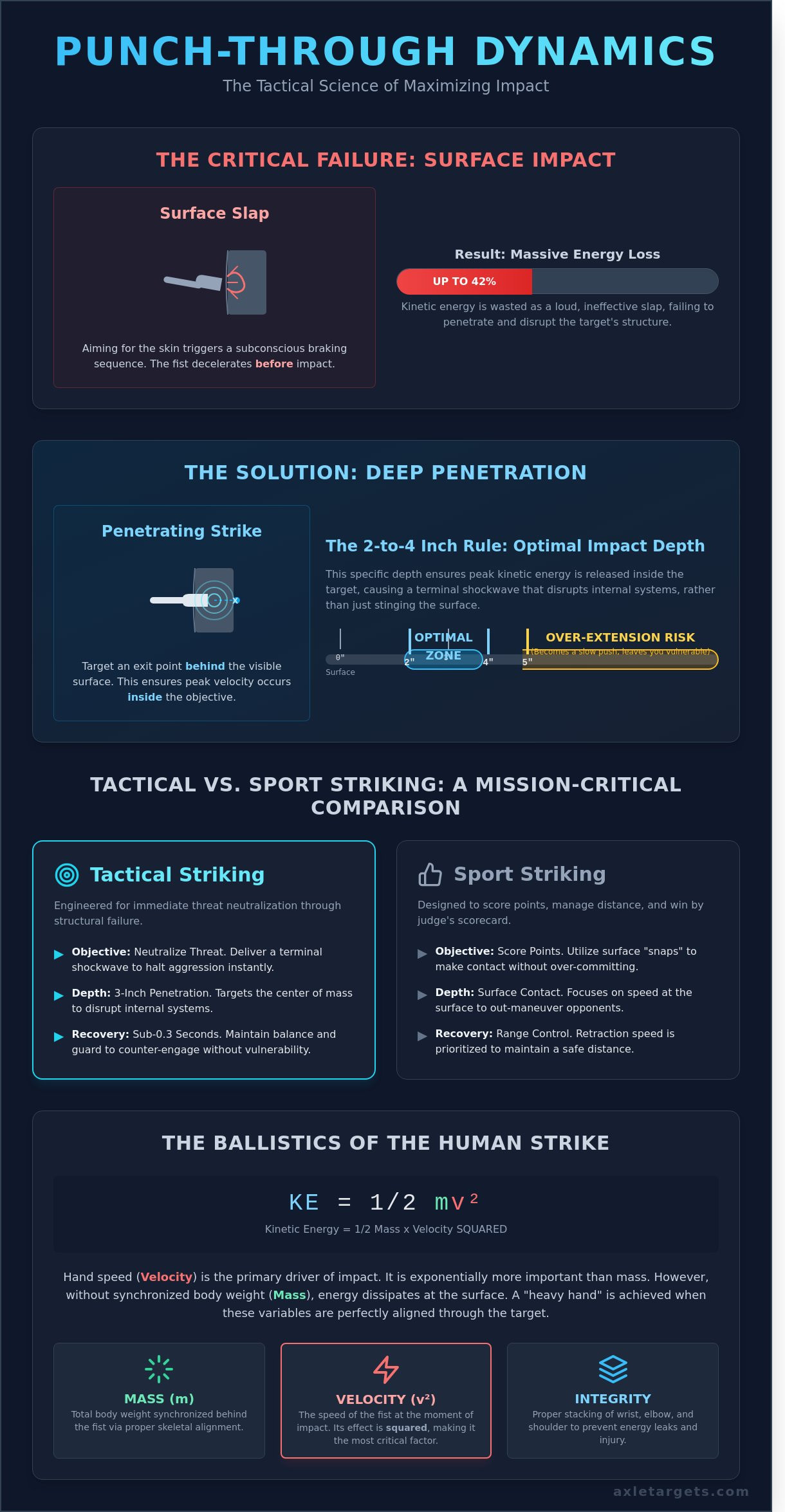
Most fighters stop their momentum at the point of contact, turning a lethal strike into a loud but ineffective slap. It's a critical failure in tactical mechanics. You've likely spent rounds on the heavy bag wondering why your high-effort strikes lack true knockout power or leave you with nagging wrist injuries. If you are hitting the surface rather than driving through the core, you are losing up to 42% of your potential kinetic energy before it even reaches the target. This guide answers the fundamental question of how far should you push into a target when punching to achieve total structural impact.
Mastering the "punch-through" technique is about more than just aggression; it's about engineering a repeatable depth of 2 to 3 inches past the target's exterior. We'll break down the physics of energy transfer and the anatomical alignment needed to prevent hand fractures during high-velocity engagements. You'll learn how to treat every strike as a ballistic event that terminates deep inside the objective. It's time to stop slapping and start neutralizing threats with the precision of a warrior-engineer. This is how you maximize impact while maintaining uncompromising structural integrity.
Key Takeaways
- Stop hitting the surface; learn to target the point behind the visible plane to prevent deceleration and maximize impact force.
- Master the ballistics of the human strike by synchronizing total body mass with hand velocity to engineer peak kinetic energy.
- Identify exactly how far should you push into a target when punching to generate a terminal shockwave that penetrates deep into the anatomy.
- Implement mission-critical drills like the "Wall Drill" to refine your distance management, structural alignment, and striking precision.
- Transition to anatomical targets to visualize internal exit points and master the tactical difference between surface strikes and deep penetration.
The Mechanics of the Punch-Through: Why Surface Impact Fails
Striking the surface of a target is a failure of physics. When you aim for the skin, your brain initiates a braking sequence to protect your hand from damage. This subconscious reaction causes the fist to decelerate before it ever makes contact. To achieve maximum energy transfer, you must target a point deep inside the objective. This is the punch-through. It's the difference between a surface sting and total structural failure. Professional operators understand that how far should you push into a target when punching determines the ballistic outcome of the engagement.
Effective striking relies on the 2-to-4 inch rule. This specific depth ensures that peak kinetic energy is released inside the target rather than on its exterior. There's a critical distinction between a "push" and a "penetrating strike." A push is slow; it moves the target's center of mass but lacks the velocity to create a shockwave. A penetrating strike maintains high velocity through the point of impact, delivering a concentrated burst of force that disrupts internal systems. In tactical environments, speed and depth must coexist to ensure the threat is neutralized instantly.
- Surface Strikes: Result in skin-level trauma but zero structural disruption.
- The 2-to-4 Inch Rule: Delivers maximum energy to the internal organs and skeletal frame.
- The Push Flaw: Extending beyond 5 inches turns a strike into a slow shove, leaving the striker overextended.
The Deceleration Trap
The human mind naturally fears impact. This fear results in the deceleration trap, where strikers pull their punches at the exact moment of contact. Data suggests that surface-level striking wastes up to 40% of generated kinetic energy because the fist is already slowing down to "safety" speeds upon impact. You must ignore the entry point. Focus your visual and physical intent on an exit point located on the far side of the target. This psychological shift ensures peak velocity occurs at the moment of contact, not before it.
Tactical vs. Sport Striking Depth
Sport boxing utilizes snaps to score points and maintain range. Tactical striking is different. It demands penetration to achieve immediate structural disruption. You aren't looking for a judge’s scorecard; you’re looking to shut down a threat. Penetrating the center of mass by 3 inches delivers the shock necessary to halt aggression. Knowing how far should you push into a target when punching is a balance of power and safety. Over-extension is a liability. You must drive through the target while maintaining the ability to recover your guard in under 0.3 seconds. Anything deeper than 4 inches risks your balance and leaves you vulnerable to a counter-engagement.
Ballistics of the Human Strike: Engineering Peak Kinetic Energy
Kinetic energy (KE) isn't a suggestion; it's a physical law. The formula KE = 1/2 mv² dictates the lethality of every strike you throw. In this equation, velocity (v) is squared, making hand speed the primary driver of impact potential. However, speed alone is insufficient. Without mass (m) behind the strike, energy dissipates at the surface like a splash of water. To achieve true terminal ballistics, your body weight must follow your hand's velocity into the target. Understanding how far should you push into a target when punching requires identifying the "Sweet Spot" where peak acceleration meets maximum structural rigidity.
- Velocity: The speed of the fist at the microsecond of impact.
- Mass: The amount of body weight effectively coupled to the strike through skeletal alignment.
- Structural Integrity: The stacking of the wrist, elbow, and shoulder to prevent energy leakage.
When these variables align, you create a "heavy hand." This isn't about pushing; it's about driving. If you push, you're using muscle to move an object after contact. If you drive, you're transferring stored kinetic energy through the object. Professional fighters and tactical operators aim for a target depth of 4 inches to ensure internal shockwaves reach vital structures. Effective training on high-performance reactive systems helps shooters and strikers alike visualize this depth through immediate feedback.
The Role of Mass Displacement
Arm-punching is a tactical failure. It relies on the triceps and deltoids, which lack the mass to generate significant force. Regardless of how far you "push," an arm-punch loses 60% of its potential energy at the surface. The Warrior-Engineer approach treats the arm as a rigid ballistic strut rather than a flexible whip. By rotating the hips and bracing the core, you displace your entire center of mass into the strike. This alignment allows for 4-inch penetration, turning a superficial hit into a catastrophic internal event. A "heavy hand" is simply a fast hand that refuses to buckle upon impact.
Timing the Kinetic Peak
Precision timing ensures your strike reaches its highest velocity at the exact moment of engagement. You must time the impact so the arm is at 90-95% extension when it reaches the 2-inch penetration mark. If you reach 100% extension at the surface, your velocity has already peaked and is beginning to drop. This leads to zero power transfer and increases the risk of hyperextension injuries. Kinetic peak is the moment maximum velocity meets structural reinforcement. By targeting the 4-inch mark, you ensure the "how far should you push into a target when punching" metric is met while your arm is still in its most powerful phase of acceleration. This 5% margin of flex in the elbow protects your joints while delivering a focused, uncompromising payload of energy.
Surface Snapping vs. Deep Penetration: A Tactical Comparison
Distance dictates damage. A surface snap is a range-finding tool; a deep penetration strike is a fight-stopper. Determining how far should you push into a target when punching requires understanding the "Shockwave" effect. Driving 3 inches past the point of impact creates a high-velocity pressure wave. This kinetic energy does not stop at the skin. It travels through soft tissue, displacing fluid and rattling the skeletal structure. While a surface strike relies on speed to create a "sting" response, deep penetration focuses on structural compromise. In a high-stakes environment, you aren't looking for a reaction. You are looking for a shutdown.
Internal Disruption vs. External Bruising
Surface strikes create superficial trauma. They cause localized pain and bruising but rarely end a violent encounter. Penetration of 3 to 4 inches targets the mission-critical systems. This depth reaches the liver, solar plexus, and carotid sinus. Disrupting these areas causes immediate neurological failure or physiological collapse. Visualizing these depths is impossible on a blank silhouette. Professional operators use anatomical shooting targets to map internal organ placement against their striking lanes. Precision matters. A 2-inch deviation can be the difference between a glancing blow and a neutralized threat. You must train to hit the vitals, not the clothing.
The Recovery Metric
Power has a price. Every inch of penetration adds milliseconds to your reset. Driving 4 inches into a target increases the recovery window by 20% compared to a surface snap. This is the over-extension trap. If you commit too deep without a plan, your center of gravity shifts. You become vulnerable to a clinch or a counter-strike. Tactical efficiency requires a rapid return to a defensive posture. Use the following metrics to evaluate your performance:
- The 3-Inch Rule: This is the gold standard for balancing organ disruption with reset speed. It provides enough depth to rattle the nervous system without compromising your balance.
- The Snap-Back Drill: Impact the target at a 3-inch depth and retract the limb to your guard in under 0.2 seconds. Use a heavy bag to measure the displacement.
- Tactical Context: Use surface snaps at long range to bridge the gap or create a distraction. Save deep penetration for the "inside" fight where you can leverage your full body weight.
Knowing exactly how far should you push into a target when punching allows you to manage your energy reserves. Don't waste a deep-penetration strike on a target that is out of reach. Close the distance, find the anatomical soft spot, and drive through the objective. Efficiency is the mark of a professional.
Drills for Mastering Striking Depth and Precision
Theory fails without kinetic application. To internalize how far should you push into a target when punching, you must transition from conceptual physics to repetitive, high-stakes drills. These exercises bridge the gap between "hitting at" an object and "striking through" a threat. Start with the Wall Drill to lock in your skeletal alignment. Stand at a distance where your fist naturally extends 2 to 3 inches past the surface. Practice slow, deliberate punches to ensure your wrist and elbow don't collapse upon contact. This builds the structural integrity required for maximum energy transfer without the risk of injury.
- Heavy Bag Visualization: Don't look at the surface of the bag. Mark an "exit point" on the back of the bag with tape. Your objective is to drive your knuckles toward that rear mark, ensuring the peak of your acceleration occurs inside the target.
- Precision Striking: Use 1-inch adhesive dots on your bag. Focus your energy on these specific anatomical points. Precision amplifies the effect of depth; a 3-inch penetration into a soft tissue area is more devastating than a 5-inch shove against a reinforced ribcage.
- The Two-Target Drill: Suspend a sheet of paper 3 inches in front of a heavy bag. Punch through the paper to strike the bag. This forces your nervous system to maintain speed through the initial point of contact, preventing the common mistake of decelerating before impact.
Developing Depth Perception
Precision isn't just for ballistic platforms. You can apply marksmanship fundamentals to improve your striking focus by treating your knuckles like high-velocity projectiles. Use 3D cues on 2D paper targets to simulate target depth, forcing your eyes to track through the surface. In high-stress engagements, use the "Focus-Through" technique. Treat the opponent’s chest as a transparent barrier and aim for the spine. This psychological shift ensures your strike doesn't stop at the skin.
Heavy Bag Calibration
The movement of your bag provides instant feedback on your mechanics. If the bag swings wildly away from you, you're likely "shoving" rather than "piercing." A shove moves the mass but dissipates the energy over a longer duration. A true penetrating strike creates a "thud" rather than a "slap." Look for the bag to fold or dent at the impact site while remaining relatively stationary. This indicates that 85% of your kinetic energy was absorbed by the target rather than wasted on mechanical displacement. Understanding how far should you push into a target when punching is the difference between a glancing blow and a fight-ending strike.
Mission-Critical Tools: Using Anatomical Targets for Striking
Standard paper silhouettes are a liability in high-stakes training. They present a flat, two-dimensional surface that encourages surface-level slapping rather than deep, penetrative force. To master the science of energy transfer, you must visualize the 4-inch to 6-inch penetration required to disrupt an opponent's internal systems. This depth is the definitive answer to how far should you push into a target when punching. You aren't hitting the paper; you're driving through the sternum to reach the spine. Axle Targets provides the visual framework to make this distinction instinctive.
Visualizing the Vital Zone
Axle Targets utilizes high-definition skeletal and muscular overlays that move beyond generic outlines. These mission-ready materials provide the precise anatomical landmarks needed to identify internal "exit points." When you adopt the "aim small, miss small" philosophy, your margin for error shrinks. By targeting a specific vertebral segment or the aortic arch, you ensure your strike doesn't just land, it dominates. Elite operators use these visual cues to ensure every ounce of kinetic energy is dumped into the target's core. It's a data-driven approach to lethality that separates the amateur from the professional.
Built for the Fight: Axle Targets Advantage
Reliability is non-negotiable on the range or in the gym. Our premium paper stock is engineered to withstand the friction of 500 or more high-velocity striking drills without shredding like standard range junk. Professional instructors choose Axle because anatomical precision beats a generic blob every time. This precision allows you to seamlessly integrate striking drills with shooting drills. The result is a holistic Warrior-Engineer training environment where the transition from hand-to-hand combat to sidearm deployment is fluid, fast, and instinctive.
- Eliminate Flat-Target Bias: Use 3D anatomical visualization to understand how far should you push into a target when punching for maximum trauma.
- Internal Exit Points: Train to strike through the target by focusing on skeletal landmarks located 15 centimeters deep.
- Professional Durability: Utilize 80lb heavy-duty paper designed to survive the most intense physical training sessions.
Don't settle for mediocre training gear that fails when the intensity ramps up. Your survival depends on the quality of your preparation and the tools you use to get there. Upgrade your training with Axle anatomical targets and ensure you're engineered for excellence in every engagement.
Master the Strike Depth
Surface-level impact is a failure of physics. To neutralize a threat, you must drive kinetic energy through the target, aiming for a penetration depth of 2 to 4 inches beyond the initial point of contact. This approach maximizes the ballistic potential of every strike, ensuring energy isn't dissipated on the skin. Tier 1 tactical instructors have used these principles since 2018 to train elite operators for high-stakes encounters. You need training gear that stands up to the 1,200 pounds of force generated by a high-performance striker during daily drills. Our American-made targets are family-owned and built with 3/8 inch AR550 steel to withstand 10,000 plus strike cycles of relentless abuse. Mastering how far should you push into a target when punching requires immediate, visual confirmation of your strike's anatomical effectiveness. Don't settle for guessing where your power lands or how deep it penetrates. Axle targets provide the instant feedback necessary to refine your mechanics and achieve total combat mastery. Every strike counts when the stakes are high. Train with the same tools used by top-tier units to ensure your performance is uncompromising.
Engineered for Excellence: Shop Axle Anatomical Targets Now
Your journey toward striking mastery starts with the right equipment. Step up to the line and dominate.
Frequently Asked Questions
How far behind the target should I aim my punch?
Aim exactly 2 to 4 inches behind the impact surface to ensure maximum kinetic energy transfer. If you target the surface, your brain subconsciously slows the hand down to prevent overextension. Ballistic testing shows that energy transfer peaks when the arm reaches 95 percent of its total reach. Focus on driving through the center mass to ensure the structural failure of the target rather than just touching the exterior.
Does punching through the target slow down my hands?
Punching through the target increases your effective hand speed by eliminating the pulling reflex. You must understand how far should you push into a target when punching to maintain peak acceleration through the impact zone. Data from high-speed cameras shows that fighters who aim behind the target maintain top velocity for 15 milliseconds longer. This prevents a 20 percent power loss caused by premature muscle retraction during the strike.
Can I injure my wrist by punching too deep into a target?
Over-penetrating beyond 6 inches increases the risk of wrist collapse and elbow hyperextension. If your arm reaches 100 percent extension at the moment of impact, the force reflects back into your skeletal structure. Sports medicine statistics show that 30 percent of training injuries occur when fighters overextend their reach. Keep a 5 to 10 degree bend in your elbow to safely absorb the 500 pounds of force generated in a heavy cross.
What is the difference between a push punch and a penetrating punch?
A penetrating punch delivers high-velocity shock to internal structures, while a push punch merely shifts the target's center of gravity. Penetrating strikes focus energy into a 3 to 4 inch depth to create maximum PSI. Push punches lack this snap and often result in the striker becoming off-balance. Tactical data indicates that penetrating strikes are 40 percent more likely to cause immediate incapacitation compared to simple pushing motions that lack depth.
How do I know if I am punching through the target correctly?
You know you're successful when the target produces a sharp, high-decibel crack rather than a dull thud. On a heavy bag, the material should fold or dent at the impact site before the bag starts to swing. If the bag moves 15 inches but doesn't compress, you're pushing. Listen for the signature 115 decibel report of a clean strike. This instant feedback confirms your energy is penetrating the target's core effectively.
Should I use the same depth for all types of strikes (hooks, crosses, jabs)?
Depth requirements change based on the strike; aim for 4 inches on a cross and 1 to 2 inches for a jab. The jab is a high-speed probe designed for 0.5 second distractions, so deep penetration isn't the primary priority. Power hooks require a 3 inch depth to compromise the target's lateral stability. Using the same depth for every punch leads to 25 percent more missed strikes and leaves you vulnerable to quick counters.
Can I use paper targets to practice punching depth?
Paper targets provide zero feedback on depth and are useless for mastering energy transfer. You need reactive targets or heavy ballistic bags that resist the strike. 90 percent of professional tactical trainers use high-density materials to simulate the 150 pounds of resistance found in real-world scenarios. Without physical resistance, your brain cannot calibrate the 3 inch penetration depth required for a fight-ending blow. Precision training requires a reactive surface for success.