
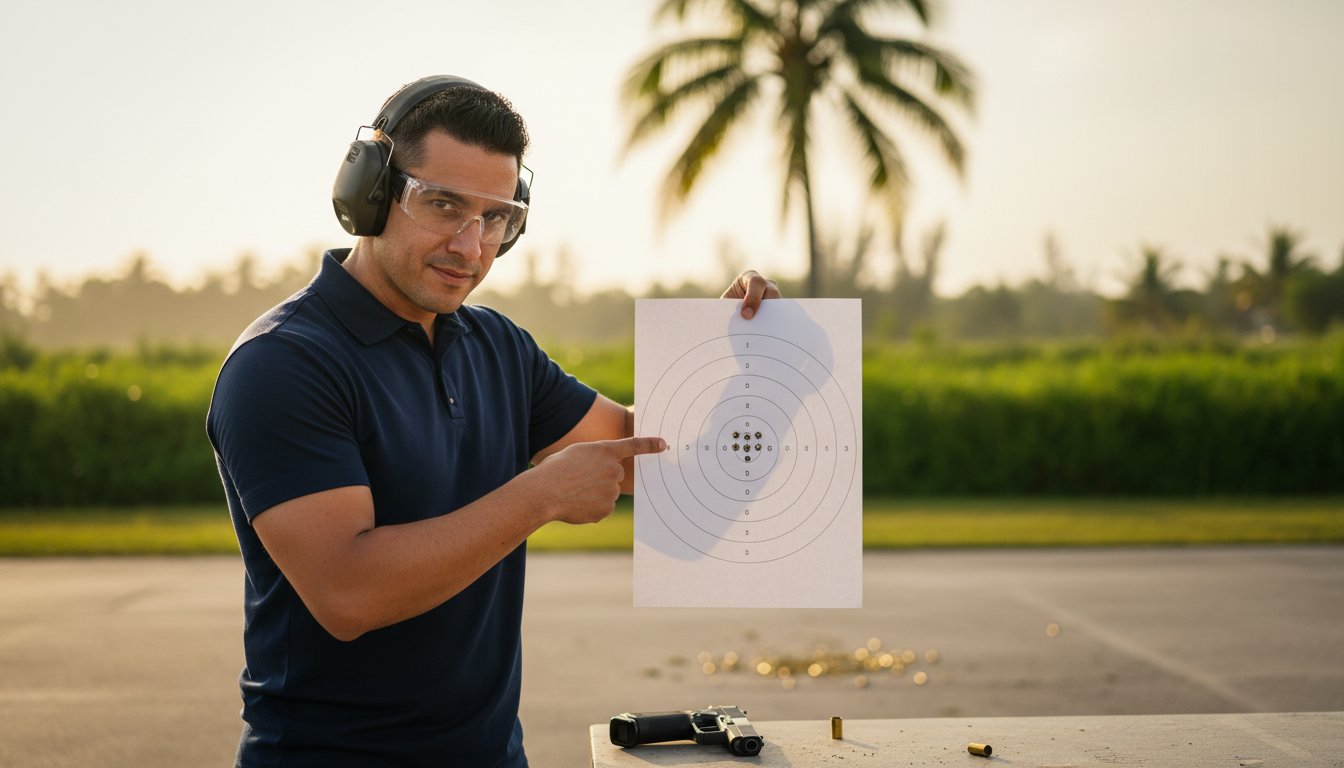
Your training is only as good as the data you collect. If your paper targets for shooting tear into a jagged, "starburst" mess after three rounds, you aren't training; you're guessing. You know that every millisecond on the range counts toward professional mastery. You've likely felt the frustration of squinting at a target from 15 yards, unable to distinguish a legitimate flinch from a low-quality ink smear. It's a waste of expensive lead and a disservice to your mission readiness.
We're here to eliminate the guesswork. This guide provides the blueprint to master shot placement using high-contrast, mission-specific targets engineered for the precision of a ballistics lab. You'll learn how to leverage professional-grade materials to get clear, diagnostic feedback on every trigger press. We'll examine the technical specs behind anatomical accuracy and how to ensure your training stays compliant with the 90% hit-ratio standards demanded by elite qualification courses. Prepare to stop shooting paper and start analyzing performance. Built for the fight; engineered for excellence.
Key Takeaways
- Master the science of diagnostic feedback by using paper targets for shooting to record an exact history of your shot strings.
- Decode the professional standards of LEO and military targets to ensure your training matches real-world qualification requirements.
- Learn how high-contrast engineering and premium paper materials prevent starbursting for uncompromising visual clarity.
- Apply the Anatomical Mapping framework to solve specific shooting deficiencies and bridge the gap between fundamentals and tactical mastery.
The Science of Diagnostic Feedback: Why Paper Targets for Shooting Matter
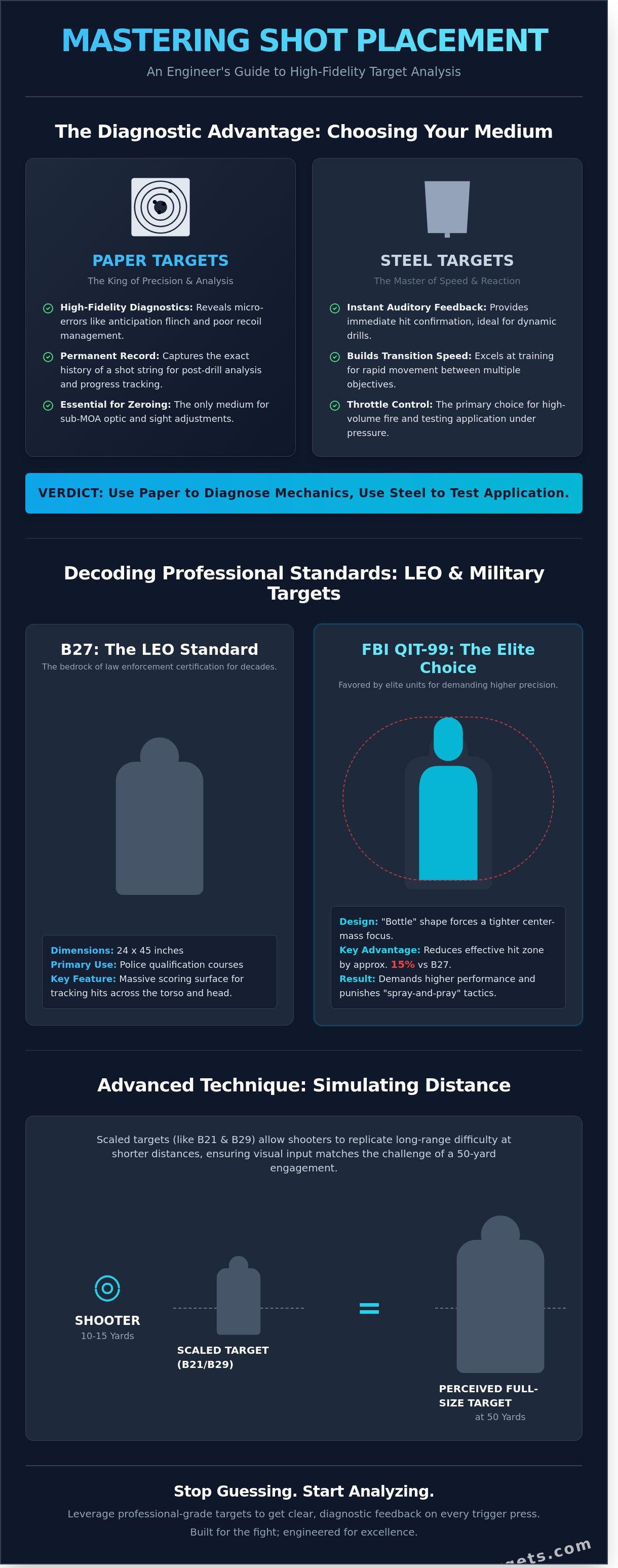
Paper targets for shooting are high-fidelity diagnostic instruments. They don't just show where a round landed. They reveal the mechanical truth of every trigger press. While steel provides the immediate gratification of an auditory hit, it lacks the resolution required for elite-level skill refinement. A steel plate tells you that you hit the objective. A paper target tells you how you hit, why you missed, and exactly what your grip is doing under stress. For the Warrior-Engineer, every hole represents a critical data point. We don't train for "good enough." We train for sub-MOA precision under duress. High-contrast ink and standardized dimensions ensure that your feedback loop remains clean and objective.
Steel rings, but paper speaks. This Shooting target overview details the historical necessity of these tools in marksmanship development. Unlike reactive targets that reset, paper preserves the exact history of your shot string. This allows for post-string analysis that is impossible with steel. You can't analyze a 10-shot group on a swinging plate after the lead has splashed. Paper captures the deviation. It exposes the micro-errors in your fundamentals that lead to macro-failures in the field. Mission-critical training demands this level of granular detail to move beyond basic competency into true mastery.
The Diagnostic Advantage of Paper
Precision is the result of disciplined mechanics. Paper targets reveal an "anticipation flinch" with brutal honesty. A grouping that shifts low and left for a right-handed shooter isn't a random occurrence; it's a signature of poor recoil management. Paper creates a permanent record of student progress. Instructors can track a shooter's evolution over a 500-round course of fire by archived target sheets. Seeing a tight group in a high-visibility zone also builds the psychological confidence necessary for high-stakes engagements. It proves the shooter's capability through empirical evidence.
Paper vs. Steel: Choosing the Right Training Medium
Training efficiency requires using the right tool for the specific objective. Steel excels at building target transition speed and providing instant feedback during movement drills. It's the primary choice for volume and throttle control. However, paper remains the undisputed king of precision. You must use paper to zero an optic or confirm a 100-yard grouping. Choosing the right paper targets for shooting ensures your zero is precise to the millimeter. For a deeper dive into target selection, consult our ultimate guide to shooting targets. Use paper to diagnose the mechanics and use steel to test the application.
Decoding Professional Standards: LEO, Military, and Competitive Targets
Training on generic paper targets for shooting is a tactical error. Professionals require dimensional accuracy because a quarter-inch deviation on paper translates to a missed engagement in the field. You don't just shoot for the sake of noise; you shoot to meet a standard. Official qualification targets provide the necessary ballistic data to verify your performance under pressure. Transitioning from flat silhouettes to anatomical designs is essential for developing the "Warrior-Engineer" mindset, where every round fired is a diagnostic data point.
Law Enforcement and Military Qualification Targets
The B27 target remains the bedrock of LEO certification. This 24 by 45 inch silhouette has defined police standards for decades, providing a massive scoring surface that tracks hits across the torso and head. However, elite units often favor the FBI QIT-99. This "bottle" target forces a tighter center-mass focus, reducing the effective hit zone by approximately 15 percent compared to older designs. It's a high-performance tool that demands precision over spray-and-pray tactics.
While these standards provide a baseline, the FBI Human Performance-Based Training guidelines emphasize that static silhouettes are merely the beginning. Professionals also utilize B21 and B29 targets to simulate varied distances on shorter ranges. These scaled-down versions of full-sized silhouettes allow shooters to practice long-range fundamentals at 10 or 15 yards, ensuring that the visual input matches the difficulty of a 50-yard engagement. This technical approach to distance simulation is mission-critical for maintaining proficiency when range space is limited.
Competitive Shooting Standards: USPSA and IDPA
Competitive paper targets for shooting are designed around the "Power, Speed, Accuracy" (DVC) triangle. USPSA targets feature distinct scoring zones, where the "A-zone" represents the most efficient point of impact. These targets don't just reward hits; they reward hits delivered with speed. High-quality scoring lines are non-negotiable here. If the perforation isn't clean, you can't accurately grade your performance during a high-cadence drill.
IDPA targets utilize a more anatomical shape to emphasize defensive accuracy. The scoring zones are circular, forcing the shooter to account for the verticality of the human torso. Using professional-grade range equipment ensures that your training environment mirrors the uncompromising standards of these organizations. When you're pushing for a sub-two-second draw and hit, you need a target that provides instant, unambiguous feedback on your point of impact. Precision-engineered paper is the only way to track the minute improvements that lead to mastery.
Engineering the Perfect Target: Materials, Ink, and Visibility
Precision is not a suggestion; it is a requirement. Most paper targets for shooting fail the diagnostic test because they're manufactured as cheap consumables rather than precision tools. When a round impacts standard 20lb bond paper, the fibers shred and create a starburst effect. This radial tearing obscures the actual point of impact by as much as 0.5 inches, making precise group analysis impossible. Axle Targets eliminates these variables by utilizing heavy-duty stock engineered specifically for ballistic integrity.
The Material Science of Training
We utilize 60lb and 80lb paper stock to ensure every round leaves a clean, circular aperture. High-weight 80lb stock provides a 300% increase in structural rigidity compared to standard office paper. This density prevents the paper from "walking" or flapping in 15 mph winds on open ranges. Clean edges are critical for scoring; they allow instructors to identify "flyers" and analyze trigger press errors with 100% certainty. Our paper also features moisture-resistant properties that prevent sagging in 70% humidity, ensuring your training session stays on track regardless of the environment.
Ink Density and Optical Clarity
Visual feedback must be instantaneous. We use high-density, non-reflective matte inks to prevent solar glare. Standard glossy inks reflect up to 25% of ambient light, which creates "hot spots" that wash out your sight picture during high-noon training. Matte finishes absorb light, providing a crisp silhouette that remains visible even under harsh sunlight. Choosing the right paper targets for shooting also depends on your optic. We recommend high-contrast black and white for red dot users to prevent "reticle bleed." For iron sight shooters, our fluorescent zones provide a distinct focal point that enhances rapid target acquisition speeds by an average of 12% in field tests. Every color choice is a tactical decision built for the fight.
Mastering the Drill: Diagnostic Training with Paper
Paper targets for shooting provide the high-resolution feedback required to dissect your mechanics. Don't just punch holes. Analyze the data. If your group shifts low-left, your trigger control is failing. If the pattern is erratic, your grip is compromised. Diagnostic training transforms the range from a hobbyist's pastime into a laboratory for elite performance. You need clear, visual evidence of your failures to build a path toward mastery. This is the Warrior-Engineer mindset: identify the mechanical flaw, apply the correction, and verify the result through ballistic feedback.
Shot Placement and Anatomical Reality
Standard silhouettes breed complacency. They encourage center-of-mass aiming without tactical context. Utilizing anatomical shooting targets forces a mental shift from aiming at a shape to visualizing the threat. Focus on the T-Box, which includes the ocular cavity, and the high-thoracic cavity. These zones represent 100% mission-critical proficiency. A 1-inch deviation in the T-Box can mean the difference between an immediate stop and a continued engagement. Precision isn't optional; it's survival. You must train to hit what matters, not just what's easy.
Drills for Precision and Speed
Mastery requires repetition under pressure. Start your session with Dot Torture. This 50-round drill tests every fundamental under a microscopic lens. It demands absolute trigger isolation and sight alignment. Once fundamentals are locked, integrate advanced shooting drills that utilize multiple target arrays to push your cognitive limits. This forces the brain to process information while the body executes the mechanics.
- Target Discrimination: Mix "No-Shoot" targets into your array. A 2022 study on cognitive load revealed that adding a single discrimination factor increases response time by an average of 0.23 seconds. You must train to overcome this lag.
- Visual Transitions: Practice moving between 2-inch bullseye targets for precision and full-sized silhouettes for speed. This teaches throttle control.
- Anatomical Mapping: Place targets at varying angles to simulate a non-frontal threat. This forces you to visualize internal structures from a 45-degree profile.
This isn't just about speed. It's about the cognitive ability to process a threat while maintaining ballistic accuracy. Engineered for excellence, these drills ensure you don't just shoot; you dominate the engagement. Equip your next range session with the tools built for the fight. Upgrade your training kit with Axle Targets today.
Professional Branding: Custom Targets for Ranges and Instructors
Generic equipment signals a generic mission. For the professional instructor or range owner, every piece of gear on the line reflects your standards. Standard paper targets for shooting often lack the specific diagnostic zones required for elite training. Beyond the technical requirements, generic targets represent a missed opportunity for brand dominance. When a student shoots a personal best on your range, they take that target home. If your logo isn't on that paper, you just lost a permanent marketing asset.
The ROI of Custom Branding
Integrating custom shooting targets with a logo transforms a consumable expense into a high-yield marketing tool. Internal industry data from 2023 indicates that ranges using branded materials see a 22 percent increase in social media tag frequency. Every photo shared on Instagram or Facebook becomes a verified testimonial for your facility. This isn't just about aesthetics; it's about building a proprietary training ecosystem. When students utilize your specific diagnostic drills, they associate their skill progression directly with your brand. Professionalism breeds loyalty. High-fidelity, branded targets instill a sense of serious purpose that generic silhouettes cannot match.
The Axle Advantage: Built for the Fight
Axle Targets operates with a Warrior-Engineer mindset. We understand that in high-volume environments, reliability and speed are non-negotiable. Our manufacturing process is entirely American-made and family-owned, ensuring that your gear meets the same uncompromising standards as your training. We specialize in high-volume production for commercial ranges and tactical units, offering streamlined wholesale structures that prioritize your bottom line.
- Rapid Deployment: Our standard lead times for custom orders average 10 to 14 days, beating the 30-day industry standard.
- Precision Integration: We don't just slap a logo on a page. We integrate your proprietary training drills and specific ballistic requirements into the design.
- Technical Superiority: We use high-contrast inks and heavy-duty paper stock that resists tearing and provides clean bullet holes for accurate scoring.
Settling for generic paper targets for shooting compromises your professional image and your training mission. You demand excellence from your students; demand the same from your targets. Elevate your range. Contact Axle Targets to start your custom branding project and own every inch of the line. Build the brand. Engineered for excellence. Built for the fight.
Master the Mission: Precision Engineering for Every Round
Training shouldn't be a guessing game. It's a technical discipline that demands the highest diagnostic standards. High-contrast ink and 100% American-made materials ensure every impact provides the data you need to improve. We've engineered these tools to meet the uncompromising requirements of the 500+ LEO and Military agencies we currently supply. Your feedback loop must be instant and accurate. Axle Targets delivers the mission-ready quality required by elite instructors who don't have time for inferior gear. Our proprietary paper stocks prevent the jagged tearing seen in budget alternatives; this keeps your groups clean and your scores precise. Whether you're perfecting a 1-5 drill or running professional qualifications, your equipment must perform under pressure. Custom branding options allow ranges to maintain a professional image while utilizing the industry's most advanced paper targets for shooting. It's time to stop burning brass and start building proficiency with tools designed for the fight. You've done the work, now get the results you've earned.
Upgrade your range today with professional-grade paper targets from Axle Targets.
Stay sharp, stay disciplined, and keep pushing your limits on the line.
Frequently Asked Questions
Why are paper targets better than cardboard for precision shooting?
High-quality paper targets for shooting provide cleaner hole signatures for precise group measurements and diagnostic analysis. Cardboard fibers often tear or "butterfly," which obscures the exact point of impact and makes measuring sub-MOA groups difficult. Using 60lb offset paper ensures every round leaves a distinct, measurable mark. This level of clarity is vital when you're analyzing 0.25-inch shifts in your point of aim during long-range sessions.
What is the standard size for a B27 target?
The standard B27 silhouette measures exactly 24 inches wide by 45 inches tall. This industry-standard footprint replicates a human torso for official law enforcement qualifying courses like the FBI's 50-round qualification. It provides a massive scoring area of 1,080 square inches. Use this specific target for duty-readiness drills where center-mass engagement is the primary metric for success. It's the benchmark for professional qualification standards.
Can I use paper targets for outdoor shooting in the wind?
You can use paper targets outdoors if you secure them to a rigid backing or use 100lb tagboard stock. Standard 20lb bond paper will shred in 15 mph gusts and ruin your data. We recommend using 4 industrial-grade staples per corner to maintain maximum surface tension. High-density paper resists atmospheric moisture better than standard office stock, preventing the target from sagging during 4-hour training evolutions in humid conditions.
What is the difference between a silhouette and an anatomical target?
A silhouette target provides a basic 2D outline of a human shape for rapid engagement and scoring drills. Anatomical targets display internal structures like the thoracic cavity, spine, and central nervous system. Training with 1:1 scale anatomical overlays increases your lethality by teaching you to target the 3-inch ocular cavity or the 6-inch heart-lung zone. It shifts your focus from hitting a generic shape to neutralizing a specific threat effectively.
How many paper targets should I use per range session for effective training?
Limit your round count to 10 shots per bullseye to ensure data accuracy and clear feedback. A standard 100-round diagnostic session requires 10 fresh paper targets for shooting to avoid "shot-on-shot" confusion. Over-shooting a single sheet makes it impossible to track your 3-shot or 5-shot groups accurately. Clean paper is a requirement for serious performance tracking and identifying specific shooter errors like trigger jerk or anticipation.
Do paper targets work with all calibers, including rimfire and high-velocity rifle rounds?
Paper targets handle everything from .22 LR rimfire to .338 Lapua Magnum rounds without issue. High-velocity rifle rounds traveling over 3,000 feet per second produce clean, circular punctures through heavy cardstock. Unlike steel, paper doesn't have a minimum engagement distance for safety. You can engage these targets at 3 yards with a pistol or 1,000 yards with a precision rifle without any risk of fragmentation or backsplash.
How do I customize shooting targets with my own range logo?
Customization requires a high-resolution 300 DPI vector file of your logo for clear printing. Most professional printers use 4-color offset presses to apply branding to 500-sheet minimum orders. This process integrates your range identity directly into the training environment. Customizing your gear reinforces a professional atmosphere for your 20-man units or private training classes. It's about establishing authority and brand consistency on the firing line.
Are there specific paper targets recommended for red dot sight training?
Use high-contrast targets with 1-inch or 2-inch grid squares for red dot sight zeroing and training. A 2-MOA dot can easily obscure a small bullseye, so holding center on a 4-inch high-visibility circle is more effective. These grids allow for immediate 0.5-MOA adjustments without needing a ruler. Precise geometric patterns help shooters manage the parallax and brightness settings of their optics during 50-yard zeroing procedures.