

A single forgotten battery or a mismatched optic plate can turn a $200 training evolution into a total loss in less than sixty seconds. You've felt the frustration of arriving at the firing line only to find your range day checklist was incomplete. It's a waste of precision ammunition and tactical momentum that no professional can afford. We agree that your time is the most valuable asset in your arsenal; it shouldn't be squandered on logistical failures.
This comprehensive 2026 guide is engineered to eliminate gear friction and maximize every ballistic engagement. You'll master a streamlined packing process that ensures your AR550 steel targets, medical blow-out kits, and specialized optics are ready for immediate deployment. We're moving beyond basic gear lists to provide a mission-critical blueprint for high-performance training. From verifying torque specs on your rail systems to auditing your reactive target inventory, this guide ensures your next session is defined by progress, not problems.
Key Takeaways
- Eliminate training friction and maximize ballistic readiness by utilizing a professional range day checklist designed for high-stakes performance.
- Secure your mission baseline with high-performance ballistic protection and rugged loadouts that mirror elite professional requirements.
- Master mission-critical shot placement by transitioning to anatomical targets that provide realistic skeletal feedback for every round fired.
- Integrate uncompromising metrics and essential field tools to diagnose performance and resolve technical gear failures on the firing line.
- Establish a disciplined workspace and zero-compromise safety protocols to ensure every training evolution is executed with absolute precision.
Defining the Mission: Why a Tactical Range Day Checklist is Non-Negotiable
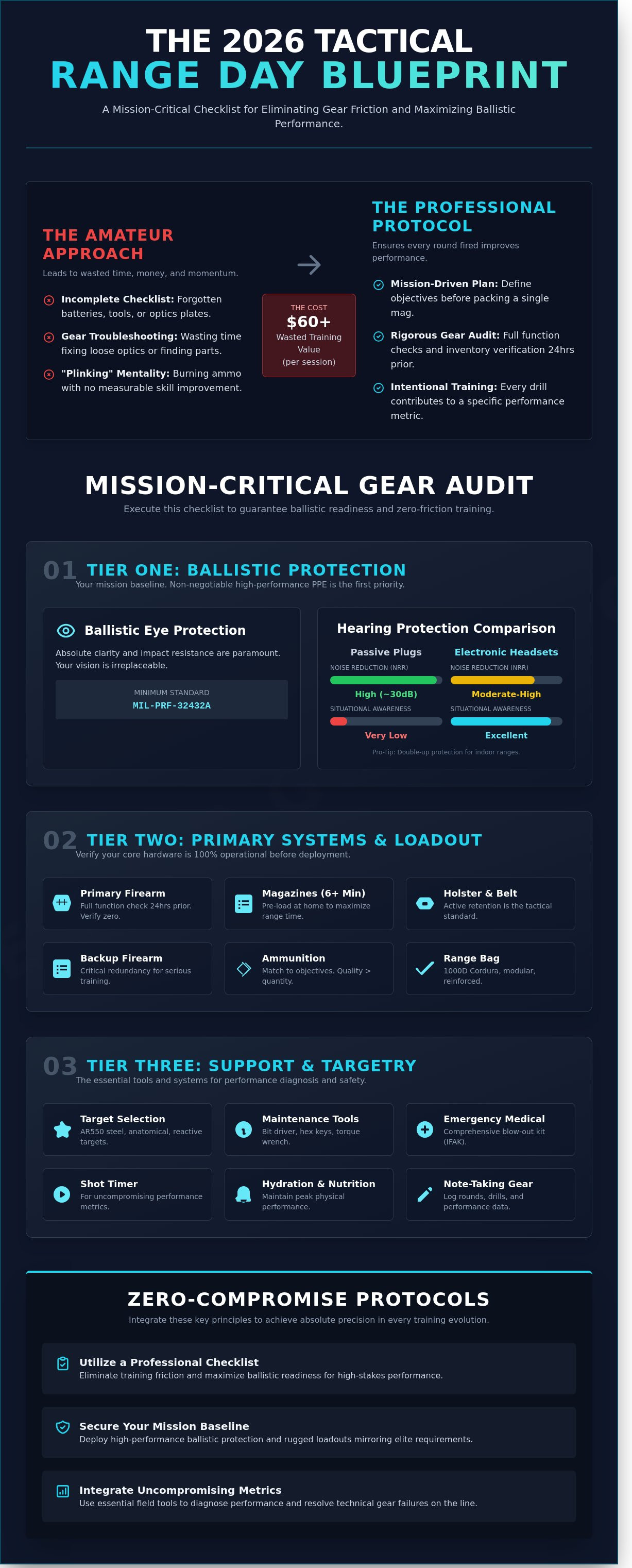
Range time is a finite resource. Every minute you spend digging through a range bag for a hex key or a spare battery is a minute of lost proficiency. Training friction kills momentum and degrades the quality of your repetitions. A range day checklist acts as the primary tool for mitigating this friction, ensuring you maintain ballistic readiness from the first cold bore shot to the final drill of the afternoon. Professional instructors at elite facilities use these protocols to standardize performance across high-volume sessions. They understand that firearm safety principles and technical execution rely on organized, repeatable preparation. A range day checklist is a mission-critical inventory designed to ensure every piece of hardware and support gear is present to maximize firearms proficiency.
The Cost of Poor Preparation
Amateur shooters treat the range like a social club, but professionals treat it like a laboratory. In 2026, the financial impact of wasted ammunition is significant, with quality 5.56 NATO rounds averaging $0.55 per round and precision 6.5 Creedmoor exceeding $2.10. If you spend 40 minutes of a two-hour session troubleshooting a loose optic because you forgot a bit driver, you've effectively burned $60 in potential training value. Gear failure erodes the warrior mindset and introduces doubt into your weapon system. A "plinking" session might burn 300 rounds with 0% measurable skill improvement. Intentional training, backed by a rigorous gear audit, ensures every round fired contributes to a specific performance metric.
Setting Your Training Objectives
The list doesn't start in the garage; it starts with the mission. You must define your objective before you pack a single magazine. Whether you're chasing a specific Law Enforcement qualification, preparing for a USPSA match, or refining CCW fundamentals, your loadout must adapt. Match your gear to your marksmanship fundamentals to ensure the hardware supports the software. If your objective is low-light engagement but you forgot your handheld light, the session is a failure. Ensure your environment, from target stands to hydration, matches your mission requirements. Precision isn't an accident. It's the result of a disciplined range day checklist and an uncompromising standard of prep.
The Essential Loadout: Ballistic Protection and Primary Gear
Protection is your baseline. Without elite PPE, your mission fails before the first round leaves the chamber. A professional range day checklist starts with gear that survives the same abuse you do. Your range bag must mirror this high-performance standard. It isn't just a carry-all; it's a mobile armory. Choose a platform built with 1000D Cordura, reinforced stitching, and modular compartments to keep your kit accessible under stress. Efficiency is the mark of the professional.
The PPE Tier List
Ballistic eye protection requires absolute clarity. Impact resistance isn't a suggestion. Look for MIL-PRF-32432A standards to ensure your vision remains intact during catastrophic equipment failures. Hearing protection demands a strategic choice between passive and electronic systems. Passive foam plugs offer high noise reduction ratings, often reaching 30dB, but they kill situational awareness. Electronic headsets suppress impulse noise while amplifying commands, allowing you to maintain communication during live fire. When selecting the best ear protection for shooting, consider your environment. Indoor ranges create concussive pressure that often requires doubling up on protection. For comprehensive safety protocols, professional instructors often reference the 4-H Range Safety Checklist to ensure every hazard is mitigated before the line goes hot.
Primary Weaponry and Support Gear
Your primary firearm must be range-ready long before you arrive. Perform a full function check 24 hours before deployment. Verify trigger reset, extractor tension, and optic zero. Magazine management is a massive time-sink if ignored. Bring at least 6 magazines per primary platform to minimize downtime. If you're running high-volume drills, pre-load them at home. Your holster and belt must be battle-tested. Friction-fit systems may work for concealed carry, but active retention is the standard for tactical training.
The same battle-tested principle applies to your tactical apparel. Ill-fitting clothing can restrict movement and snag on equipment, compromising your performance. To ensure your gear works with you, not against you, it's crucial to get the sizing right; for a detailed guide on standardized measurements, check out Socom Tactical.
Sourcing all this specialized equipment, from tactical apparel to holsters and modular pouches, can be a challenge. Online retailers that specialize in military-style equipment, such as Catus-airsoft.eu, are often a good starting point for building a professional-grade loadout.
Don't forget a backup firearm. Training with a secondary system ensures you're prepared for the 2% of malfunctions that can't be cleared in the field. Organize ammunition by caliber and specific drill intent. This keeps your focus on the front sight, not digging through a box of loose 9mm. Our reactive steel systems are engineered for excellence, providing the instant feedback required for elite skill development. Every piece of gear should serve a purpose. If it doesn't improve your performance or ensure your safety, leave it out of the bag.
Engineering Performance: Target Selection for Specific Drills
Targets are not just paper. They are the interface between your tactical intent and your ballistic results. If you use a generic silhouette, you get generic feedback. A warrior-engineer demands more. You need high-resolution data to refine your lethality and speed. Your range day checklist must prioritize targets that simulate real-world variables, from anatomical accuracy to high-stress cognitive processing.
Training for mission-critical shot placement requires realistic skeletal overlays. Standard bullseyes fail to account for the three-dimensional nature of a threat. Anatomical targets force you to visualize the spinal column and thoracic cavity, ensuring your rounds achieve the necessary terminal effects. If you aren't benchmarking against LEO and Military standards like the B27 or FBI QIT-99, you're just making noise. These official targets provide a 100-point metric to quantify your progress against professional operators.
Add cognitive load to every session. Use situational and "No Shoot" targets to bridge the gap between marksmanship and decision-making. Forcing your brain to identify a threat before engaging adds 0.5 to 1.2 seconds of processing time. Your goal is to drive that number down through disciplined repetition.
Choosing the Right Paper for the Fight
High-quality paper shooting targets beat generic cardboard for precision feedback every time. Cardboard tears; paper punches clean holes. This clarity is essential when you're shooting 1-inch groups or diagnostic drills. Match your media to your mission. Use USPSA or IDPA targets when you're prepping for competitive speed and movement. Switch to anatomical shooting targets when the focus shifts to defensive science. These targets teach you that a "center mass" hit might miss vital organs if the angle is off by 15 degrees. Precision is a requirement, not an option.
Target Management Tools
A warrior-engineer treats the range like a laboratory. Logistics shouldn't slow down your training momentum. Use heavy-duty staple guns and adhesive pasters to extend target life by 300%. Pasters allow you to reset a target in 20 seconds rather than five minutes. It's about efficiency. Organize your targets by drill sequence before you arrive at the firing line. This ensures your range day checklist stays on track. Use target stands and backers that withstand high-volume fire. A flimsy backer will fail after 100 rounds of 5.56; use corrugated plastic or reinforced wood to handle 500+ rounds without collapsing. Maintain your gear so you can maintain your focus.
Beyond the Basics: Maintenance, Tools, and Emergency Medical
Amateurs hope their gear works; professionals ensure it does. A mission-critical range day checklist requires more than just lead and steel. You're maintaining a ballistic system, and systems fail under stress. Screws back out under recoil. Carbon chokes gas ports. If you don't have the tools to fix a hardware failure on the firing line, your training session ends prematurely. A professional range bag functions as a mobile armory, keeping your weapon systems operational through high-volume fire.
Speed is irrelevant without precision. The shot timer is the uncompromising metric for measuring performance under pressure. It provides the cold, hard data needed to audit your draw stroke or split times. If you aren't training against the clock, you're just making noise. High-performance shooters use these devices to push past plateaus and identify the exact millisecond where their fundamentals break down.
The Individual First Aid Kit (IFAK) is an essential, non-negotiable range safety component required to treat life-threatening trauma in the field.
The Tactical Tool Kit
Modern weapon systems are precision-engineered machines. Integrating specific maintenance hardware into your range day checklist ensures 100% mission readiness. Carry a dedicated multi-tool, a comprehensive hex key set, and high-viscosity lubrication. A loose 2.5mm screw on an optic mount can shift your zero by 4 MOA in a single magazine. High-round-count days exceeding 500 rounds demand field-expedient cleaning. Keep carbon-cutting solvents and a bore snake ready to clear fouling before it causes a failure to cycle. Always pack 100% redundancy for electronics. If your optic battery dies at 0900, your training shouldn't end at 0901. Carry spare CR2032 and 123A batteries in a waterproof container.
Medical and Emergency Prep
Ballistic training carries inherent risk that requires professional-grade preparation. You must carry "Stop the Bleed" essentials: a windlass tourniquet, vented chest seals, and hemostatic gauze. Seconds matter when an arterial bleed occurs. Beyond the kit, you need a communication plan. Cell service often drops in rural training canyons. Know the nearest GPS coordinates for an emergency medevac landing zone before you chamber the first round. Maintain cognitive performance with 1 liter of water per hour and high-protein nutrition. Data shows that dehydration slows reaction times by 15% before you even feel thirsty, compromising both your safety and your split times.
Build a more resilient training environment with uncompromising steel targets designed for the professional warrior-engineer.
Executing the Plan: Range Etiquette and Post-Action Review
Arriving at the firing line marks the transition from preparation to execution. Deploy your gear with tactical precision. Establish a clean, modular workspace that allows for rapid magazine changes and immediate tool access. Every second wasted searching for a hex key or a loose round is a lost training opportunity. Safety is your baseline, and it remains non-negotiable. Adhere to the four universal rules of firearms safety with zero deviation. A single breach of protocol ends the mission immediately. High-performance shooters treat every range day checklist item as a life-saving measure rather than a suggestion.
Focus on the objective. When you are executing shooting drills, maintain absolute discipline. Don't just burn powder. Every trigger press must serve a diagnostic purpose. The Post-Action Review (PAR) starts the moment the line goes cold. You aren't just looking at holes in paper; you're analyzing ballistic data to identify patterns of failure or mastery. In the FY2025 training cycle, elite units reported that structured PAR sessions increased skill retention by 35% compared to unstructured practice.
Range Etiquette for Professionals
Respect the status of the range. When the line is cold, firearms remain holstered or benched with actions open. Discipline extends to your environment. Manage your brass and dispose of targets properly. Leaving a clean lane is a mark of professional character. If you're new to a high-intensity environment, consult the professional’s guide to your first mission for deep-dive etiquette protocols. Your conduct on the range reflects your respect for the craft and your fellow operators.
The Diagnostic Cycle
Your targets provide a raw data stream. Learn to read your groups. A 3-inch cluster low and to the left for a right-handed shooter often indicates recoil anticipation or improper finger placement. Correct the mechanical error immediately. Record these findings in a training log. Tracking your split times and group sizes allows you to visualize a 0.5-second improvement in your draw stroke over a six-month period. Before exiting the facility, perform a final gear inspection. Ensure your optics are secure and your primary weapon system is ready for the next deployment. This final step in your range day checklist guarantees you never walk into a fight with compromised equipment.
Master the Mission: Execute with Precision
Discipline starts before you reach the firing line. You've mapped your mission, verified your ballistic protection, and staged your medical kit. A comprehensive range day checklist isn't a suggestion; it's a protocol for survival. High-performance shooters don't leave success to chance. They rely on the same 100% American-made quality trusted by over 500 law enforcement and military agencies worldwide. Whether you're running a 50-round baseline or a complex 4-hour tactical course, your gear must meet the standard. We provide the tools for that mastery. Our targets offer the technical precision required for professional instructors, including custom branding options for elite training facilities. Don't settle for inferior paper when your performance is on the line. Every shot is a data point in your progression toward technical excellence. You've done the work to prepare. Now, it's time to engage with equipment that matches your intensity.
Engineered for Excellence: Shop Axle Targets Premium Paper Selection
Frequently Asked Questions
What are the absolute essentials for a first-time range trip?
Your absolute essentials include wrap-around ballistic eye protection, electronic hearing protection with a 23dB NRR rating, and your primary firearm. Pack 100 rounds of factory-new ammunition and three functional magazines. This baseline ensures you focus on fundamentals rather than gear failure. Include a copy of the range rules to maintain 100% compliance with local safety protocols and ensure a professional training environment.
How much ammunition should I bring for a 2-hour training session?
Bring 250 rounds of ammunition for a high-intensity 2-hour training block. This volume allows for 125 rounds per hour, covering 10 to 12 structured drills including reloads and malfunctions. Consolidating this into your range day checklist prevents mid-session shortages. Professional shooters at Axle Targets recommend 50 extra rounds to account for unexpected drill repetitions or corrective training sessions that require additional trigger time.
Why should I use anatomical targets instead of standard silhouettes?
Anatomical targets provide realistic aim points that mirror human physiology rather than arbitrary geometric shapes. Standard silhouettes often build 10-ring habits that don't translate to high-stakes defensive encounters. Using anatomically correct zones forces 100% accountability for shot placement on vital organs. This technical shift increases your lethality and ensures training translates to real-world ballistic effectiveness and mission success.
What is the best way to organize a range bag for quick access?
Organize your range bag using the "last-in, first-out" principle with modular internal pouches. Place high-use items like magazines and eye protection in external pockets for immediate deployment. Heavy items like 500-round ammo boxes belong at the bottom to maintain a stable center of gravity. This systematic approach reduces gear-retrieval time by 40% during active training sessions, allowing more time for actual engagement.
Do I really need a shot timer for basic target shooting?
You need a shot timer because you can't manage what you don't measure. A timer provides the only objective metric for speed and reaction time under stress. It transforms casual plinking into a quantifiable data set. Use it to track your split times and draw speed down to the 0.01-second increment. This data drives the engineering of your shooting mechanics and identifies specific performance bottlenecks.
What should be in a basic firearms-specific first aid kit?
A mission-critical IFAK must contain one CAT Gen-7 tourniquet, hemostatic gauze, and two vented chest seals. Standard bandages don't stop arterial bleeds or tension pneumothorax from ballistic trauma. Include a pair of nitrile gloves and trauma shears to access wound sites rapidly. Every shooter on the line should have this kit within 5 feet of their firing position to ensure immediate response to life-threatening injuries.
How do I choose between paper and steel targets for a range day?
Choose paper targets for initial zeroing and group testing where precision tracking is the priority. Switch to AR550 steel for high-volume tactical drills to gain instant auditory and visual feedback. Steel eliminates the 15-minute downtime spent taping paper holes, increasing your total engagement time. Our 3/8-inch AR550 plates handle 3,000 feet per second impacts without deformation, providing a lifetime of reliable feedback for the serious operator.
Is it necessary to bring a cleaning kit to the range?
A compact field cleaning kit is mandatory for clearing malfunctions and maintaining 100% weapon reliability during high-volume sessions. Pack a multi-tool, a bore snake, and high-performance lubricant to address carbon buildup or grit. 85% of mid-session failures result from lack of lubrication or debris in the action. Adding these tools to your range day checklist ensures your hardware performs as engineered through every 500-round cycle.