

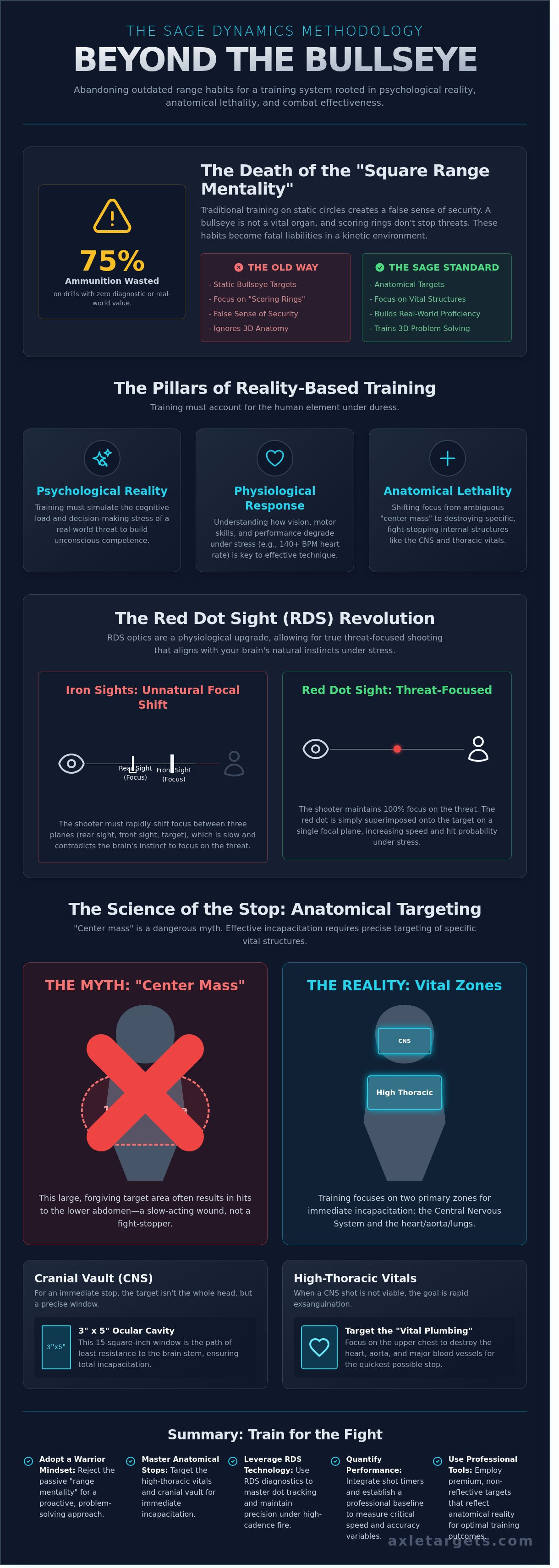
A bullseye is not a vital organ. If you are training on static circles, you are preparing for a competition that does not exist. You know square-range habits become fatal liabilities when the environment turns kinetic. Data indicates that shooters often waste 75 percent of their ammunition on drills with zero diagnostic value. You need a training system built for the fight. This is where sage dynamics redefines the standard.
We are stripping away the fluff to focus on anatomical lethality and the technical precision of Red Dot Sight transitions. You will learn the science behind specific shot placement and how to achieve unconscious competence under stress. This guide provides the exact roadmap needed to transform your range time into mission-critical proficiency. We will break down the philosophy, the diagnostic drills, and the targets required for elite performance. It is time to stop practicing and start preparing.
Key Takeaways
- Abandon the "range mentality" and adopt a training methodology rooted in psychological and physiological reality.
- Master the science of the CNS stop by targeting high-thoracic vitals and the cranial vault for immediate incapacitation.
- Implement the sage dynamics RDS recoil diagnostic to master dot tracking and maintain precision during high-cadence fire.
- Establish a professional baseline zero and integrate shot timers to quantify the critical speed variables of your survival equation.
- Discover why premium, non-reflective targets are essential for maintaining visibility and performance in high-glare, outdoor environments.
Beyond the Bullseye: The Sage Dynamics Reality-Based Philosophy
Sage Dynamics defines the standard for reality-based training. It isn't a curriculum for hobbyists. This methodology targets the intersection of psychological stress, physiological response, and anatomical lethality. Aaron Cowan pioneered this approach to move shooters past the limits of the square range. You need more than mechanical accuracy. You need the ability to apply technical skills while your brain processes the crushing weight of a life-or-death encounter. This is the path to unconscious competence. Every movement must be deliberate. Every shot must be grounded in the cold reality of physics.
The transition from range performance to combat effectiveness requires a total rejection of "range mentality." Traditional training environments often prioritize comfort and static conditions. Sage Dynamics breaks this cycle by introducing variables that mirror force-on-force encounters. You don't just shoot; you solve problems under duress. This philosophy demands that gear and technique survive the friction of high-intensity environments. It's about building a warrior who is as much an engineer of their own survival as they are a marksman.
The Death of the Square Range Mentality
Flat paper targets create a false sense of security. Traditional scoring rings don't stop threats; destroying vital structures does. Sage Dynamics forces a transition to three-dimensional thinking because human targets have depth. A center-mass shot from the flank requires a different point of aim than a frontal engagement to reach the same internal vitals. Cowan's extensive bio-mechanical research proves that target design must evolve to reflect human anatomy. We prioritize anatomical reality over artificial competition standards. It's about stopping the fight immediately. We build tools for the fight, and that starts with understanding how bodies actually fail under ballistic impact.
Why Red Dot Sights (RDS) Change the Training Requirement
The shift to Red Dot Sights (RDS) is a physiological upgrade for the modern shooter. Aaron Cowan's 2018 white paper on RDS for duty use provided four years of empirical data proving that optics increase hit probability under stress. Iron sights force an unnatural focal shift between the threat and the front post. This contradicts the natural human instinct to maintain focus on the danger. RDS allows for true threat-focused shooting. Shooters must develop new diagnostic habits to maintain dot tracking during high-cadence fire and recoil. Red dot sights provide a single focal plane solution that allows the shooter to maintain total threat focus while simultaneously superimposing the aiming point on the target.
- Psychological Reality: Training must account for the cognitive load of a real-world threat.
- Physiological Response: Understanding how vision and motor skills degrade under 140+ BPM heart rates.
- Anatomical Lethality: Shifting focus from "center mass" to specific internal structures.
Sage Dynamics isn't just about shooting faster. It's about the uncompromising application of force through a lens of scientific research and battle-tested experience. When the buzzer is replaced by a heartbeat, your training methodology determines the outcome.
The Science of Shot Placement: Vital Anatomy and Bio-Mechanical Targets
Center-mass is a lie that gets people killed. For decades, the tactical industry accepted a 10-inch circle on the chest as the standard for success. Reality dictates otherwise. Sage dynamics emphasizes that stopping the threat requires a shift from target-scoring to anatomical lethality. This approach moves away from the belly and toward high-thoracic targets where the vital plumbing actually sits. Training on human-analogue targets builds the visual library required to identify these zones under 150 beats per minute of heart rate stress. It forces the shooter to recognize that a hit in the lower abdomen is often just a slow-acting wound, not a fight-stopper.
Engineering the Cranial Vault Target
The cranial vault isn't a round ball; it's a reinforced structure of bone and angles. Traditional headshots often impact the jaw or the forehead, failing to reach the Central Nervous System (CNS). To achieve an immediate stop, the round must penetrate the 3-inch by 5-inch ocular cavity. This specific geometry represents the path of least resistance to the brain stem. Axle Targets builds this precision into every anatomical overlay. By training on these exact dimensions, shooters move past the aim-at-the-head mentality and start hunting the 15-square-inch window of total incapacitation. This level of target geometry ensures that training translates to the street.
Mastering the Thoracic Vitals
When a CNS shot isn't viable, shooters must target the high-thoracic cavity to force physiological failure. This means aiming for the heart, the aortic arch, and the lungs. The V-Medial approach focuses on the centerline of the upper chest where these critical systems converge. In Sage Dynamics' Citizen Response to an Active Shooter, the emphasis is on rapid, accurate fire into these vital zones to end the threat before it can inflict more harm. Relying on paper circles won't cut it when the target is moving or wearing heavy clothing. You need to understand anatomical shooting targets to visualize the 3D internal structure behind the skin. This training creates a psychological shift, desensitizing the shooter to the human form while sharpening the focus on bio-mechanical failure points. For those ready to upgrade their range sessions, check out the professional-grade steel solutions engineered for these high-stakes drills.
Essential Sage Dynamics Drill Targets: A Tactical Breakdown
Training for the win requires more than just rounds downrange. It demands data. Sage Dynamics targets serve as precision instruments designed to expose every flaw in your technique. These aren't passive silhouettes; they're high-performance diagnostic tools that force a shooter to confront their mechanical limits. By focusing on anatomical lethality and red dot integration, these targets bridge the gap between range practice and a gunfight. Every line and grid on the paper serves a tactical purpose, turning a standard range session into a laboratory for human performance.
The Eleanor Drill: Speed Under Pressure
The Eleanor Drill stands as a brutal assessment of your draw-to-first-shot proficiency. You have exactly 2.5 seconds to draw from concealment and land a single hit on a 3x5-inch target at a distance of 3 yards. It's a binary test of your ability to acquire a sight picture under extreme time constraints. Common failures often stem from a rushed grip or "hunting" for the dot; the target reveals these errors through low or erratic hits. This drill is a pillar of Reality Based Training because it replicates the immediate need for precision during a high-stress ambush. If you can't beat the 2.5-second par, your survival odds drop in a real-world engagement.
Cadence and Recoil Diagnostics
Mastering a red dot sight (RDS) requires understanding the dot's path during recoil. The RDS Recoil Diagnostic target allows shooters to identify if their dot tracks in a predictable vertical line or an inefficient elliptical pattern. This visual data is critical for refining your grip pressure. Simultaneously, the Cadence Standards target pushes you to find the exact point where speed compromises accuracy across 10, 15, and 25-yard intervals. High-contrast targets create a diagnostic feedback loop that translates erratic dot movement into actionable grip and trigger corrections. You'll learn to track the dot through the entire cycle of the slide, ensuring the trigger reset happens as the dot returns to the point of aim. This isn't just shooting; it's engineering a more efficient human-machine interface.
- 10-Yard Zero: Provides a flat trajectory for close-quarters engagements where height-over-bore is a factor.
- 25-Yard Zero: The industry standard for balancing hold-overs across common defensive engagement distances.
- 50-Yard Zero: Optimized for duty roles where precision at distance and ballistic efficiency are non-negotiable.
Sage dynamics simplified zero targets utilize specific grid offsets for these distances. They eliminate the guesswork, allowing you to achieve a surgical zero in fewer than 10 rounds. When the stakes are high, you don't guess; you verify. These targets provide the technical foundation for the uncompromising standards required in professional tactical environments.
Implementing the Sage Standards: A Professional Training Plan
Mastery isn't an accident. It's the result of disciplined, data-driven repetitions. To implement the sage dynamics methodology, you must move beyond casual plinking and embrace a structured training plan that prioritizes anatomical lethality. The process begins with a confirmed 25-yard zero using the Sage Dynamics RDS target. This provides the mechanical baseline required for every subsequent drill. If your zero is off by even an inch, your diagnostic data at distance becomes useless. Stop guessing and start measuring.
Once your zero is locked, execute the Cadence Standards. This drill identifies your accuracy ceiling by forcing you to increase fire rates until your groups begin to degrade. It reveals the exact split time where your recoil management fails to keep the dot within a high-probability thoracic cavity. Follow this with the Eleanor Drill to test your cold-start performance. You have 2.5 seconds to draw and deliver a single, perfect shot into a 1-inch square at 3 yards. It's a brutal, binary metric of your draw stroke and immediate visual acquisition.
Integrating the Shot Timer
Data-driven training requires millisecond precision. A shot timer is your most honest coach; it removes subjectivity from the survival equation. You can't manage what you don't measure. Use the timer to set aggressive par times for every drill, pushing your limits until the system breaks. This pressure exposes flaws in your grip and stance that remain hidden during slow-fire practice. For a deep dive into technical setup and par time optimization, read this guide on shot timer mastery to refine your performance metrics.
Reading Your Paper: Diagnostic Analysis
Your target is a blueprint of your performance. You must differentiate between mechanical errors and visual errors. A mechanical error, like a poor trigger press, results in consistent displacement. A visual error occurs when you fire before the dot has settled or while it's still in motion. Use anatomical overlays to analyze every "flyer."
- Low-Left Groups: Usually indicates a sympathetic grip squeeze or "milking" the frame during the trigger press.
- Vertical Stringing: Often points to inconsistent breathing or timing the shot during the natural point of aim shift.
- Scattered Impacts: Signals a lack of visual focus or failing to track the dot through the recoil cycle.
High-quality paper is essential for this analysis. Cheap, thin targets tear and "starburst," making it impossible to see the exact point of entry. Professional-grade paper preserves the integrity of the shot hole, allowing for the precise diagnostic correction that sage dynamics demands. Stop wasting rounds on inferior paper and equip your range with Axle Targets to ensure every shot provides actionable intelligence.
Premium Sage Dynamics Targets: Engineered for the Fight
Training for lethality requires gear that doesn't quit when the environment gets harsh. Most shooters settle for thin, 40-pound bond paper that tears in a light breeze or sags in high humidity. Axle Targets engineers equipment for a higher standard. Our paper targets utilize heavy-duty 100-pound tag stock. This material withstands 20-mph wind gusts without curling or shredding. It ensures every round leaves a clean, measurable hole for accurate feedback. When you're running high-cadence sage dynamics drills, you can't afford to guess where your rounds landed. Precision is the baseline; durability is the requirement.
- 100-lb Heavy-Duty Stock: Prevents the "paper-curl" common in cheap range sheets.
- Matte Non-Glare Ink: Eliminates the white-out effect caused by direct sunlight.
- Anatomical Accuracy: High-contrast lines designed for realistic target identification.
- Mission-Ready Shipping: Most orders process within 48 hours to keep your training on schedule.
The Axle Advantage: Quality You Can Call a Hit On
Technical precision defines our manufacturing process. We print with non-reflective, matte inks specifically chosen for high-glare outdoor ranges. Standard gloss inks create a mirror effect under the 12 o'clock sun, making anatomical zones invisible to the shooter. Our targets maintain high contrast even in 100-degree heat. This clarity is vital for anatomical recognition and split-second decision making. You can find more details on why material density and ink chemistry matter in our ultimate guide to shooting targets. Clear lines and durable stock mean your training remains focused on the fight, not the target stand.
Custom Solutions for Tactical Instructors
Professional instructors need more than generic paper. We offer custom branding options that allow you to integrate your own logo alongside sage dynamics standards. This creates a unified, professional curriculum for your students and reinforces your brand authority on the firing line. We handle the logistics so you can focus on the instruction. Our bulk ordering system supports law enforcement agencies and private training facilities with uncompromising reliability. We don't make you wait weeks for essential gear. We provide the tools you need to build better shooters. Don't compromise on the final link in your training chain. Flimsy targets lead to sloppy results. Equip your next course with Sage Dynamics targets from Axle and experience the difference that professional-grade engineering makes on the range.
Secure Your Tactical Advantage
Training isn't about punching holes in paper; it's about total bio-mechanical disruption. You've analyzed the science of shot placement and the rigorous requirements of the Sage Standards. Now, it's time to apply that knowledge on the range. Every drill must replicate the complexity of a human threat to ensure your skills translate from the flat range to the street. Precision is the only metric that matters when lives are on the line. You've studied the sage dynamics philosophy; now it's time to execute it.
Axle Targets provides the uncompromising gear required for high-performance training. Our American-made, professional-grade paper targets are the standard for elite LEO and Military instructors who demand absolute anatomical accuracy. These tools are engineered to provide the instant visual feedback necessary for survival. Don't settle for generic silhouettes when the mission requires surgical precision. You've put in the work; now give yourself the tactical advantage of superior training aids. Our targets are built for those who refuse to compromise on their readiness.
Upgrade your training with premium Sage Dynamics targets from Axle Targets. Secure your gear, push your limits, and stay ready for the fight.
The discipline and mindset discussed here extend beyond the range, fostering a unique community culture. For those looking to support businesses that align with these values, the veteran-owned Another DAMM Find offers unique apparel and gifts that resonate with this lifestyle.
Frequently Asked Questions
Who is Aaron Cowan of Sage Dynamics?
Aaron Cowan is the lead instructor and founder of the organization. He brings over 10 years of experience in the infantry and law enforcement to his curriculum. Cowan is a recognized industry leader in red dot sight integration and reality-based training. His white papers on optics reliability provide data-driven insights for professional end-users who demand absolute gear performance.
What is the best zero distance for a pistol Red Dot Sight (RDS)?
A 25-yard zero is the gold standard for a pistol RDS. This distance minimizes deviation across common engagement ranges from 3 to 50 yards. It ensures your point of aim remains consistent with your point of impact during high-stress encounters. Data from sage dynamics white papers confirms this zero offers the most versatile ballistic arc for duty use in urban environments.
How do I run the Sage Dynamics Eleanor Drill?
The Eleanor Drill requires three rounds fired in three seconds at a three-inch circle from three yards. You must draw from a concealed or duty holster and achieve 100% hits within the time limit. This drill tests your ability to process information and execute precise shots under intense pressure. It's a foundational exercise for mastering these training principles on the range.
What is the difference between an anatomical target and a silhouette?
Anatomical targets depict internal organs and skeletal structures rather than a simple 2D outline. Traditional silhouettes use arbitrary scoring zones like the A-zone, while anatomical designs focus on physiological stops. Training with these targets forces you to visualize the three-dimensional path of a bullet through a torso. This transition from paper to biology increases your lethality in real-world, high-stakes environments.
Why should I use Sage Dynamics targets over standard USPSA targets?
Sage Dynamics targets prioritize anatomical lethality over competition scoring. USPSA targets reward speed within large boxes, but they don't account for vital organ placement. Using these specialized targets ensures every round you fire builds the habit of targeting high-percentage physiological zones. It removes the training scar of point hunting in non-vital areas and prepares you for a real fight.
Can I use Sage Dynamics targets for iron sight training?
You can use these targets for iron sight training with high efficiency and precision. While designed with RDS users in mind, the anatomical focus benefits all sighting systems. Iron sight shooters must maintain the same disciplined focus on vital zones to achieve a stop within 2.5 seconds. The lack of high-contrast scoring lines forces you to aim small and miss small during every drill.
What does 'unconscious competence' mean in firearms training?
Unconscious competence is the stage of learning where you perform complex tasks without conscious thought. You draw, track the dot, and press the trigger as a reflexive response to a threat. Reaching this level requires 3,000 to 5,000 repetitions in a professional training environment. It's the point where your gear becomes an extension of your body during a fight for survival.
Where can I buy physical Sage Dynamics targets on heavy paper?
You can purchase official targets directly through Axle Targets. We print these on heavy 100-pound paper to ensure durability during high-volume range sessions. These professional-grade targets resist tearing and provide clean bullet holes for accurate feedback. Order them in bulk packs of 100 or 500 to sustain your mission-driven training schedule and maintain your tactical edge.